1951 Chevrolet Brakes
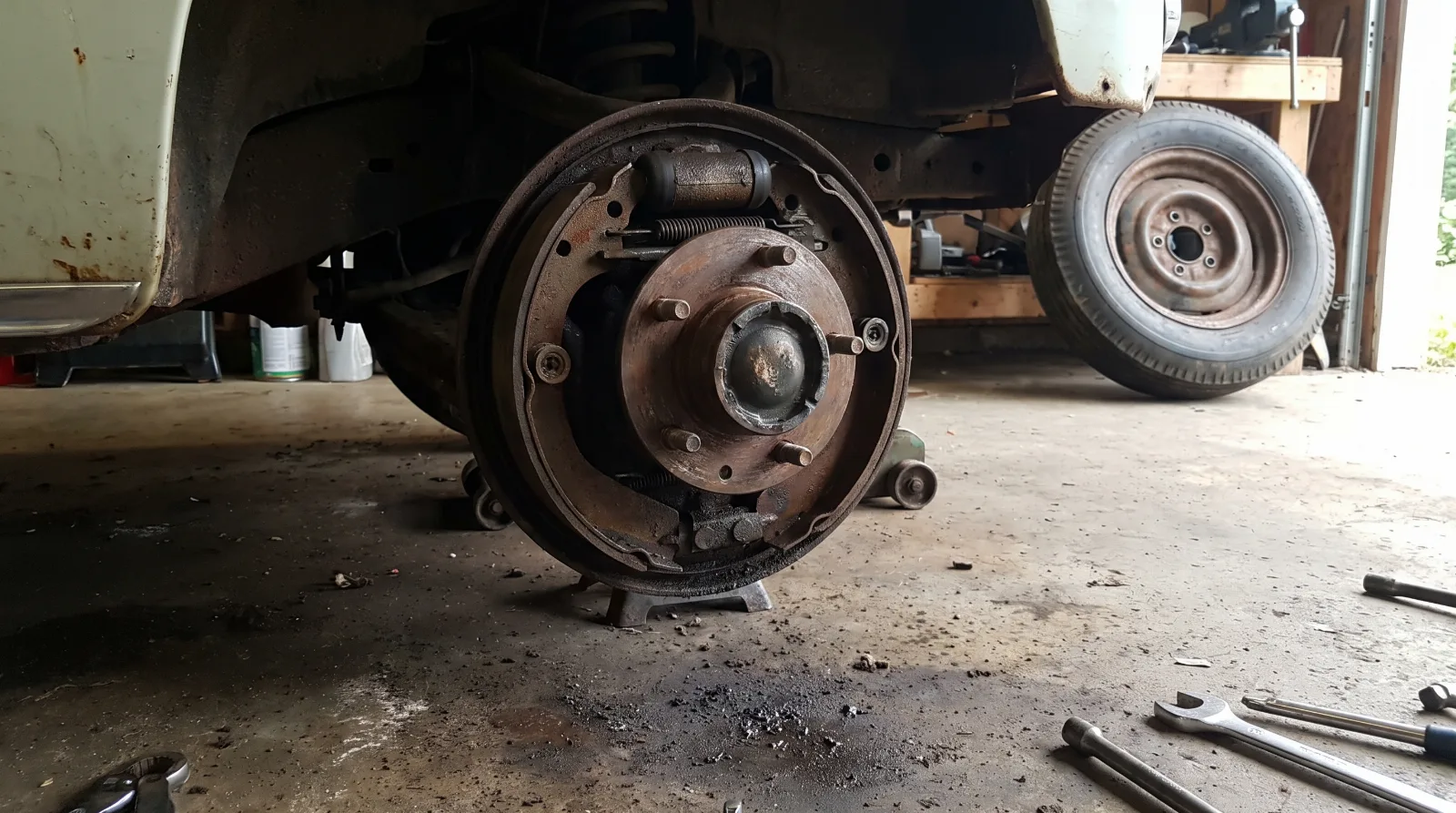
Four eleven inch drums, four wheel cylinders, one master cylinder, and no assistance of any kind. That is the entire braking system of a 1951 Chevrolet, and when it is in good order it is perfectly adequate for the car it was built for. When it is not, it is the single most dangerous thing about the vehicle, because there is nothing in the design that tells you it has gone wrong until you need it.
The parts are cheap and reproduced. The knowledge is what people are missing.
What the system actually is
Hydraulic drum brakes at all four corners, eleven inches in diameter front and rear. The drum has a 2-3/8 inch lining surface inside a three inch overall width, a 2-3/4 inch centre hole, and the five on 4-3/4 inch bolt pattern that Chevrolet kept for decades afterwards. That last detail matters more than it looks: the same drum casting carries through to 1960, so this is not a part you have to hunt for.
Chevrolet redesigned the brake linings for 1951. It is one of the few mechanical changes in a year that was otherwise a grille and trim exercise, and it is worth knowing when somebody tells you the 1950 and 1951 cars are identical underneath.
| Item | Figure |
|---|---|
| Drum diameter, front and rear | 11 in |
| Lining surface width | 2-3/8 in |
| Drum overall width | 3 in |
| Bolt pattern | 5 on 4-3/4 in |
| Hub centre hole | 2-3/4 in |
| Hydraulic circuits | One, all four wheels |
| Adjustment | Manual, star wheel, one per wheel |
| Power assistance | None offered |
What goes wrong, in the order it happens
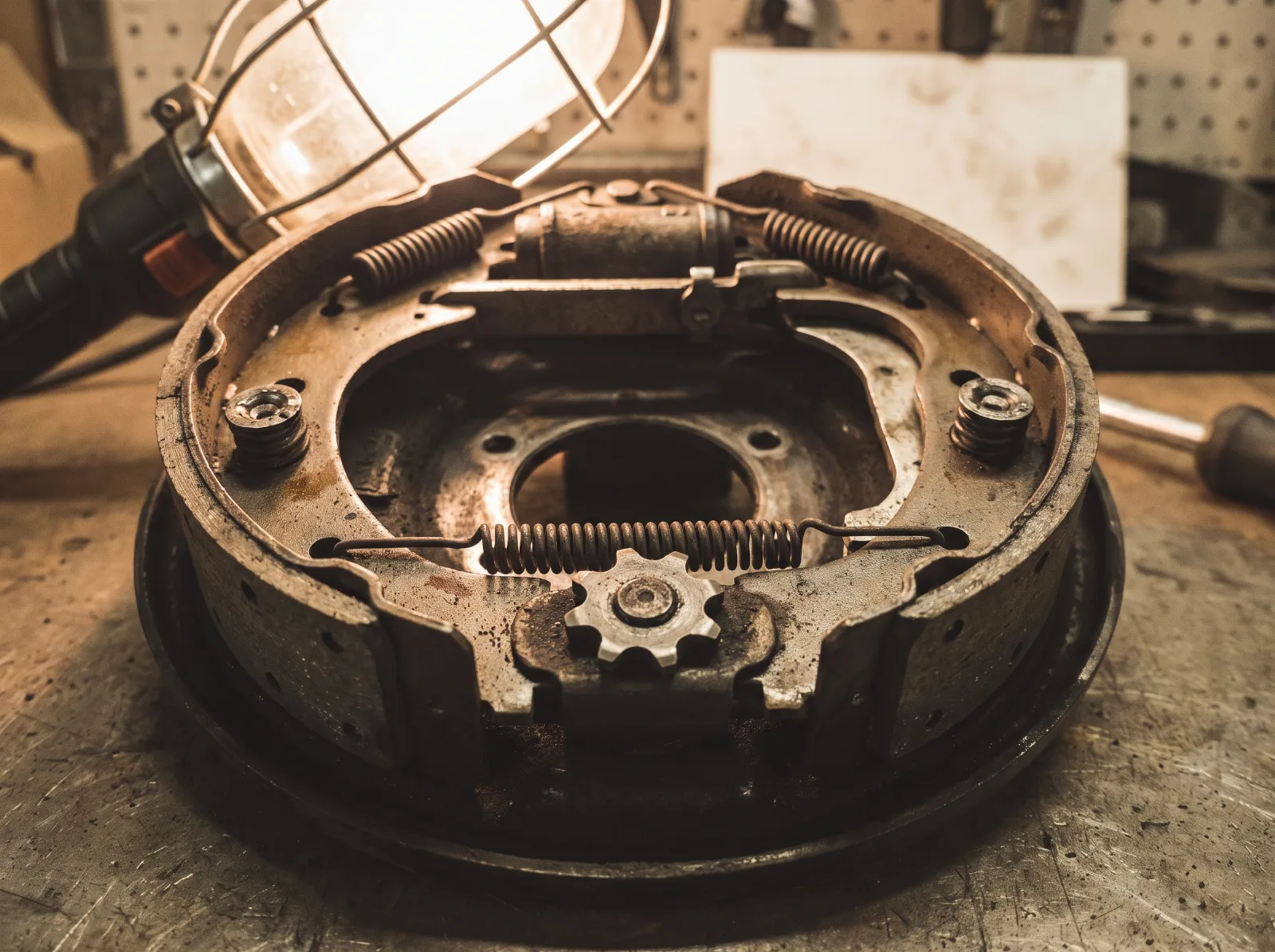
Adjustment, first and cheapest. Long pedal, car pulls, one wheel doing all the work. The adjuster is a screw with a star wheel on it, and the assembly Chevrolet used from 1951 through 1957 has a closed length of 3.17 inches. If the pedal comes back up after a proper adjustment, you have just fixed the car for nothing.
Wheel cylinders, next. They sit at the bottom of the drum where water collects, and a car that has been parked has almost certainly got at least one seized or weeping. The rear cylinder for a 1951 to 1954 car is the same part used on the half ton pickup and on the 1953 to 1955 Corvette, which is a pleasant discovery when you go looking for it. Rebuild kits exist, but on a car you intend to drive, new cylinders are a better use of a Saturday.
Fluid, and this one catches people. Ordinary glycol brake fluid absorbs something like one percent of its volume in water every year. Do the arithmetic on a car that was last touched in 1988 and you understand why the inside of the system looks the way it does. Water lowers the boiling point and rusts the bores from the inside, and it is why a system that was rebuilt fifteen years ago is often no better than one that was not.
Drums, last. They wear, they get turned, and eventually they are past their limit. Reproduced drums are available, so this is a cost rather than a problem, but do measure before you buy linings.
"Man brings me a car, says the brakes are gone, wants a whole new system. I put it on the lift, turn four star wheels, hand him the keys. He did not believe me until he drove it out of the yard."
— Earl Dawson
The single circuit problem, and what to do about it
Here is the part that deserves more attention than it gets. There is one master cylinder feeding all four wheels through one hydraulic circuit. A failed steel line, a burst hose, a wheel cylinder that lets go, any one of those empties the whole system. The pedal goes to the floor and stays there, and the only thing left is the handbrake acting on the rear drums.
Modern cars have had split circuits since the late sixties for exactly this reason. On a car you keep in a heated garage and show twice a year, the original single circuit is part of what you own and there is a fair case for leaving it alone. On a car you actually drive in traffic, converting to a dual reservoir master cylinder is the cheapest real safety improvement available to you, and it is a smaller and less visible change than fitting discs.
That is worth saying plainly, because the usual order of operations is backwards. People fit disc brakes for stopping power on a three thousand pound car that is not short of stopping power, and leave the single circuit that will actually kill them exactly as it was.
Check this first
- Pedal height and travel, engine off. A pedal that sinks slowly under steady pressure is a master cylinder or a leak, not an adjustment.
- All four star wheels. Free adjustment before you spend anything at all.
- The inside of each drum. Wet, black or streaked means a wheel cylinder is past it, and linings soaked in fluid are scrap.
- The colour of the fluid in the master cylinder. Anything darker than pale amber has water in it.
- The steel lines along the frame and over the axle. One circuit means one bad section takes everything.
- The handbrake. On a single circuit car it is not a parking convenience, it is the reserve system.
Where this fits
The brakes are one of four systems under this car, and the other three are laid out alongside them in the 1951 Chevrolet chassis. If you are pulling the front drums you are already most of the way into the front suspension, so the two jobs belong in the same weekend. The case for and against going to discs, with what the kits actually contain, is in the disc brake conversion. Where brake work sits in the order of a full restoration is in the restoration guide, and the rest of the car's numbers are in the 1951 specifications.
Sources and notes
- Brake drum, front or rear, Chevs of the 40s - the eleven inch inside diameter, 2-3/8 inch lining surface, three inch overall width, 2-3/4 inch centre and five on 4-3/4 inch bolt pattern, and the drum carrying through from 1951 to 1960.
- Brake shoe adjuster assembly with star wheel, Chevs of the 40s - the manual star wheel adjuster used from 1951 to 1957, its 3.17 inch closed length, and one required per wheel on cars and half ton pickups.
- Brakes, wheel cylinders, Chevs of the 40s - the rear wheel cylinder for 1951 to 1954 passenger cars, shared with the half ton pickup and the 1953 to 1955 Corvette.
- 1951 Chevy car parts, Chevs of the 40s - the brake linings redesigned for 1951, and the brake categories catalogued for the car from drums and hoses to master cylinders and overhaul kits.
- Classic car brake fluid, Restore An Old Car - glycol fluid absorbing around one percent moisture a year, silicone fluid belonging only in a new or freshly cleaned system, and the risk of silicone swelling old seals.
- 1951 Chevrolet Styleline De Luxe Series 2100 JK specifications, Classic Car Database - hydraulic drum brakes of eleven inches front and rear, on a Styleline De Luxe convertible of 3,380 pounds riding on 6.70 x 15 tyres.
More from the garage
Rebuilding a Chevy 216
Rebuilding a 216 is not like rebuilding anything made after about 1955, and the difference is not the tools. It is that on most engines the botto...

The 1951 Chevrolet Apache
There is no 1951 Chevrolet Apache. The Apache name belongs to the generation of Chevrolet trucks that came after the one built in 1951, and it do...
The 1951 Chevrolet Impala
There is no 1951 Chevrolet Impala. The name did not exist in 1951, the car did not exist in 1951, and nothing Chevrolet built that year was ever...