The Chevy 235 Engine
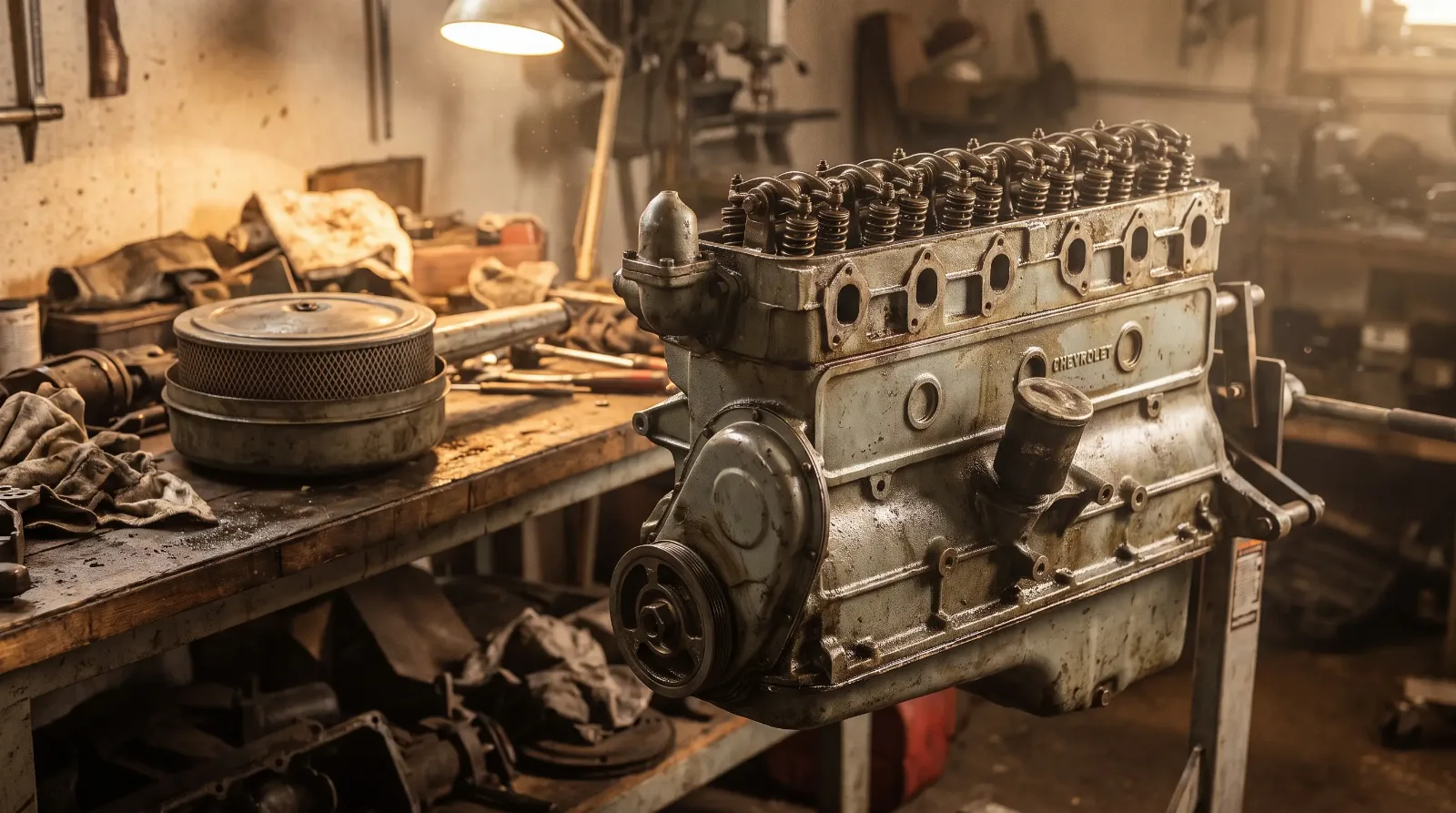
The Chevrolet 235 six is one of those engines everybody praises without asking which one they mean. There are two very different 235s, and the difference decides how you drive the car, how you service it, and what it is worth when a bearing goes. If you own a 1951 Chevrolet with Powerglide, you have the early one. That is not a criticism, but it is worth knowing before somebody at a swap meet tells you the 235 is bulletproof.
I have had both kinds apart on the bench. The engine that earned the reputation arrived in 1954. The engine in a 1951 car looks the same from the outside and is a different animal inside.
Where the 235 came from
The 235 cubic inch six debuted in 1941, in trucks. Chevrolet needed more engine than the 216 for hauling work, and the 235 was the answer: same basic overhead-valve architecture, more displacement, a stronger crankshaft and stronger connecting rods.
It reached passenger cars in 1950, and only in one place. If you wanted a 235 in a Chevrolet car, you had to order Powerglide, the new two-speed automatic. The engine and the transmission came as a package, and the package was De Luxe only. A manual-shift car got the 216. That pairing held through 1952, which is why a 1951 Chevrolet with two pedals has the bigger six and a 1951 with three has the smaller one.
| Specification | Chevrolet 235 |
|---|---|
| Displacement | 235 cu in |
| Bore | 3.5625 in |
| Stroke | 3.94 in |
| Configuration | Overhead-valve inline six, cast iron block and head |
| First use | 1941, trucks |
| First use in cars | 1950, Powerglide only |
| Output, 1950 to 1952 | 105 hp |
| Corvette Blue Flame, 1953 to 1955 | 150 hp with three carburetors |
| Peak output | 145 hp in 1958 |
| Later years | 135 hp, 1959 to 1962 |
The two 235s, and which one you have
Here is the part that matters, and it is the part most write-ups skip.
The early 235, 1941 through 1952. Hydraulic lifters arrived with the 1950 Powerglide version, which is genuinely nice: it runs quietly and it does not want the valves adjusted. But underneath, the bottom end is old-fashioned. Poured babbitt main and rod bearings, and the same lubrication idea as the 216, which is pressure to the mains and troughs in the oil pan where dippers on the rods fling oil up to the rod bearings. Splash, in other words, on the parts that work hardest.
The 1953 middle year. Chevrolet upgraded the 235 for Powerglide cars with full pressure lubrication and hydraulic lifters. Manual-transmission cars that year kept cast iron pistons, babbitt rods and splash oiling on the rods. So 1953 is the year you genuinely have to ask which transmission the car was born with before you know what is inside the engine.
The 1954 and later 235. From 1954 every 235 got aluminum pistons, full pressure oiling and insert bearings on both mains and rods. This is the engine that built the reputation, and it is the one people mean when they say a 235 will run forever.
What that means for how you drive it
A splash-oiled bottom end does not like sustained high revs and it does not like being lugged under load at low speed. Neither habit will kill it in an afternoon, but both shorten the life of the rod bearings, because the oil reaching them depends on dippers picking up out of troughs rather than on pressure through a drilled crank.
What it likes is exactly what these cars were built for: moderate throttle, unhurried cruising, and oil changed more often than a modern engine needs. Keep the level up, because the trough system depends on the pan being full to work as designed. Low oil on a splash engine is worse than low oil on a pressure engine.
That is the honest picture. It is not a fragile engine. It is an engine with a design assumption baked into it, and once you know the assumption it is easy to live with.
"People swap a 235 into a 216 car and think they have modernised it. If it is a 1951 or 1952 engine, they have moved sideways. Find a 1954 or later block and then you have actually done something, because that is the one with the pressure oiling and the insert bearings."
— Earl Dawson
The 235 as a swap engine
The most common upgrade on an early Chevrolet is putting a later 235 into a car that came with a 216, and it is a sensible one. You get more displacement, a stronger bottom end, and a service life that does not depend on oil level the way the older engine does. Parts are still made and the engine bay does not need surgery.
Two cautions. First, buy the year, not the number: a 1954 or later 235 is the engine worth having, and an early one gains you displacement without gaining you the bottom end. Second, mind the flywheel and starter. Chevrolet moved to 12 volt for 1955, and the later starters use a drive gear matched to the 168 tooth ring gear on the newer 235 and 261 engines. Mixing eras here is where swaps stall.
If you are trying to work out which engine is actually sitting in your car right now, that is its own job and I laid it out in Chevy 235 engine identification. If you know what you have and it is tired, the rebuild picture is in rebuilding a 235. And for what Chevrolet actually fitted to the 1951 cars, engine by engine and transmission by transmission, start with what came in the cars.
Check this first
- Which 235 is it. Pre-1953 means babbitt and splash-fed rods. 1954 and later means insert bearings and full pressure. This changes what the engine is worth and how you drive it.
- Oil pressure at idle, hot. On a splash-rod engine the gauge tells you about the mains, not the rods. A healthy reading is not the whole story.
- Listen at the bottom end under load. A rod knock on a babbitt engine means the bearings get poured or the crank gets turned, not a set of shells from a shelf.
- Lifters. Hydraulic on the Powerglide engines from 1950. Noisy lifters on one of those usually means oil supply, not adjustment.
- Ring gear tooth count. Matters the moment you mix engines and starters across the 1955 changeover.
- Head and block casting numbers. The only way to date the engine properly rather than guess from the badge.
The 235 ran in Chevrolet trucks all the way through 1962, which tells you what General Motors thought of it. It is simple, it is torquey, and parts are still on the shelf seventy years later. Just know which version you are talking about before you make a plan, because the badge on the block covers two engines with very different insides. For the numbers the 1951 cars actually left the factory with, the reference sheet is the full specifications.
Sources and notes
- Chevrolet 235 inline six, EngineFacts - the 1941 truck debut, 1950 arrival in cars with Powerglide, 3.5625 in bore and 3.94 in stroke, 105 hp for 1950 to 1952, the 150 hp triple-carb Corvette Blue Flame, 145 hp peak in 1958 and 135 hp through 1962.
- Stovebolt six history and information, Restore An Old Car - the 235 taken from the truck line, its stronger crankshaft and connecting rods against the 216, and the pre-1953 engines being splash-oiled babbitt bearing designs.
- Everything to know about the 235 Chevy engine, VehicleHistory - the 1953 upgrade to pressure-lubricated rod bearings on Powerglide cars while manual cars kept cast iron pistons and splash-oiled rods, and the 1954 move to aluminum pistons, full pressure oiling and insert bearings across the range.
- Secrets of the Chevy Powerglide 1950-73, Mac's Motor City Garage - Powerglide as a De Luxe-only option and its pairing with the larger 235 with hydraulic lifters.
- Chevrolet 216 and 235 high torque starters, Vintage Auto Garage - Chevrolet moving to 12 volt for 1955, negative ground practice at Chevrolet, and the 168 tooth ring gear matching on later 235 and 261 starters.
- 1951 Chevrolet De Luxe Series, Conceptcarz - the 216.5 cu in at 92 hp and 235.5 cu in at 105 hp ratings as fitted to the 1951 cars.
More from the garage
Rebuilding a Chevy 216
Rebuilding a 216 is not like rebuilding anything made after about 1955, and the difference is not the tools. It is that on most engines the botto...
The 1951 Chevrolet Apache
There is no 1951 Chevrolet Apache. The Apache name belongs to the generation of Chevrolet trucks that came after the one built in 1951, and it do...
The 1951 Chevrolet Impala
There is no 1951 Chevrolet Impala. The name did not exist in 1951, the car did not exist in 1951, and nothing Chevrolet built that year was ever...