1951 Chevrolet Truck Restoration
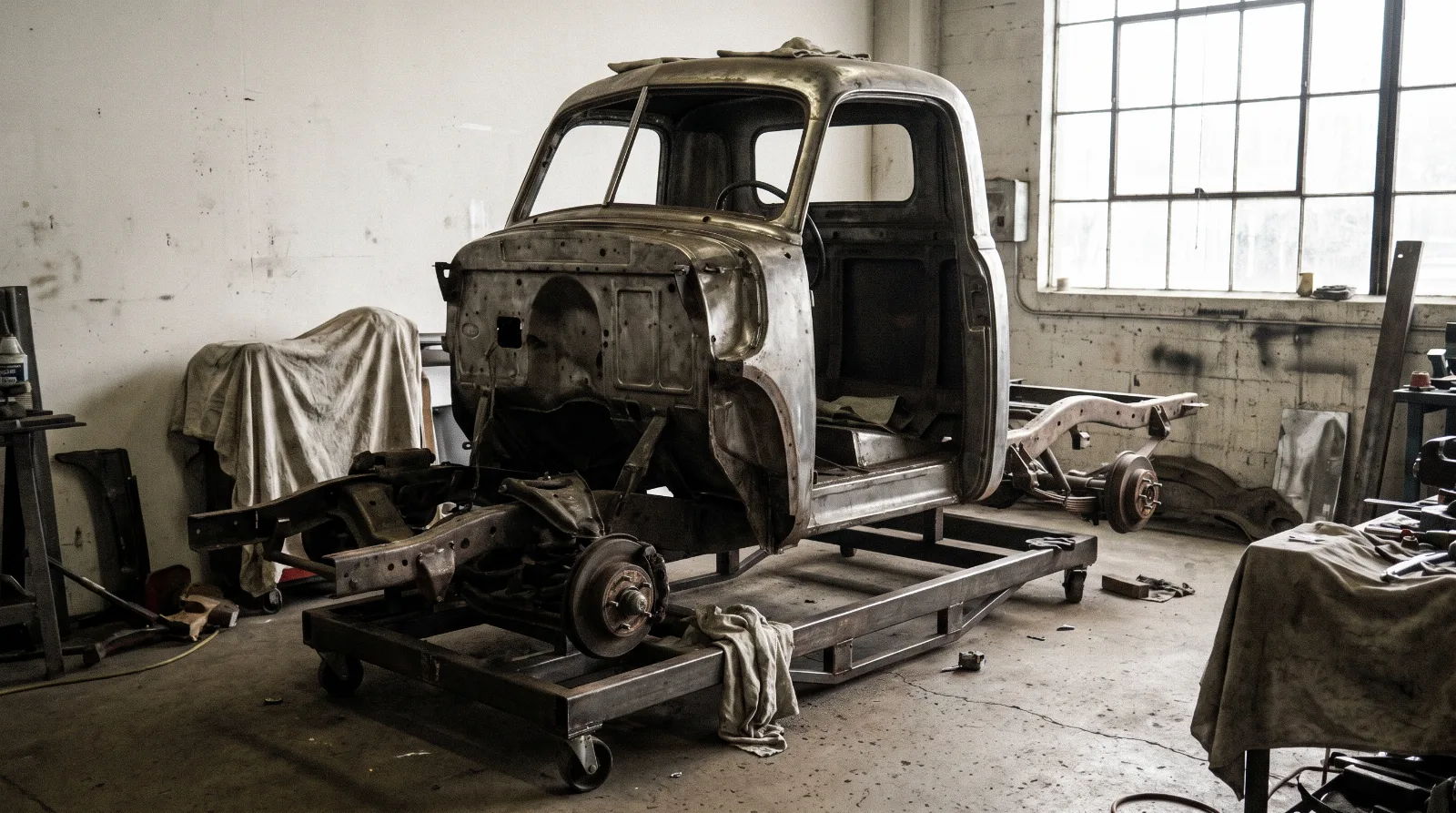
An Advance Design truck is one of the easiest old vehicles in the world to restore and one of the easiest to get wrong, and the two facts have the same cause: almost everything is available, so nothing forces you to think about the order you do it in.
What follows is the order that saves money, and the small number of 1951 specific details that decide whether the finished truck is right or merely finished.
Start by working out what you have
Before any parts are bought, establish the year, the series and where the truck sits relative to the mid year changes. The plate on the left front hinge pillar gives you plant, year, series, month and sequence, and for 1951 the series letters are JP for the half ton, JR for the three quarter and JS for the one ton.
Then confirm it against the vehicle. Vent windows in the doors plus pull down outside handles means 1951 and nothing else, because the vent windows arrive that year and the handles go to push buttons in 1952. Count the bed boards, because early 1951 has nine and late 1951 has eight and both are correct. Look at the speedometer, which reads to 80 on a 1951 and to 90 from partway through 1952.
| Stage | What happens |
|---|---|
| 1. Identify | Plate, vent windows and handles, bed boards, speedometer |
| 2. Assess | Cab corners, floor, frame, bed sills |
| 3. Decide | Original driveline or modified, and stick to it |
| 4. Structure | Frame, cab repairs, bed sills and sides |
| 5. Mechanical | Brakes, front end, engine, wiring |
| 6. Paint | After all metalwork, never before |
| 7. Glass and rubber | Before any soft trim goes in |
| 8. Interior and bed wood | Last, and in that order |
The order that saves money
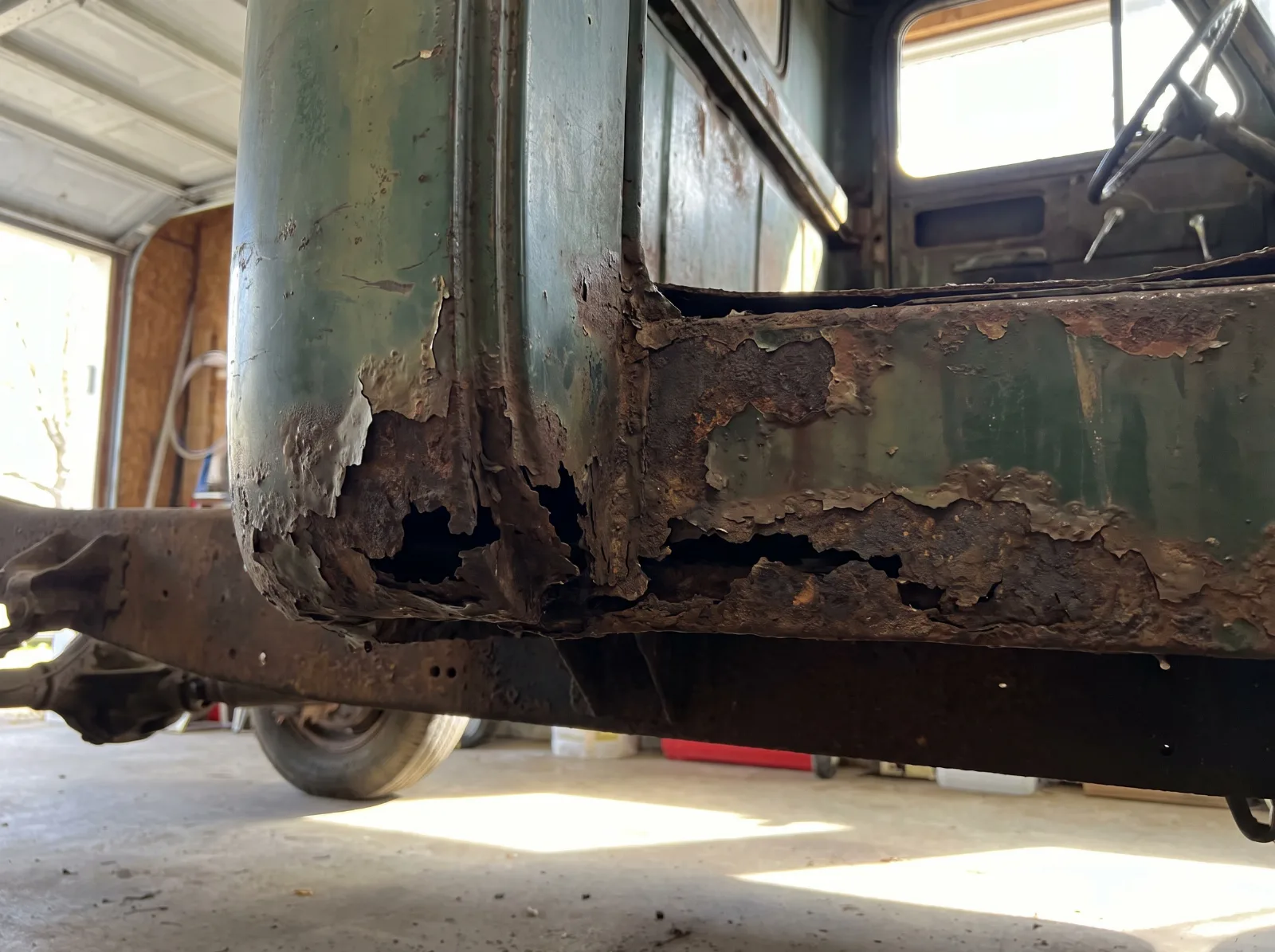
Structure first, always. Cab corners, cab floor, the bottoms of the doors, the frame, the bed sills and the bed sides. This is where all the real money in an Advance Design restoration lives, and every job you do before it is a job you will disturb.
Mechanical second. Brakes before anything else, because a truck that cannot stop cannot be tested. Then the front end, which on these is king pins and bushings and a steering box that is usually innocent. Then the engine, which on a 216 is a straightforward and forgiving rebuild. Then the wiring, in one go, with a decision already made about six or twelve volts.
Paint third, after every piece of metal is where it will finally be. Mask the identification plate and check the masking yourself, because plates get lost at the paint shop more often than anywhere else.
Glass and rubber fourth. Windscreen, vent windows, corner windows on a Deluxe cab. Every leak in this cab starts at a rubber, and a leak found after the trim is in is a leak found too late.
Interior and bed wood last. The seat, the panels, the headlining, the mat, and then the floor of the bed. These are the parts that get damaged by other work, so they go in when there is no other work left.
"I have never once seen somebody regret doing the metal first. I have seen plenty of new seats with a wiring loom dragged across them."
— Earl Dawson
The 1951 details that decide whether it is right
These trucks all look the same and they are not, and 1951 is a year with an unusual number of one year items. Getting them right costs nothing at the time and is expensive to fix later.
Chrome, not paint. 1951 is the last year of the brightwork. From 1952 the Korean War puts painted hubcaps, painted bumpers and painted grilles on these trucks, and the chrome window handle knobs and chrome wiper knob disappear with them. A 1951 built from a box of 1953 parts will be subtly and permanently wrong.
The 80 mile an hour speedometer. Correct for 1951, and a 90 face tells everybody the cluster came from something later.
The seat adjuster. A rod under the cushion, not the earlier cable arrangement.
The bed boards. Nine or eight according to what the truck was born with, not according to what the catalogue offers first.
Duo servo brakes. The self energising Bendix design arrives for 1951, which matters when you are ordering parts against a 1950 listing because the pictures look the same.
Check this first
- The plate, and then the truck against the plate. Identify before you spend.
- Cab corners and floor, from underneath, on a lift if you can. This is the budget.
- The frame, especially anywhere somebody has drilled or welded it. Previous projects leave marks.
- Bed sills before bed wood. The single most repeated mistake on these trucks.
- Whether the brightwork is right for the year. Cheap to get right now, annoying later.
- Your own answer to what the truck is for. It decides original against modified, and everything follows from that.
Where this fits
The truck at the centre of all this is the half ton itself, with the heavier versions in the 3600 three quarter ton and the 3800 one ton, all under the whole truck line. The stages have their own pages: the VIN plate for identification, the Deluxe cab option for what you are repairing, the truck bed for the floor, the cab trim for the trim, the truck instruments for the dash, and the V8 swap for the decision you make at the start. Parts sources are in the truck parts guide and the engine is in the 216.
Sources and notes
- Comprehensive history of 1947-1955 first series Advance Design, Deves Technical Network - the 1951 interior redesign with two piece door glass and vent windows, the driver's side cowl vent disappearing, 1951 as the only year with vent windows and pull down handles, the bed changing from nine boards to eight during the year, chrome window handle and wiper knobs ending after 1951, and the 1952 move to push button handles, a 90 mile an hour speedometer and painted hubcaps and bumpers.
- Serial number decoder, Advance Design Chevy trucks 1947-1954, Greg Wapling - the plate on the left front body hinge pillar, the plant, year, series and month structure with a plant sequence starting at 001001, and the JP, JR and JS series codes for 1951.
- Car of the week, 1951 Chevrolet 3100 pickup, Old Cars Weekly - the change to duo servo self energising Bendix brakes for 1951, the Ventipane door vent windows replacing the cowl vents, 1951 as the only year with vent windows and hold on door handles, and the 216.5 six of 92 horsepower with a column shifted three speed.
- 1951 Chevy truck parts, Chevs of the 40s - the seat adjustment changing from a metal cable to a rod under the cushion for 1951, the cowl vent replaced by door vent windows, the mid year bed change, and the full parts categories from brakes and engine through to bed wood and interior.
- Advance Design 1947-1955, Classic Chevy Trucks - tubular shock absorbers from 1950, door vent windows for 1951, and brightwork eliminated across 1952 and 1953 because of Korean War shortages.
- Classic Chevy truck bed wood dimensions, ChevyTrucks.org - the nine board floor in yellow pine with its board widths and routed edges, and the changeover to eight boards during 1951.
More from the garage
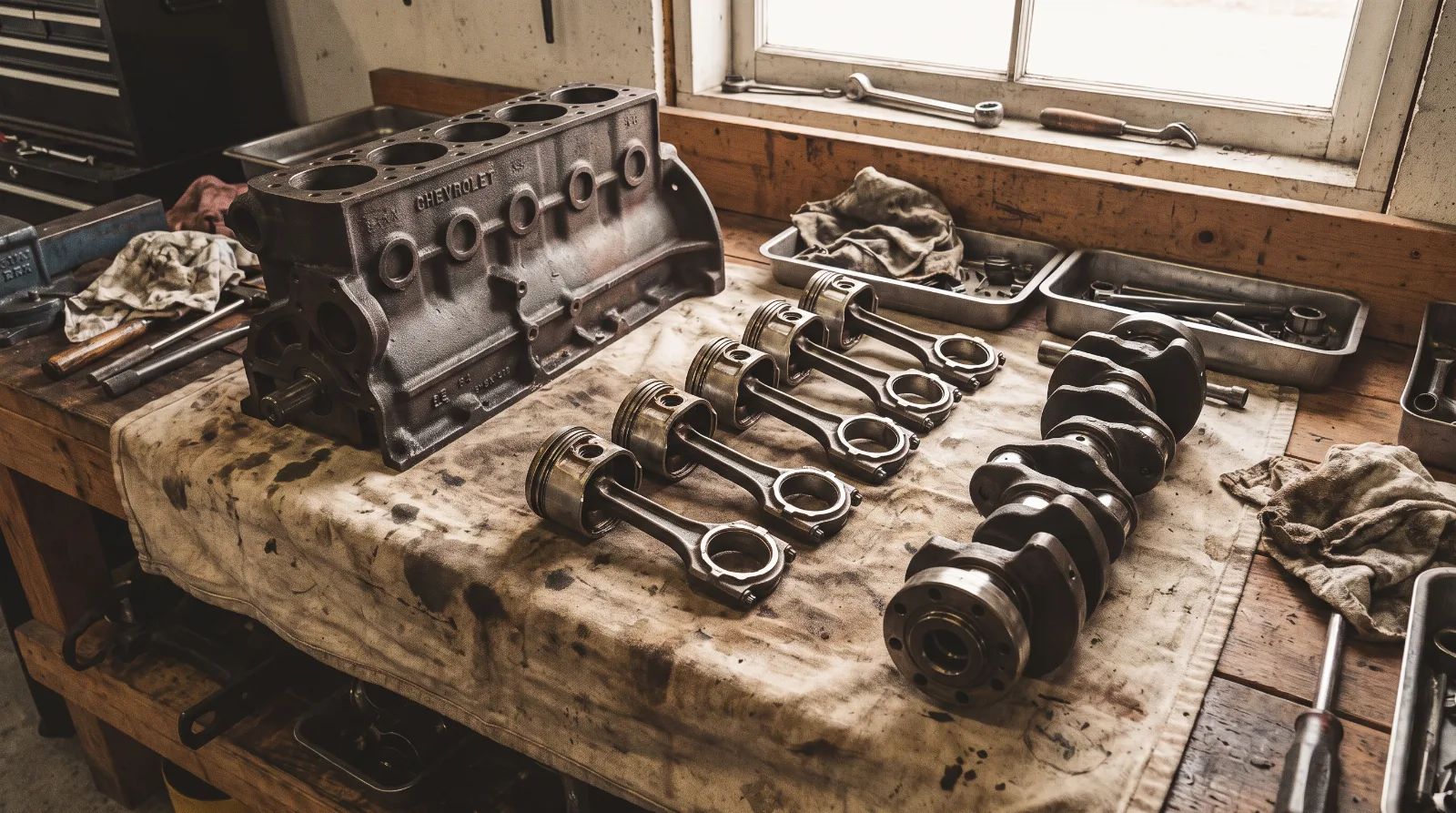
Rebuilding a Chevy 216
Rebuilding a 216 is not like rebuilding anything made after about 1955, and the difference is not the tools. It is that on most engines the botto...

The 1951 Chevrolet Apache
There is no 1951 Chevrolet Apache. The Apache name belongs to the generation of Chevrolet trucks that came after the one built in 1951, and it do...
The 1951 Chevrolet Impala
There is no 1951 Chevrolet Impala. The name did not exist in 1951, the car did not exist in 1951, and nothing Chevrolet built that year was ever...