The 1951 Chevrolet Apache
There is no 1951 Chevrolet Apache. The Apache name belongs to the generation of Chevrolet trucks that came after the one built in 1951, and it does not appear until 1958.
A 1951 Chevrolet truck is an Advance Design, and it is identified by a number rather than a name: 3100 for the half ton, 3600 for the three quarter, 3800 for the one ton.
When Apache arrives
Chevrolet replaced the Advance Design truck in the middle of 1955 with the Task Force series, its first major truck redesign since 1947. Task Force ran from 1955 to 1959.
Three years into that run, for 1958, Chevrolet started attaching names to the truck ranges by weight. Light duty trucks became Apache. Medium duty trucks became Viking. Heavy duty became Spartan. The Apache name then carried over into the following generation and lasted through 1961.
So Apache covers 1958 to 1961, and everything before that is either Advance Design or an unnamed Task Force truck.
| Years | What the light truck is called |
|---|---|
| 1947 to 1955 first series | Advance Design, numbered 3100, 3600, 3800 |
| 1955 second series to 1957 | Task Force, still numbered |
| 1958 to 1961 | Apache |
| 1958 onward, medium duty | Viking |
| 1958 onward, heavy duty | Spartan |
What a 1951 truck is called instead
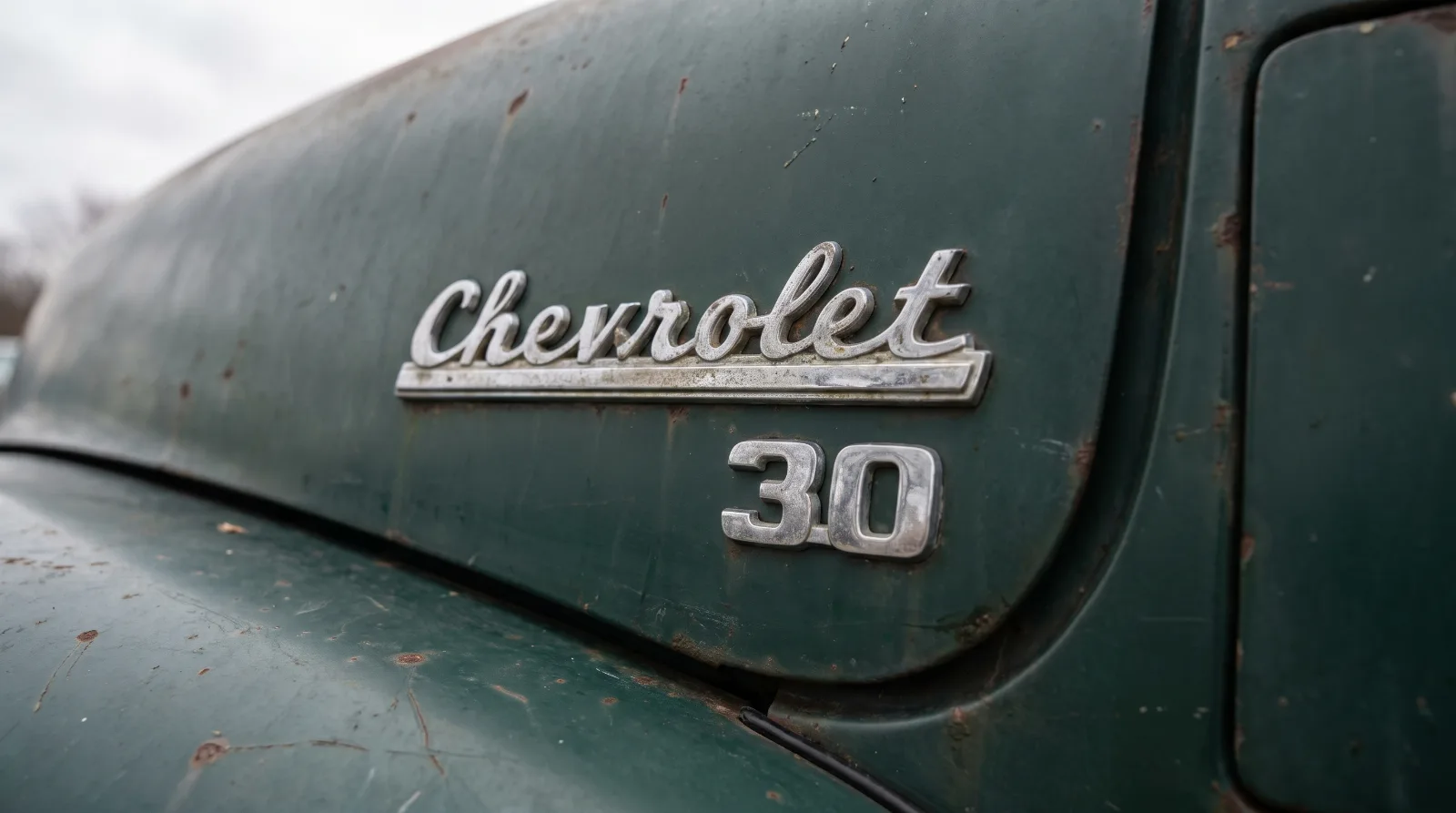
The number on the side of the bonnet is the model. From late 1949 the hood side emblems carried Chevrolet above and the load rating below, so a 1951 half ton reads Chevrolet and 3100, a three quarter ton reads 3600 and a one ton reads 3800.
The serial plate agrees with it. On a 1951 truck the plate on the left front hinge pillar carries JP for the half ton, JR for the three quarter and JS for the one ton, where J is the year and the second letter is the load rating.
And the wheelbases separate them physically: 116 inches for the 3100, 125.25 for the 3600 and 137 for the 3800.
Above those sit the heavier conventionals in the 4100 and 4400 series, and the cab over engine trucks numbered 5100, 5400 and 5700 by wheelbase. None of them are Apaches either.
"I have stopped correcting people at shows. If a man calls his 1951 an Apache and he has kept it alive for thirty years, he has earned the right to call it whatever he likes."
— Earl Dawson
Telling a 1951 from what came after
If you are trying to work out whether the truck in front of you is an Advance Design or something later, the changes are visible and they are quick.
A 1951 has vent windows in the doors and pull down outside door handles, and it is the only model year with both, because the vent windows arrive that year and the handles become push buttons for 1952. The speedometer reads to 80, which is the last year for that face before it goes to 90 partway through 1952.
The brightwork is chrome. From 1952 and through 1953 the Korean War took it away, and hubcaps, bumpers and grilles came painted instead.
And the badges do the rest. Two separate emblems each side of the bonnet, Chevrolet above and the model number below, puts the truck in 1949, 1950 or 1951. A truck with only the number, on a larger base, is 1953 or 1954. A truck with Thriftmaster is 1947 or 1948.
Check this first
- The year against the name. Apache is 1958 to 1961 and nothing earlier.
- The number on the bonnet side. 3100, 3600 or 3800 is what a 1951 is called.
- Vent windows plus pull down handles. The fastest confirmation of 1951 there is.
- The serial plate on the left front hinge pillar. JP, JR or JS for 1951.
- Whether the brightwork is chrome or painted. Chrome through 1951, painted after.
- One badge or two on each side of the bonnet. Two puts it in 1949 to 1951.
Where this fits
The full 1951 range and the other names that arrive later are in the 1951 Chevrolet models, with the Impala and the Corvette as the other two cases. The truck people actually mean is the 1951 Chevrolet 3100, alongside the 3600 and the 3800, all in the 1951 Chevrolet trucks. The badges that date it are in the hood emblem and the plate is in the truck VIN plate.
Sources and notes
- Chevrolet Task Force, Wikipedia - the Task Force series running from 1955 to 1959 as Chevrolet's first major truck redesign since 1947, all light duty trucks being called Apache from 1958 and carried over into the next generation through 1961, and the Viking and Spartan names applied to medium and heavy duty trucks from the same year.
- Chevrolet Advance Design, Wikipedia - the hood side emblems changing in late 1949 from Thriftmaster and Loadmaster to numbers designating cargo capacity, 3100 on the half ton, 3600 on the three quarter and 3800 on the one ton, the 1951 door vent windows and last year for the 80 mile an hour speedometer, and the JP, JR and JS serial codes.
- Advance Design hood side emblems, Deves Technical Network - Chevrolet over Thriftmaster in 1947 and 1948, two separate emblems with Chevrolet over the model number from 1949 to 1951, the number dropped for 1952, and the number alone on a larger base for 1953 and 1954.
- Car of the week, 1951 Chevrolet 3100 pickup, Old Cars Weekly - the 116 inch wheelbase half ton, and 1951 as the only year with the new vent windows alongside the old hold on door handles.
- Serial number decoder, Advance Design Chevy trucks 1947-1954, Greg Wapling - the plate on the left front body hinge pillar and the JP, JR and JS series codes that identify a 1951 truck by load rating.
- Advance Design 1947-1955, Classic Chevy Trucks - the brightwork eliminated across 1952 and 1953 because of Korean War shortages, leaving painted hubcaps, bumpers and grilles.
More from the garage
Rebuilding a Chevy 216
Rebuilding a 216 is not like rebuilding anything made after about 1955, and the difference is not the tools. It is that on most engines the botto...
The 1951 Chevrolet Impala
There is no 1951 Chevrolet Impala. The name did not exist in 1951, the car did not exist in 1951, and nothing Chevrolet built that year was ever...
Chevy 216 Engine Specs
This is the page I keep in the toolbox. Not the history, not the argument about whether the 216 or the 235 is the better engine, just the numbers...