1951 Chevrolet Station Wagon
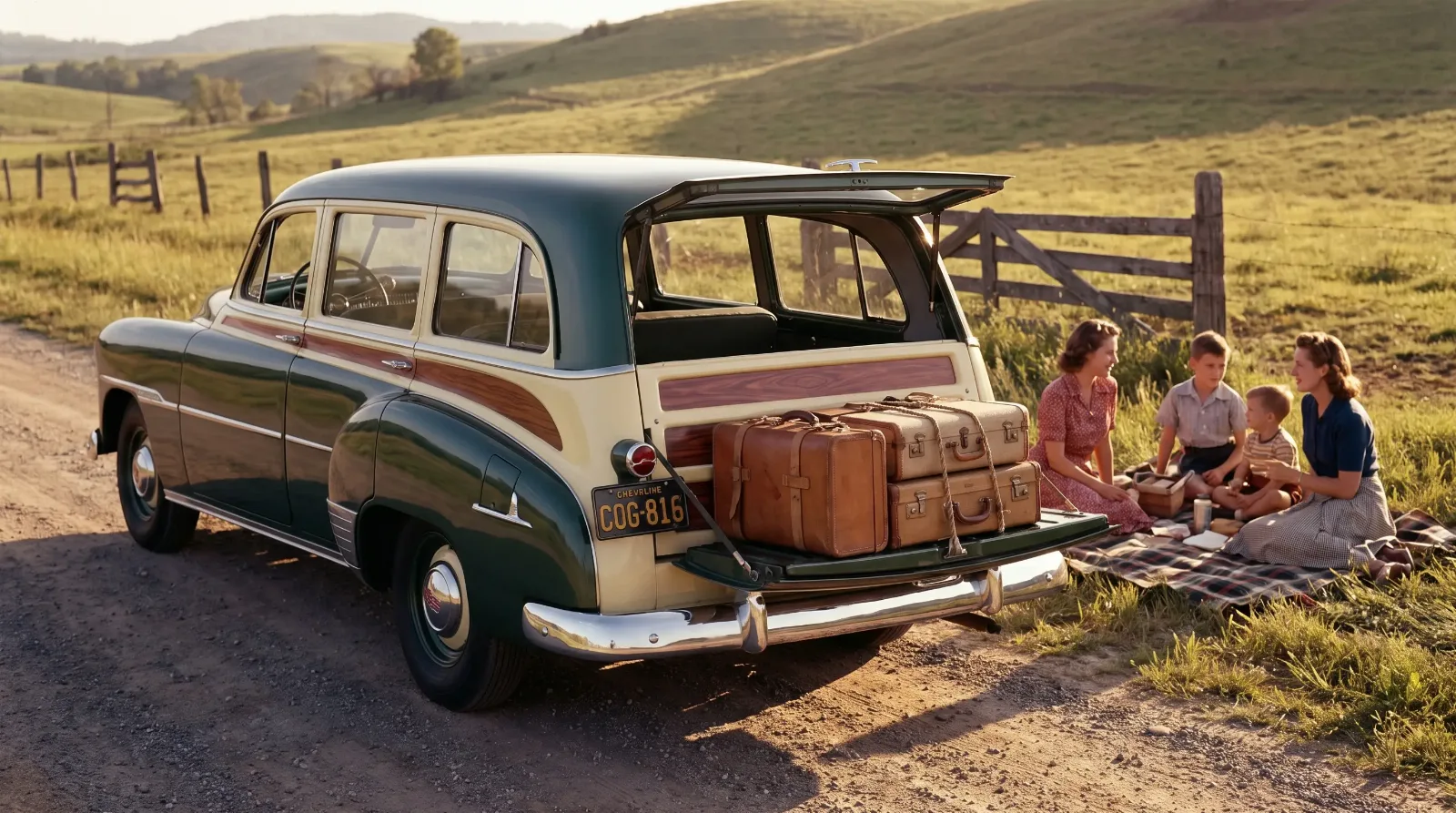
The 1951 Chevrolet station wagon was the most expensive car Chevrolet sold that year. Not the convertible, not the Bel Air hardtop. The wagon, at $2,190. That surprises people who grew up thinking of a wagon as the sensible cheap car for a family, but in 1951 a wagon was a specialty body, built in small numbers and priced accordingly. Chevrolet made 23,586 of them.
It is a Styleline De Luxe underneath, and like the convertible and the Bel Air it was a De Luxe car only. There was no Special wagon. So every 1951 Chevrolet wagon started out at the top of the range, wearing the fender-to-door stainless and the better interior trim that came with the upper series.
Steel body, painted wood
By 1951 the Chevrolet wagon body is all steel. What you see on the upper doors and the tailgate is wood-grain trim, applied and painted to look like framed wood panels. The nickname the hobby settled on is the tin woodie, and it is a fair description. The car reads as a woody from twenty feet and reveals itself as steel when you put a hand on it.
That transition happened over the late 1940s and early 1950s across the whole American industry, and sources argue about exactly which model year was the last for a genuine wood-bodied Chevrolet wagon. What is not in dispute is what a 1951 buyer got, which was a steel structure dressed to look like the wagons everybody remembered from before the war. Real wood does still turn up inside some of these cars in the window reveals and interior trim, so do not be surprised to find timber in a car whose body is steel.
For an owner today that trade is entirely in your favor. A real wood body needs refinishing, refastening and constant attention, and a rotten one is a coachbuilding job. Steel you can repair with ordinary body skills. The wood-grain finish is its own specialty, and doing it convincingly is an art, but it is paint and it is fixable.
Where the wagon sat in the range
| 1951 De Luxe model | Factory price | Production |
|---|---|---|
| Styleline De Luxe four-door sedan | $1,680 | 380,270 |
| Bel Air hardtop | $1,920 | 103,356 |
| Convertible | $2,030 | 20,172 |
| Station wagon | $2,190 | 23,586 |
Twenty three thousand cars sounds like a reasonable number until you set it against 380,270 four-door sedans. The wagon and the convertible were both roughly one car in fifty. Neither was a volume product, and both have the survival problem that goes with a body built in small numbers, which is that nobody stamped replacement panels for them once the model year was over.
The wagon body is a genuine eight-passenger car with three rows of seating and doors big enough to make climbing into the middle row easy. The tailgate arrangement is the usual two-piece setup of the era, a lift-up upper section and a fold-down lower gate. Removing seats to make a load floor was part of the design, and most of these cars spent their working lives with the third row out in a garage somewhere. Missing seats are common and finding correct ones is one of the harder searches on this car.
Mechanically it is a familiar Chevrolet
The wagon uses the same drivetrain as the rest of the 1951 range. Standard is the 216.5 cubic inch overhead-valve Stovebolt six at 92 horsepower with the three-speed manual on the column. Because it is a De Luxe, Powerglide was available, and a Powerglide wagon came with the larger 235.5 cubic inch six with hydraulic lifters rated at 105 horsepower.
On a wagon that engine choice matters more than it does elsewhere. This is the heaviest body in the range and it was designed to carry eight people. The 216 with a three-speed will do it, but it will not enjoy it. If you intend to actually use the car, the 235 and Powerglide combination is worth looking for.
Six volt electrics, negative ground. The same warning as always, because the wrong assumption is everywhere. Chevrolet ran negative ground while Ford, Chrysler and GMC ran positive. The fastback sister car with the same drivetrain and the same trim is the 1951 fastback De Luxe.
"A wagon is the body style that got used the hardest and thrown away the fastest. Hauling kids, hauling lumber, hauling a dog. That is why so few good ones are left, and it is why the ones that survived are worth what people are asking."
— Earl Dawson
What to look at before you buy
Wagons are among the body styles leading collector interest in the 1949 to 1952 Chevrolets, alongside convertibles, Bel Air hardtops and the Fleetline fastbacks, and factory-correct cars are the ones going up in value. That interest is recent enough that project wagons still turn up at prices that make sense, provided you understand what you are taking on.
The problems are exactly where a working vehicle wears out. The cargo floor, because everything got dragged across it. The tailgate and its bottom edge, because water sits in there and the gate lives outdoors even when the rest of the car is under a roof. The rear quarters and the wheel arches. And the wood-grain finish, which is invisible as a cost until you get a quote to have it done right.
Check this first
- Cargo floor and rear wheel wells. This is a work vehicle body. Lift everything out and look at bare metal, not carpet.
- Tailgate, upper gate and their seals. Both sections rot along the bottom edge and the hardware is wagon-specific. Check that both open, close and latch.
- Second and third row seats. Confirm they exist and are correct. Missing wagon seats are one of the hardest things to source on this car.
- Wood-grain finish. Judge how much of it is original and how much is repaint. Reproducing this convincingly is a specialist job with a specialist price.
- Cowl, floors and door bottoms. The whole 1949 to 1952 family rots in the same places. The wagon is no exception, it just has more floor to check.
- Drivetrain match. A Powerglide wagon should have the 235 six. On the heaviest body in the range, knowing which engine is actually in there matters.
If you want a feel for what solid 1951 Chevrolets of any body style are asking right now, before you commit to the wagon in particular, it is worth looking through what 1951 Chevrolets for sale are bringing. Wagon prices sit at the top of that spread for good reason.
It is the most expensive 1951 Chevrolet, the hardest working, and one of the least likely to have survived. That is a decent definition of a car worth saving. Find one with a straight cargo floor and a tailgate that still latches, keep the seats with it, and you will have the version of this car that everybody else let go.
The wagon shared the top of the 1951 price list with one other car, and that one is the 1951 Chevrolet Bel Air. If the pillarless roof is what you are really after rather than the load space, the body style itself is explained in the 1951 Chevrolet hardtop.
Sources and notes
- 1951 Chevrolet De Luxe Series, Conceptcarz - the $2,190 station wagon price and 23,586 production figure, the rest of the De Luxe range for comparison, and the 216.5 and 235.5 cu in engine ratings.
- Taking to the woods, 1951 Chevrolet Styleline De Luxe, Supercars.net - the all-steel wagon body with hand-painted wood-grain trim on the upper doors and tailgate, and the eight-passenger layout.
- Tin woodie project, 1951 Chevrolet Styleline, Barn Finds - the tin woodie nickname, what a wagon project actually involves and where these cars typically rot.
- 1951 Chevrolet Styleline De Luxe woodie wagon, Auto Restorer - restoration detail on the 1951 wagon body, its wood-grain finish and the interior wood trim that survived into the steel-bodied cars.
- 1949 to 1952 Chevys are gaining in collectibility, Old Cars Weekly - station wagons among the body styles leading collector interest and rising values for factory-correct cars.
- Chevrolet Deluxe, Wikipedia - the De Luxe-only availability of the wagon and the 1949 to 1952 series structure.
More from the garage
Rebuilding a Chevy 216
Rebuilding a 216 is not like rebuilding anything made after about 1955, and the difference is not the tools. It is that on most engines the botto...
The 1951 Chevrolet Apache
There is no 1951 Chevrolet Apache. The Apache name belongs to the generation of Chevrolet trucks that came after the one built in 1951, and it do...
The 1951 Chevrolet Impala
There is no 1951 Chevrolet Impala. The name did not exist in 1951, the car did not exist in 1951, and nothing Chevrolet built that year was ever...