The 1951 Chevrolet Chassis
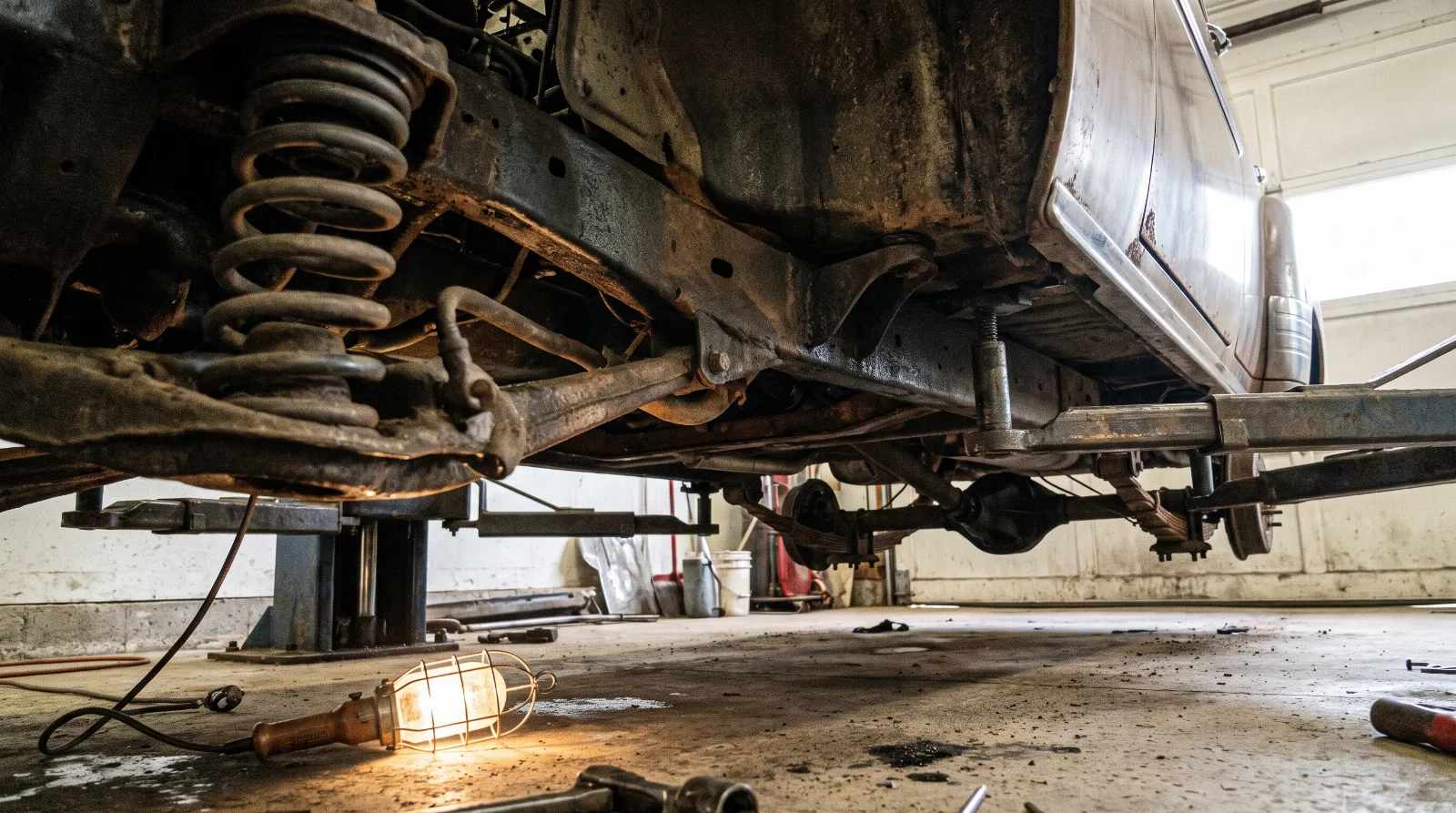
Everybody photographs the grille. Nobody photographs the frame. Then the car gets bought, driven fifteen miles, and the new owner discovers that the part he never looked at is the part that decides whether the thing is a car or a project.
The chassis of a 1951 Chevrolet is four systems bolted to a ladder frame: an independent front end on coil springs and king pins, a leaf sprung rear axle located by a torque tube, hydraulic drum brakes at all four corners, and a worm and roller steering box feeding a linkage with an idler arm in it. None of it is exotic. All of it is seventy five years old, and it wears in a predictable order.
What is actually under there
Start with the numbers, because they set expectations. This is a 115 inch wheelbase car weighing about a ton and a half, riding on 6.70 by 15 four ply tyres, stopped by eleven inch drums and steered by a gearbox with no assistance of any kind.
| Item | 1951 Chevrolet |
|---|---|
| Wheelbase | 115 in |
| Overall length / width | 196.9 in / 74 in |
| Weight, Styleline De Luxe convertible | 3,380 lb |
| Tyres | 6.70 x 15, four ply |
| Front suspension | Independent, coil springs, king pins |
| Rear suspension | Semi-elliptic leaf springs |
| Brakes | Hydraulic drum, 11 in front and rear |
| Steering | Worm and roller |
| Rear axle | Semi-floating, hypoid, 4.11:1 |
| Fuel tank | 16 gallons |
The four systems, and the order they let you down
Steering goes first, and it is usually not the box. The linkage carries an idler arm running on bushings, and when those bushings and the pivot pin wear, the arm moves up and down and the wheel develops a dead spot. People chase that dead spot into the steering box, tighten the lash adjuster, and end up with a car that is still loose on centre and now binds at full lock. The box has three adjustments in a fixed order, and none of them fixes a worn idler arm.
Front suspension is next. King pins, not ball joints. Ball joints arrived at Chevrolet in 1955, so on this car the spindle swings on a pin through bushings that need grease and did not always get it. The pin is a stock item, .866 inch across and 5.31 inches long, and it has been the same part since 1939. Add the upper and lower control arm bushings and the shock links and you have the standard front end rebuild.
Brakes are a maintenance item, not a design flaw. Eleven inch drums on a car of this weight is honest for 1951, and Chevrolet redesigned the linings for 1951 specifically to improve them. What kills them is time: seized wheel cylinders, glazed linings, drums turned oversize by somebody in 1974, and fluid that has been absorbing water for decades.
The rear axle mostly just sits there. A semi-floating hypoid unit inside a torque tube, and the tube does the locating work that trailing arms do on a modern car. It is the least troublesome part of the chassis and the most annoying to work on, because nothing back there comes apart in isolation.
"Every one of these cars I have looked at, the owner tells me the steering box is worn out. Then you get under it and rock the idler arm and it flops like a screen door. Same story for forty years."
— Earl Dawson
What the design gets right, and where it shows its age
The good part is that Chevrolet had already been building this front end since 1939 and had the bugs out of it. Independent front suspension with coil springs, a stabiliser bar, and telescopic shocks in place of the old lever type was genuinely modern for a low priced car. The ride is soft and the car tracks straight if the geometry is right.
Where it shows its age is the brake hydraulics. One master cylinder, one circuit, four wheels. A single failed line or wheel cylinder anywhere in the system takes the whole thing with it, and there is no warning light to tell you it happened. That is the honest argument for a dual reservoir master cylinder, and it is a stronger argument than the one people usually make about disc brakes.
The second thing that dates it is the steering effort. No power assistance was offered on a 1951 Chevrolet, and parking a car with the engine sitting over the front wheels and no help at the box is work. A correctly rebuilt and adjusted front end makes an enormous difference here. Most cars that steer heavily are not heavy by design, they are heavy because something is dry or bent.
Check this first
- Rock the front wheels at top and bottom. Play there is king pins or bearings, and it tells you what the front end job is going to cost before you buy the car.
- Rock the idler arm by hand. Thirty seconds, and it explains most of the slop in the steering wheel.
- Which axle ratio it has. 4.11 with the manual, 3.55 behind Powerglide. It changes what the car is good for.
- Look at the brake lines the whole length of the car. One master cylinder means one bad line ends the day.
- Check the drums are still within size. A drum turned past its limit is a new drum, and they are reproduced, so it is money rather than a problem.
- Look at the rear spring shackles and bushings. Cheap, easy, and almost always overdue.
Where this fits
Each of these systems gets its own page, because each one is a separate weekend. The hydraulics and the drums are in the 1951 Chevrolet brakes, and the modern alternative is weighed up in the disc brake conversion. The box, the linkage and the idler arm are in the steering, the springs and king pins in the suspension, and the hypoid unit and its ratios in the rear axle. How the axle is located and driven is the torque tube. Where all of it lands in the order of a full job is in the restoration guide, and what the car is in the first place is in the year in full.
Sources and notes
- 1951 Chevrolet Styleline De Luxe Series 2100 JK specifications, Classic Car Database - the 115 inch wheelbase, 6.70 x 15 four ply tyres, eleven inch hydraulic drums front and rear, worm and roller steering, independent coil front and semi-elliptic leaf rear, the semi-floating hypoid axle at 4.11:1, the 3,380 pound weight of the Styleline De Luxe convertible coupe and the 16 gallon tank.
- Chevrolet De Luxe, Wikipedia - the 196.9 inch length and 74 inch width on the 115 inch wheelbase, the front stabiliser, and the change from lever type shock absorbers to telescopic units for 1949.
- 1951 Chevy car parts, Chevs of the 40s - the redesigned brake linings for 1951, the grille and parking light change from 1950, and the chassis part categories catalogued for the car.
- Front suspension king pins, Chevs of the 40s - the king pin for knee action equipped cars from 1939 to 1954, .866 inch outside diameter by 5.31 inches long.
- Secrets of the Chevy Powerglide 1950-73, Mac's Motor City Garage - the rear axle ratio dropped from 4.11:1 to 3.55:1 on Powerglide cars to manage driveline noise and harshness.
- Steering box, 1950 Chevy coupe, Vintage Chevrolet Club forum - the idler arm as the primary wear point, its pin and bushings wearing like king pins, and the arm flopping to create the slack the driver feels at the wheel.
More from the garage
Rebuilding a Chevy 216
Rebuilding a 216 is not like rebuilding anything made after about 1955, and the difference is not the tools. It is that on most engines the botto...

The 1951 Chevrolet Apache
There is no 1951 Chevrolet Apache. The Apache name belongs to the generation of Chevrolet trucks that came after the one built in 1951, and it do...
The 1951 Chevrolet Impala
There is no 1951 Chevrolet Impala. The name did not exist in 1951, the car did not exist in 1951, and nothing Chevrolet built that year was ever...