The 1951 Chevrolet Torque Tube
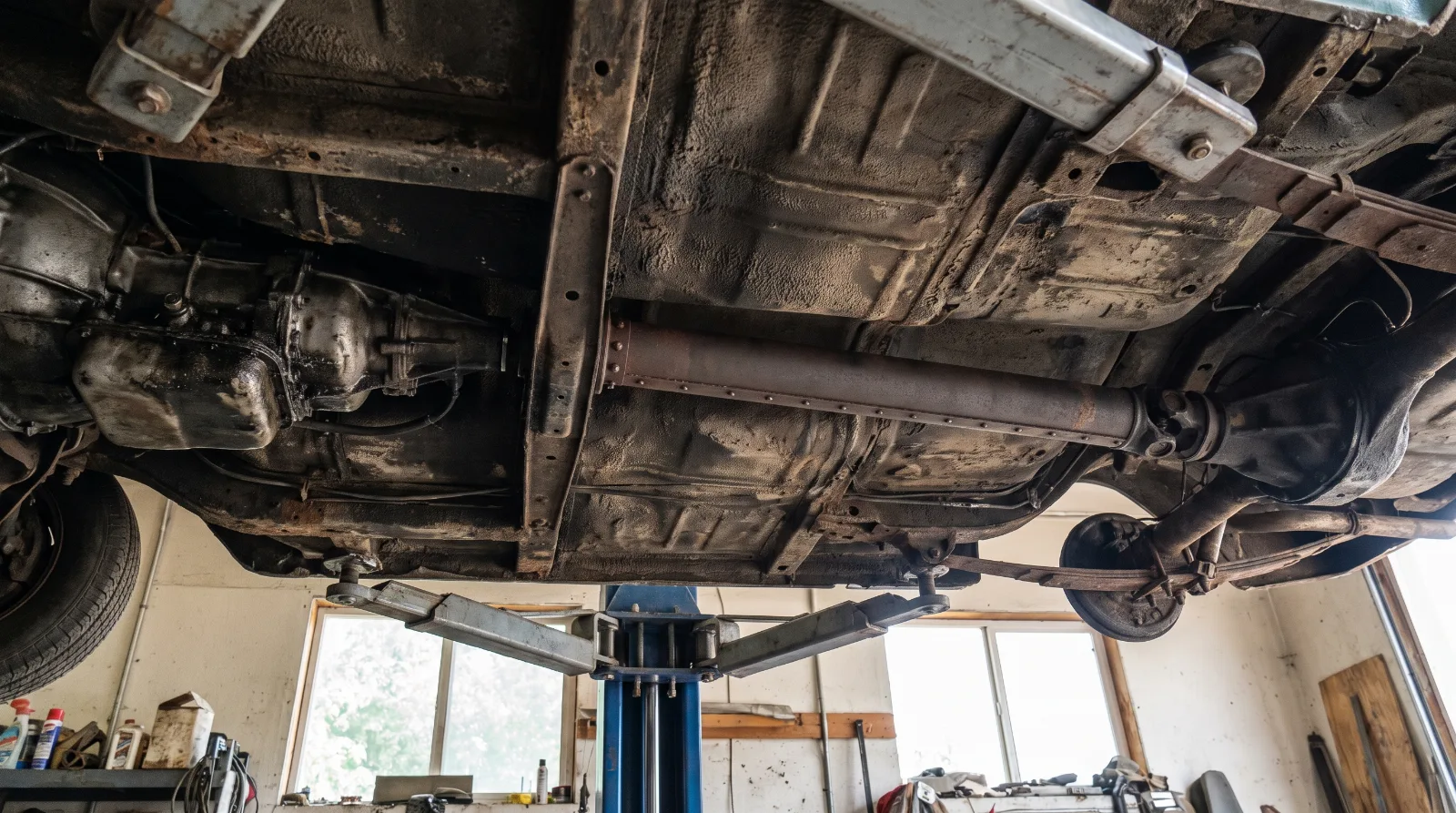
Get under a 1951 Chevrolet and you will not find a driveshaft. Not one you can see, anyway. What runs from the back of the gearbox to the rear axle is a fat steel tube, and the shaft is inside it. That is a torque tube, and it changes how you work on the car, what rear axle ratios you can have, and what happens the first time a seal starts to weep.
Nobody explains this to a first-time owner. Then a bearing goes, they get quoted for the job, and the number does not look like a driveshaft number at all. So here is what it is and why Chevrolet built cars this way for twenty-five years.
What a torque tube actually does
Think of it as a driveshaft inside a driveshaft. The outer tube does not rotate. It is a fixed housing bolted to the differential at one end and, through a ball and socket joint, to the back of the gearbox at the other. The shaft turns inside it, and the whole assembly is filled with gear oil.
The point of the arrangement is not the shaft, it is the tube. Because the tube ties the axle housing rigidly to the gearbox, the torque of accelerating and braking is fed forward through the tube and into the frame through the engine mounts, instead of trying to twist the axle up out of its springs. Axle wrap, the thing that makes a leaf-sprung car hop and tramp under power, simply does not happen the same way.
| Torque tube (1951) | Open driveshaft | |
|---|---|---|
| Shaft | Enclosed, runs in oil | Exposed, runs dry |
| Axle location | The tube locates it | Springs or links locate it |
| Universal joints | One, at the torque ball, inside the housing | Two, out in the open |
| Changing the axle ratio | A complex swap, which is why rodders avoided it | Straightforward |
| Unsprung weight | Higher | Lower |
| Springs it allows | Softer, because location is handled elsewhere | Stiffer, because they do the locating |
Why it matters when you own one
Three practical consequences, and the first one is the one that costs money.
The joint runs in oil, and that is the point. There is one universal joint, in the ball at the front of the tube, and it is a plain bearing joint that needs oil to survive. The enclosed housing is what keeps it fed and keeps the mud and grit of an unpaved road out of it. So the seal at the torque ball is not a nuisance item, it is the thing retaining the lubricant the joint depends on. A weeping torque ball is worth dealing with rather than watching, and it is a known wear point: plenty of owners have replaced the original cork composite seal with an o-ring.
Changing the axle ratio is a project, not an afternoon. That awkwardness is one of the reasons the arrangement fell out of favour and it is the reason hot rodders in particular disliked it. If you want a different final drive, this is the part of the car that decides how much work that is.
One joint, and it runs straight. That is worth understanding, because it explains why these cars are smooth. With a single joint held in line by the tube, there is nothing to set up a vibration until the suspension moves it off axis over a bump. Chevrolet only went to a two-joint open shaft later, when buyers wanted less noise and vibration than the older arrangement could give them over rough surfaces.
"There is one universal joint under this car and it lives in oil. That is not a quirk, it is the whole design. Let the seal at the torque ball go and you are running a plain bearing joint dry, and it will tell you about it long before you were planning to be under there."
— Earl Dawson
Keep it or convert it
Converting a 1949 to 1954 Chevrolet to an open driveshaft and a later rear axle is one of the most common things done to these cars, and there are kits for it. Whether you should depends entirely on what you want the car to be.
Keep the torque tube if the car is original or you want it to be, if you drive at the speeds it was built for, and if the axle ratio it has suits you. It works. It worked for a quarter of a century. Seals and a universal joint are maintenance, not a design fault.
Convert if you have fitted a V8 or a later gearbox, if you want an overdrive so the car will sit at seventy without shouting, or if you want a rear axle ratio the factory never offered. Once you have made either of those changes, the torque tube stops being the thing holding the car back and starts being the thing in the way.
What you should not do is convert because somebody told you the torque tube is obsolete. It is not obsolete. It is specific.
Check this first
- A weeping torque ball. Wet at the front of the tube means the seal is past it, and the joint inside depends on what that seal is holding in.
- Play at the torque ball. A knock on the overrun that you can feel through the floor usually starts here.
- Whether the seal is original cork or an o-ring. Either can be right. It tells you whether anybody has been in there.
- Whether the car has already been converted. An open shaft under a 1951 is common, it drives better, and it changes the value and every part number behind the gearbox.
- What axle ratio is actually in it. Count it out on a lift if nobody knows. It decides what the car is pleasant at, and you cannot casually change it.
- Rear spring condition. Softer springs were possible precisely because the tube does the locating. Tired ones on a torque tube car feel worse than they would on anything else.
Where this sits in the car
The torque tube is the back half of a drivetrain whose front half is either a three-speed manual or a Powerglide. What was in front of it, and what that decided about the engine, is in the three-speed manual and the Chevy Powerglide. The full account of what Chevrolet fitted that year is in the engine options, and where driveline work sits in the order of a whole restoration is in the whole restoration.
Sources and notes
- Torque tube, Wikipedia - the stationary housing around a rotating driveshaft coupling the differential housing to the transmission, traction forces fed through the engine mounts to the frame, the torque ball allowing suspension movement, the prevention of axle wrap, Ford using it through 1948 and on over nineteen million Model Ts, Buick from 1906, American Motors into the 1960s and the Corvette since 1997, and the trade-offs of unsprung weight and awkward gear swaps.
- Torque tube 101, Vintage Chevrolet Club of America forum - the closed driveline described as a drive shaft inside a drive shaft, universal joints running in oil, the plain bearing joint that needs that oil, the single joint running straight so it only vibrates when a bump takes it off axis, protection from mud and dirt on unpaved roads, and Chevrolet moving to two-joint open shafts as buyers demanded less noise and vibration.
- Torque tube questions, Vintage Chevrolet Club of America forum - owners replacing the original cork composite torque ball seal with an o-ring, and the practicalities of supporting the tube when the joint is disconnected.
- 1951 Chevrolet De Luxe Series specifications, Conceptcarz - the 115 inch wheelbase chassis this driveline sits in and the engines ahead of it.
- Chevrolet Deluxe, Wikipedia - the 1949 to 1952 Chevrolet range this driveline sat under, and the engines and transmissions in front of it.
- Comprehensive history of the 1947-1955 first series Advance Design, DevesTechNet - the three and four-speed manual gearboxes ahead of the driveline in the 1951 light trucks.
More from the garage
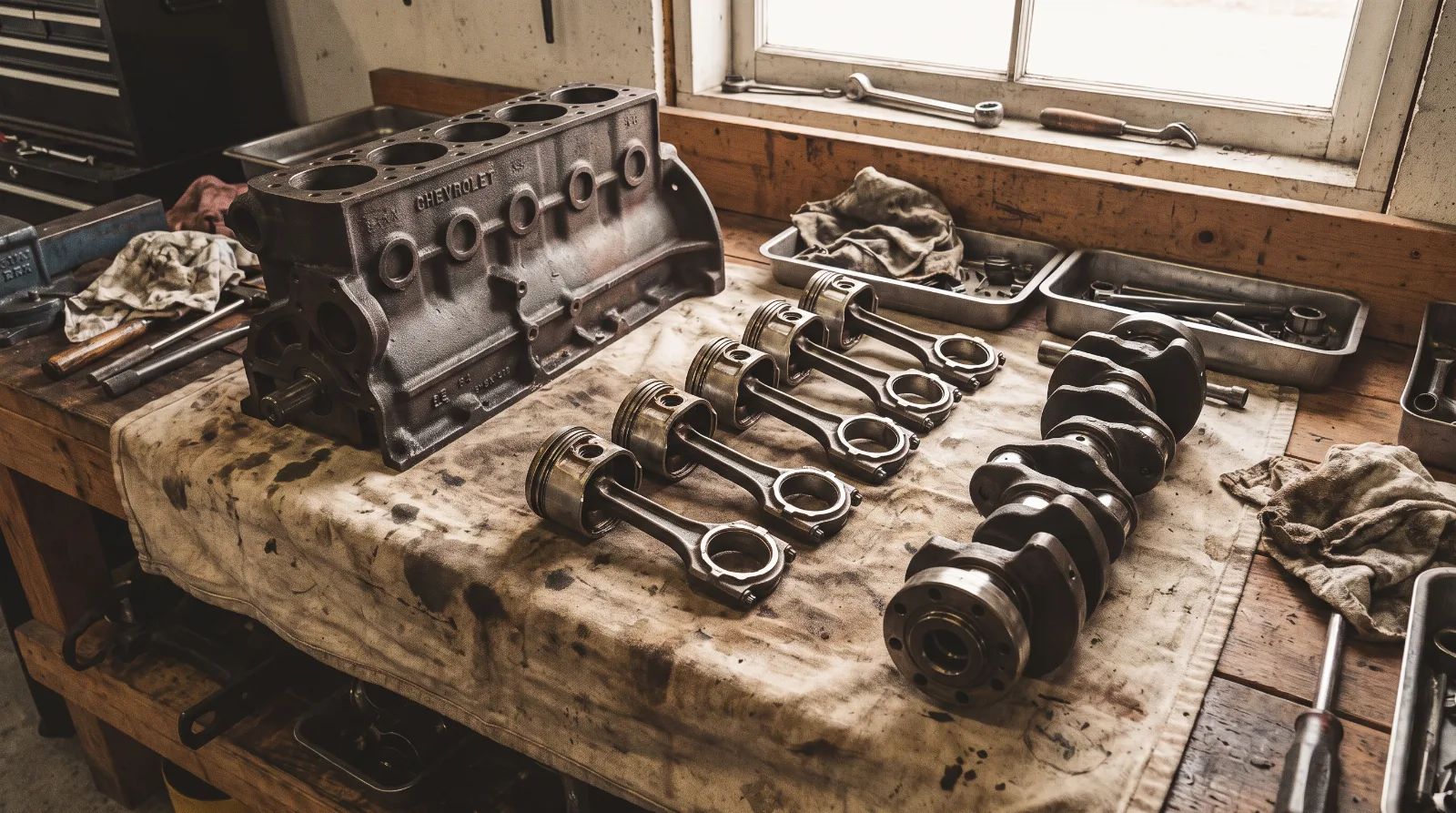
Rebuilding a Chevy 216
Rebuilding a 216 is not like rebuilding anything made after about 1955, and the difference is not the tools. It is that on most engines the botto...
The 1951 Chevrolet Apache
There is no 1951 Chevrolet Apache. The Apache name belongs to the generation of Chevrolet trucks that came after the one built in 1951, and it do...
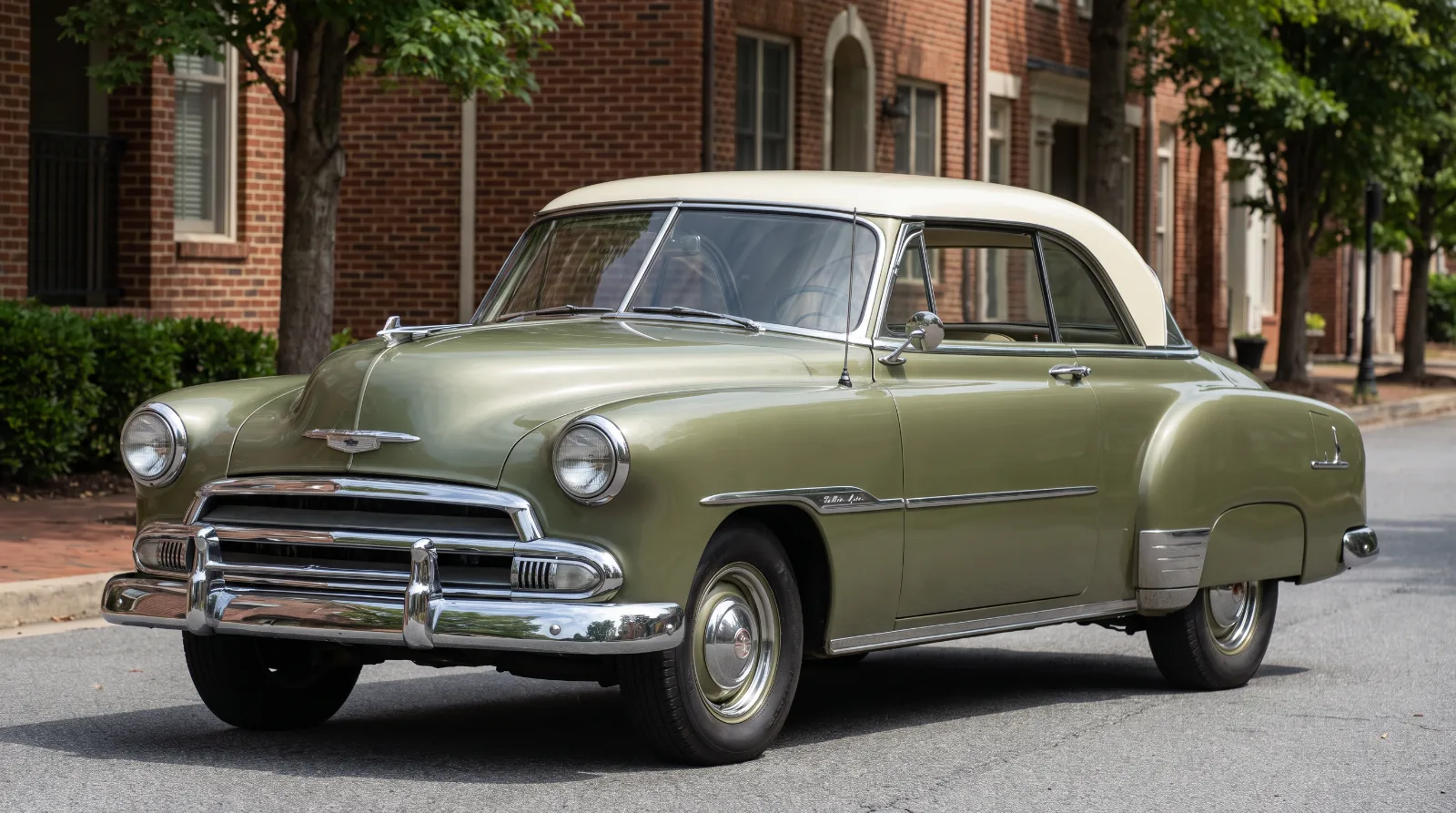
The 1951 Chevrolet Impala
There is no 1951 Chevrolet Impala. The name did not exist in 1951, the car did not exist in 1951, and nothing Chevrolet built that year was ever...