The 1951 Chevrolet Three-Speed Manual
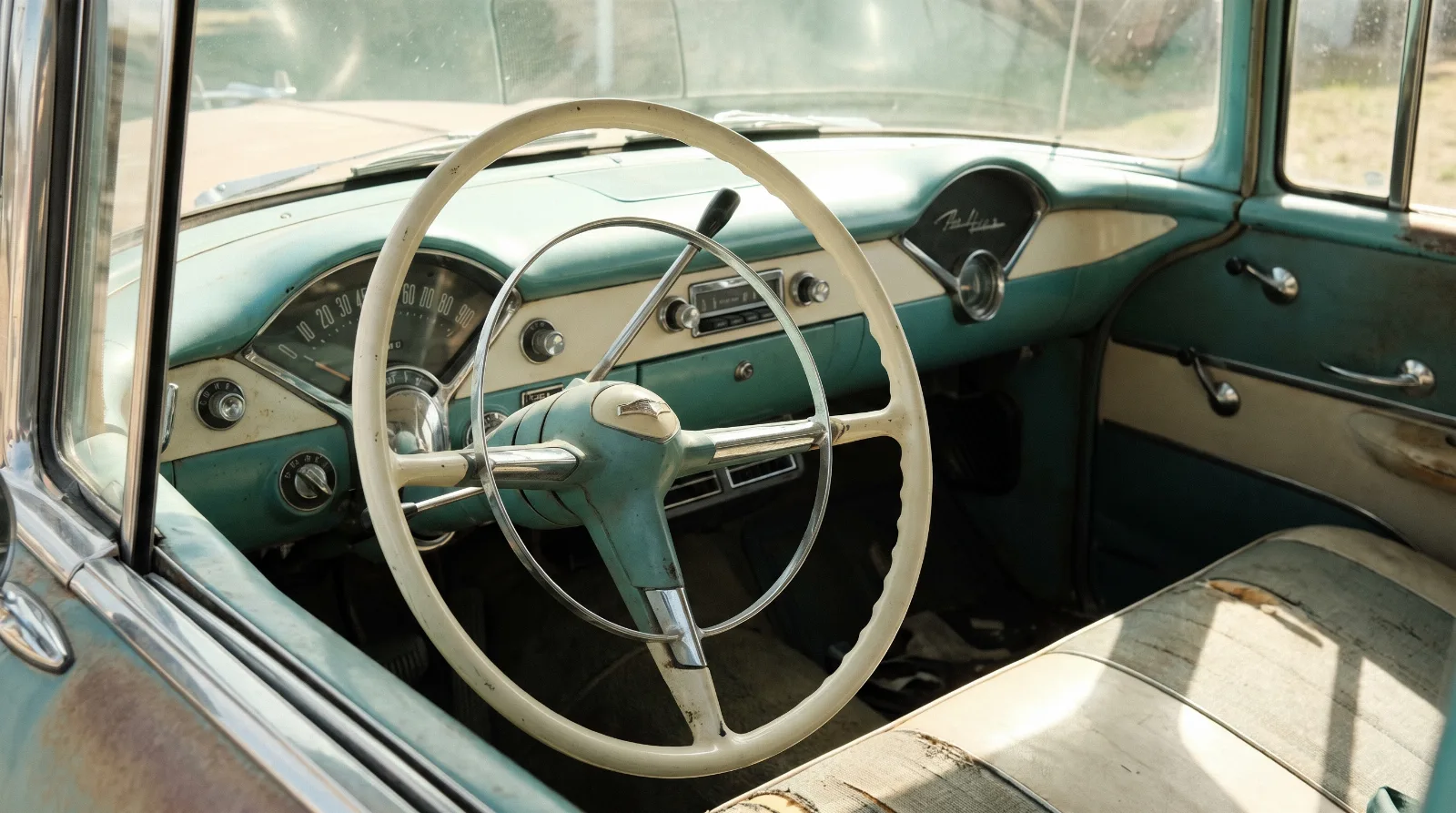
Three on the tree. Three forward gears, the lever on the steering column, and a pattern you draw in the air with your right hand until it becomes automatic. This is what almost every 1951 Chevrolet has, because the alternative cost $159 and was only available on the dearer series.
It is a good gearbox and an easy one to live with, once somebody has told you the two things about it that nobody tells you. So here they are, along with what is different in the trucks.
Where the lever went, and when
Chevrolet did not always put it on the column. Through 1947 the light trucks had a non-synchromesh three or four-speed with the lever coming up through the floor and no external linkage at all. For 1948 the three-speed was redesigned: column shift, with the linkage attached to the side of the gearbox case. That is the arrangement a 1951 has, car or truck.
The same 1948 rework moved the parking brake over to the far left and made it foot-operated, which is why the pedal box in one of these cars looks the way it does. Two changes, one model year, and together they cleared the floor of everything except the pedals.
Two synchro rings, and what that means for you
The reproduction suppliers who make synchroniser rings for the 1937 to 1954 Chevrolet three-speed list them as two required per gearbox. Two rings, three forward gears. The arithmetic tells you the rest: second and third are synchronised, and first is not.
This is entirely normal for the period and it is not a fault. What it means in practice is simple and it is the single most useful thing to know about driving one of these cars: stop before you select first. Not nearly stopped. Stopped. If you try to drop into first while still rolling, it will grind, and it will keep grinding for as long as you keep doing it.
Everything else about the gearbox is forgiving. Second and third change smoothly at any sensible speed, the ratios suit an engine making its torque at a thousand revolutions, and the column linkage, once adjusted, is pleasant rather than vague. Most of the complaints people have about these gearboxes are complaints about worn linkage bushings, not about the gearbox.
"Every person who has ever ground first gear in one of these was still moving when they tried it. The box is not worn out and you are not doing it wrong. There is simply nothing in there to help you, so you have to do the helping."
— Earl Dawson
What the trucks got instead
The cars had one manual gearbox and that was the end of it. The trucks had a choice, and the choice followed the payload rating.
| Vehicle | Standard | Optional |
|---|---|---|
| 1951 passenger cars | Three-speed, column shift | Powerglide, De Luxe series only, about $159 |
| 3100 half ton | Three-speed | Four-speed synchromesh |
| 3600 three-quarter ton | Three-speed | Four-speed synchromesh |
| 3800 one ton | Four-speed only. There was no three-speed option | |
So a floor shifter in a 1951 truck is not automatically a modification. On a 3100 or a 3600 it points at the optional four-speed, and on a 3800 it is simply what the truck came with. On a car it is a modification every time.
Living with the column shift
Check this first
- Linkage bushings at the column and at the case. Nine times out of ten a gearbox that will not find a gear cleanly has worn bushings, not worn gears.
- Whether it selects first at rest without a noise. It should. Grinding at a standstill is a clutch that is not fully releasing.
- Clutch pedal free play. Set this before you blame anything else. It is the cause of half the shifting complaints on these cars.
- Whether the lever is on the column or the floor. Column on a 1951 car is correct. Floor on a car means a later gearbox.
- Jumping out of second on the overrun. That is wear inside, and it is the one symptom worth taking seriously.
- Oil level in the gearbox. On a torque tube car the gearbox and the driveline share their oily life. Check the level rather than assuming.
Where this fits
The manual is half the drivetrain story for 1951 and the automatic is the other half. What Powerglide brought with it, and why it decided which engine the car got, is in the Chevy Powerglide. Behind the gearbox, the enclosed driveline that ties it to the axle is in the tube that drives it. What was in front of it is in the Chevy 216 engine, and the whole drivetrain in one place is the 1951 engines and drivetrains.
Sources and notes
- 1947-1959 Chevy truck model years identification guide, Classic Industries - the 1947 non-synchromesh three or four-speed without external linkage and with floor shifters, the 1948 redesigned three-speed with column shift and linkage attached to the side of the case, and the 1948 relocation of the emergency brake to the far left as a foot-operated pedal.
- Comprehensive history of the 1947-1955 first series Advance Design, DevesTechNet - three-speed standard on the 1951 light trucks with the four-speed synchromesh optional on the half and three-quarter tons, and four-speed only on the one ton.
- Chevrolet three-speed transmission synchro ring 1937-1954, Vintage Parts Club - two synchroniser rings required per gearbox on the 1937 to 1954 Chevrolet three-speed, reproduced in brass, pressed into the original synchroniser housing, and the advice to replace both when the gearbox is overhauled.
- Chevrolet Deluxe, Wikipedia - the manual gearbox as standard across the 1949 to 1952 range with the automatic restricted to De Luxe and Bel Air models.
- Secrets of the Chevy Powerglide 1950-73, Mac's Motor City Garage - the $159 price of the alternative to this gearbox, and the engine that came with it.
- Torque tube, Wikipedia - the enclosed driveline behind this gearbox, coupling the differential housing to the transmission housing.
More from the garage
Rebuilding a Chevy 216
Rebuilding a 216 is not like rebuilding anything made after about 1955, and the difference is not the tools. It is that on most engines the botto...
The 1951 Chevrolet Apache
There is no 1951 Chevrolet Apache. The Apache name belongs to the generation of Chevrolet trucks that came after the one built in 1951, and it do...
The 1951 Chevrolet Impala
There is no 1951 Chevrolet Impala. The name did not exist in 1951, the car did not exist in 1951, and nothing Chevrolet built that year was ever...