The 1951 Chevrolet 4 Door
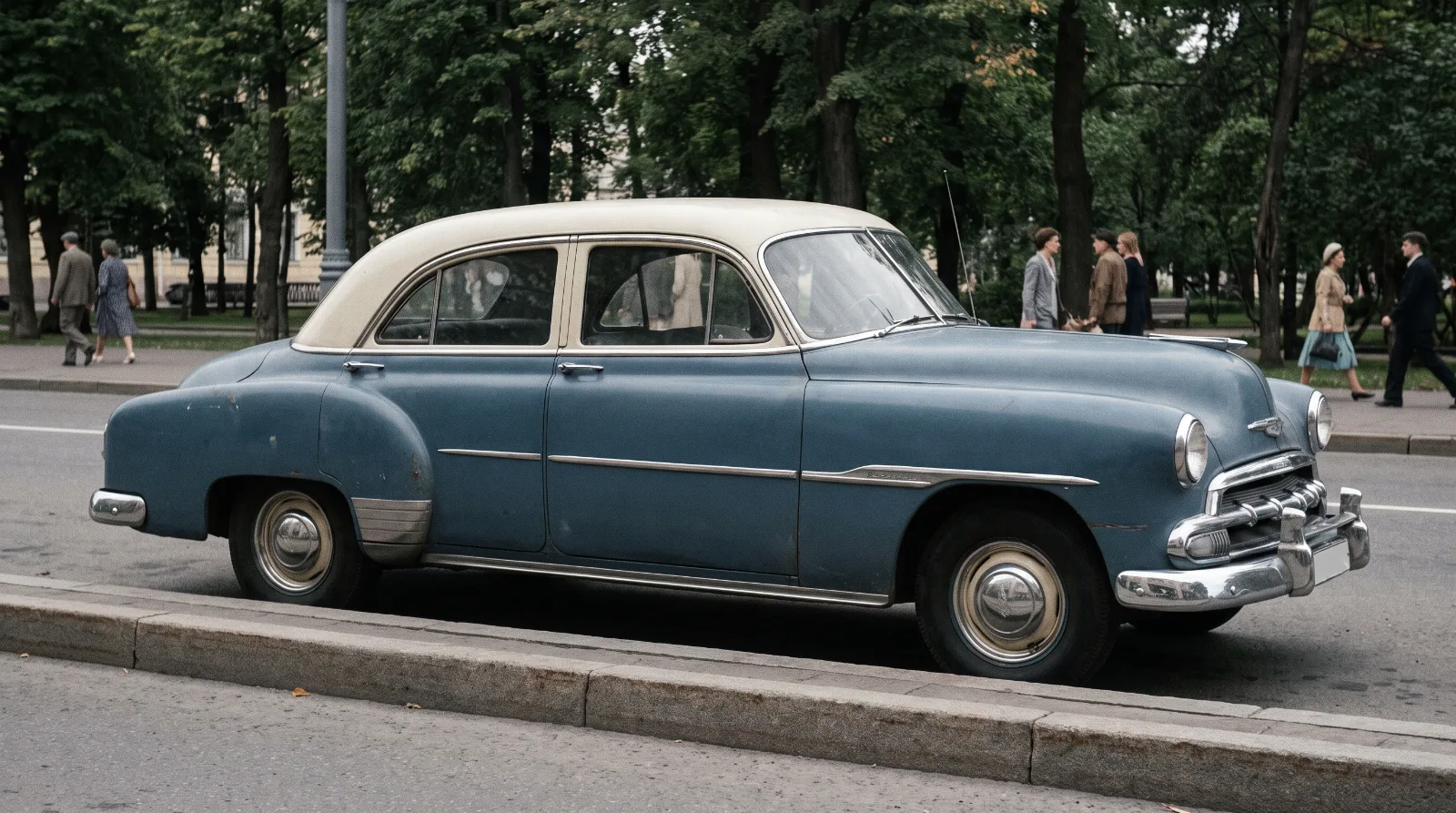
Somebody advertises a 1951 Chevrolet four door and you still do not know what they have. In 1951 Chevrolet sold four different four door sedans, in two series and two body shapes, at four different prices, and one of them outsold everything else the company made by a wide margin while another is now genuinely hard to find.
Sorting out which is which takes one look at the roof and one look at the trim.
The four of them
The two series are Special and De Luxe. The two body shapes are Styleline, which has a notchback roof and a separate boot, and Fleetline, which is the fastback with the roof sloping all the way to the tail. Every combination of those was available with four doors in 1951.
| Four door sedan | Price | Built |
|---|---|---|
| Styleline De Luxe | $1,680 | 380,270 |
| Styleline Special | $1,535 | 63,718 |
| Fleetline De Luxe | $1,680 | 57,693 |
| Fleetline Special | $1,600 | 3,364 |
Those numbers tell the whole story of the year. The Styleline De Luxe four door is the car America bought in 1951, at a rate of more than six to one over the next four door in the range. The Fleetline Special four door, at 3,364 cars, is the rarest ordinary Chevrolet of the year and most people restoring one have never seen another.
Telling them apart
Styleline against Fleetline is settled from thirty feet. Look at the back of the roof. If it steps down to a boot lid, it is a Styleline. If it runs in one continuous curve to the rear bumper, it is a Fleetline. There is no ambiguity and no in between.
Special against De Luxe is a trim question rather than a body one, and it is where advertisements get optimistic. The De Luxe carries more brightwork inside and out, better upholstery, and the details that made it worth an extra hundred and fifty dollars. The Special is the same car with less on it.
The check that settles it is not the badges, because badges are the easiest thing in the world to change. It is the serial number plate on the driver's door pillar, where the third character reads J for a Special and K for a De Luxe. After that, the style number on the Fisher body plate under the bonnet says which body the car actually left the factory as.
The other De Luxe giveaway is the transmission. Powerglide was a De Luxe option in 1951 and was never available on a Special. A Special with an automatic in it has been modified, and a genuine Powerglide car is a De Luxe by definition.
"Half the Specials I see advertised are described as De Luxes. Not because anybody is lying, mostly. Because somebody put De Luxe trim on it in 1963 and every owner since has repeated what he was told."
— Earl Dawson
Which one to buy
The honest answer is the one in the best condition, because on these cars the difference in restoration cost between a good shell and a bad one dwarfs the difference in value between the models.
That said, the four doors have a quiet advantage that people are only now noticing. They were always worth less than the coupes and convertibles, which means fewer of them were restored, which means the ones that survive are more often unrestored originals rather than cars that have been apart three times. If you want a Chevrolet of this era that has never been messed with, the four door sedan is where to look.
They are also the practical choice by a distance. Four doors, a proper boot on the Styleline, room for a family, and every mechanical part reproduced. The Fleetline four door trades some of the boot and a good deal of rear head room for the fastback roof, which is a fair swap if you want the shape and an annoyance if you do not.
Check this first
- The roof line. Notchback is Styleline, fastback is Fleetline, and it is not a matter of opinion.
- The third character of the serial number. J for Special, K for De Luxe, and it beats any badge.
- The style number on the cowl tag. The 2100 series is De Luxe, the 1500 series is Special.
- Whether it has Powerglide. A genuine one makes it a De Luxe, because the Special never had the option.
- Rear floors and the bottoms of all four doors. Twice as many doors is twice as many places for water.
- The boot floor on a Styleline and the rear valance on a Fleetline. Different bodies, different rust.
Where this fits
The two series behind these cars are the Styleline De Luxe and the Styleline Special, with the fastback versions in the Fleetline De Luxe and the Fleetline Special. The roof shape itself is in the fastback, the two door bodies above it in the coupe and the sport coupe, the sedan body in the 1951 sedan, and the shorter alternative is in the two door. The transmission that settles the series argument is in the Powerglide, the plate that settles it properly is in the serial numbers, and the year as a whole is in the 1951 Chevrolet.
Sources and notes
- 1951 Chevrolet De Luxe Series, conceptcarz - the Styleline four door sedan at $1,680 with 380,270 built, the Styleline two door at $1,630 with 262,933, the Fleetline four door at $1,680 with 57,693 and the Fleetline two door at $1,630 with 131,910, and the De Luxe line total of 1,064,896 split into 855,293 Styleline and 189,603 Fleetline.
- 1951 Chevrolet Special Series, conceptcarz - the Styleline Special four door sedan at $1,535 with 63,718 built, the two door at 75,566, the business coupe at $1,450 with 17,020, the sport coupe at $1,550 with 18,981, the Fleetline Special four door at $1,600 with 3,364 and the two door with 6,441, and a Special series total of 185,090.
- Chevrolet Fleetline, Wikipedia - the fastback as the only Fleetline body from 1949 through 1952, the 1951 production of 131,910 two door and 57,693 four door De Luxe Fleetlines, and 1952 reduced to 37,164 two door sedans alone before the name is dropped.
- Chevrolet postwar models, Classic Car Database - the 1951 range listed as Styleline De Luxe 2100 JK, Styleline Special 1500 JJ, Fleetline De Luxe 2100 JK and Fleetline Special 1500 JJ, each with its own sedan entries.
- Chevrolet model identification 1946-1954, The Old Car Manual Project - the K and J series letters separating De Luxe from Special on the serial number plate for 1949 to 1952 cars.
- Secrets of the Chevy Powerglide 1950-73, Mac's Motor City Garage - the Powerglide as the De Luxe option of these years, with the axle ratio changed to suit it.
More from the garage
Rebuilding a Chevy 216
Rebuilding a 216 is not like rebuilding anything made after about 1955, and the difference is not the tools. It is that on most engines the botto...
The 1951 Chevrolet Apache
There is no 1951 Chevrolet Apache. The Apache name belongs to the generation of Chevrolet trucks that came after the one built in 1951, and it do...
The 1951 Chevrolet Impala
There is no 1951 Chevrolet Impala. The name did not exist in 1951, the car did not exist in 1951, and nothing Chevrolet built that year was ever...