The 1951 Chevrolet COE
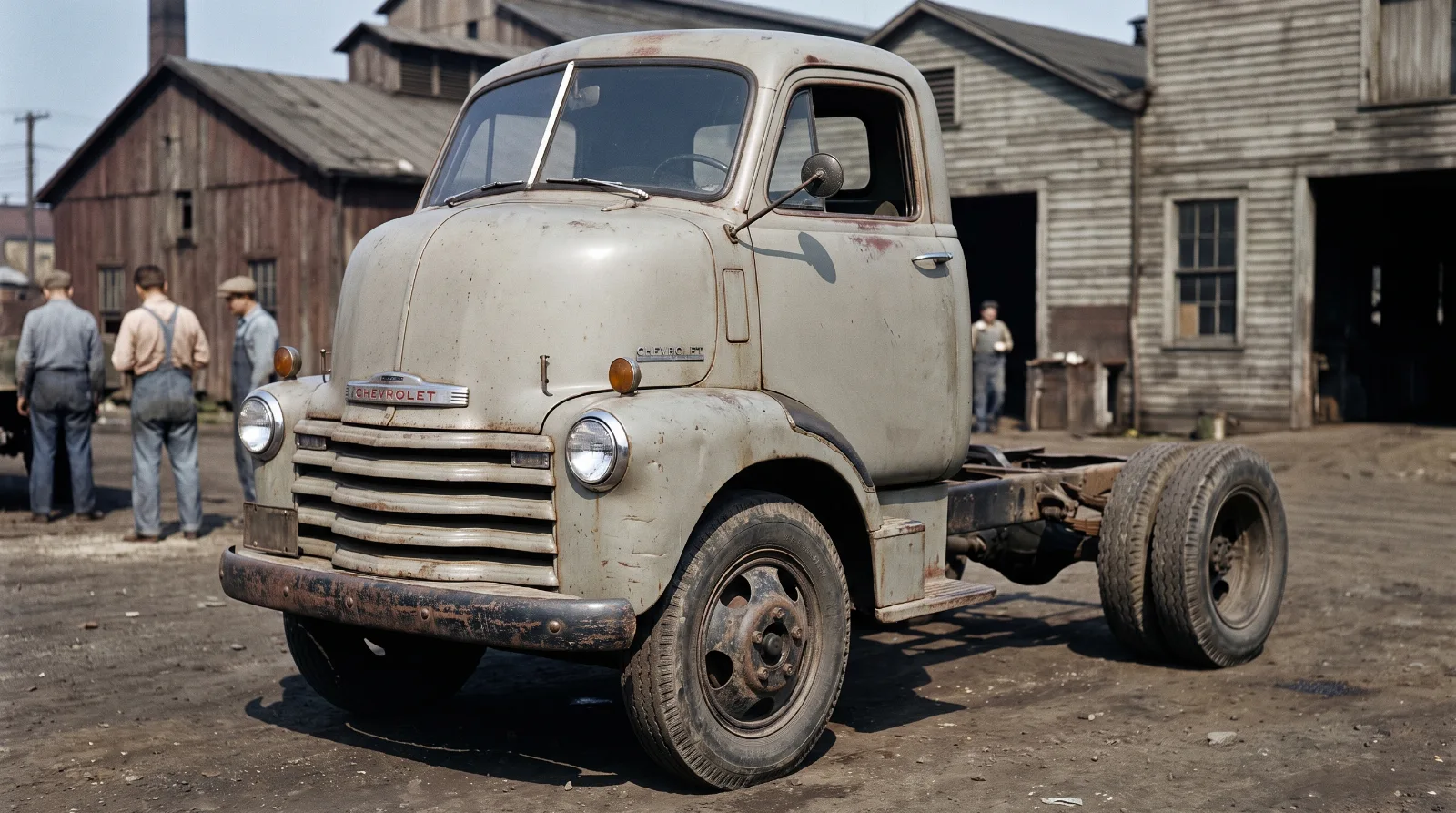
Take the Advance Design cab, put it on top of the engine instead of behind it, and you get one of the strangest looking vehicles Chevrolet ever sold: the cab over engine truck, sitting up in the air with its nose cut off and its bumper somewhere under the driver's feet.
They were built to solve a boring commercial problem and they are now among the most sought after trucks of the era, which is a fate nobody at Chevrolet would have predicted for a delivery vehicle.
What a COE is, and what it is not
The point of a cab over is length. City regulations and loading docks cared about the overall length of a truck, and putting the driver above the engine buys you several feet of body on the same overall dimension. That is the whole argument, and it is why cab overs were everywhere in urban delivery work and rare on farms.
For 1951 the Chevrolet cab overs are the 5100, 5400 and 5700, and the number tells you the wheelbase rather than the payload the way the light truck numbers do. The 5100 is the short wheelbase, the 5400 the medium and the 5700 the long. These sit above the 4100 and 4400 medium trucks, and well above the 3100, 3600 and 3800 that most people mean when they say Advance Design.
They are not light trucks with a different bonnet. A 1951 cab over is listed as a two ton with a 3.9 litre six of around 101 horsepower and a four speed gearbox, which is a different vehicle in every respect from a half ton pickup with a 216 and a column shift.
| Series | Wheelbase | Role |
|---|---|---|
| 5100 | Short | Cab over engine |
| 5400 | Medium | Cab over engine |
| 5700 | Long | Cab over engine |
| 4100 and 4400 | Short and medium | Conventional one and a half ton |
| 3100, 3600, 3800 | 116, 125.25, 137 in | Light trucks |
Living with the layout
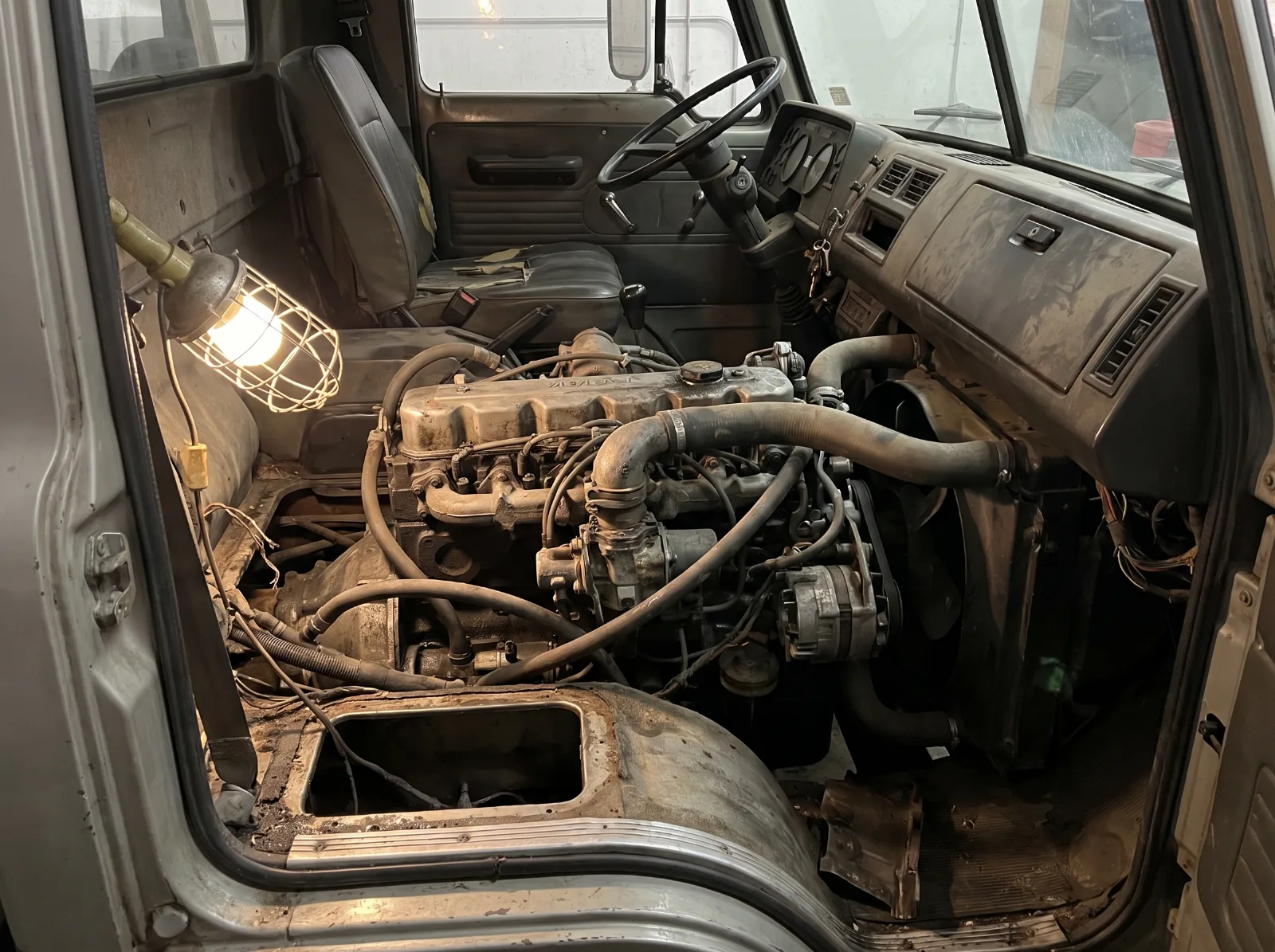
Putting the driver on top of the engine creates one obvious problem and several less obvious ones. The obvious problem is access: the engine is under the cab, and getting at it is a different proposition from lifting a bonnet.
The less obvious ones are about where everything else went. With the engine bay squeezed, the oil bath air cleaner had to be moved down and to the rear, and the horns, the oil filter, the handbrake lever and the wiper motor all ended up somewhere other than where they sit on a conventional truck. None of that is difficult once you know, and all of it is baffling if you are working from a manual for the wrong truck.
Heat is the other consequence. The engine is directly beneath the people, and cab overs of every make from this period are warm in summer in a way that is memorable rather than comfortable.
"Everybody who buys one buys it for the way it looks. Nobody buys a second one."
— Earl Dawson
Why so few are left
These were commercial vehicles owned by businesses, and businesses replace vehicles. A pickup could go to a farm and then to a son and then sit in a barn for forty years. A delivery truck went to a second operator, then a third, then to a scrapyard, and the ones that survived usually did so because they were parked in a field with a load still on them.
They were also worked far harder than a half ton ever was, and heavy trucks that have been worked are rarely in restorable condition. The survivors tend to be the ones that were doing something seasonal, stored between harvests rather than run every day.
The result is a truck that is genuinely rare, genuinely expensive to restore because almost nothing is reproduced for it, and genuinely spectacular when it is finished. That combination has made the cab over the show truck of the Advance Design world, which would have astonished the man who bought one to deliver bread.
Check this first
- Which series it is. 5100, 5400 or 5700, and the number is about wheelbase rather than payload.
- Whether you understand what a two ton truck costs to restore. Everything on it is bigger, heavier and less reproduced.
- The cab, on the assumption that nothing from a pickup will fit it. This is the single biggest trap.
- The floor and the steps. Getting in and out of a cab over wears these out and they are structural.
- Access to the engine before you buy. Have somebody show you how it is done, in person.
- What the truck was used for. Seasonal work stored under cover is why survivors survived.
Where this fits
The cab over is the outer edge of a family whose familiar members are in the truck range, starting with the 3100 half ton and running up through the three quarter ton and the one ton. The closed bodied delivery trucks that did the same commercial job at a smaller scale are in the panel truck and the canopy express. The cab it shares its styling with is in the five window cab, and parts sources are in the parts sources.
Sources and notes
- Talk page, Chevrolet Advance Design, Wikipedia - the series list identifying 5100 as the short wheelbase cab over engine truck, 5400 as the medium and 5700 as the long, with 4100 and 4400 as the one and a half ton conventionals above the 3100, 3600 and 3800 light trucks.
- Chevrolet Advance Design, Wikipedia - the cab overs using the same basic cab configuration and a similar grille with a shorter and taller bonnet and different wings, and the cab over cabs being incompatible with normal truck cabs while all conventional truck cabs interchanged.
- COE, Jim Carter Truck Parts - the limited room in the engine compartment forcing the oil bath air cleaner to the lower rear, the horns, oil filter, handbrake lever and wiper motor all relocated, and a 158 inch wheelbase example used for seasonal harvest work and stored between seasons.
- Chevrolet 5100/5400/5700 COE, 1951, car.info - the 1951 cab over listed as a two ton with a 3.9 litre petrol six of 101 horsepower and a four speed manual gearbox.
- Ready to haul, 1951 Chevrolet 5700 COE, Barn Finds - the 5700 as a heavy duty member of the Advance Design family built from 1947 to 1955, and the contrast drawn with the light half ton trucks most enthusiasts pursue.
- Car of the week, 1951 Chevrolet 3100 pickup, Old Cars Weekly - the half ton specification of 116 inches, 3,120 pounds, a 216.5 six and a three speed, for comparison against the two ton cab over.
More from the garage
Rebuilding a Chevy 216
Rebuilding a 216 is not like rebuilding anything made after about 1955, and the difference is not the tools. It is that on most engines the botto...
The 1951 Chevrolet Apache
There is no 1951 Chevrolet Apache. The Apache name belongs to the generation of Chevrolet trucks that came after the one built in 1951, and it do...
The 1951 Chevrolet Impala
There is no 1951 Chevrolet Impala. The name did not exist in 1951, the car did not exist in 1951, and nothing Chevrolet built that year was ever...