The Chevy 235 Carburetor
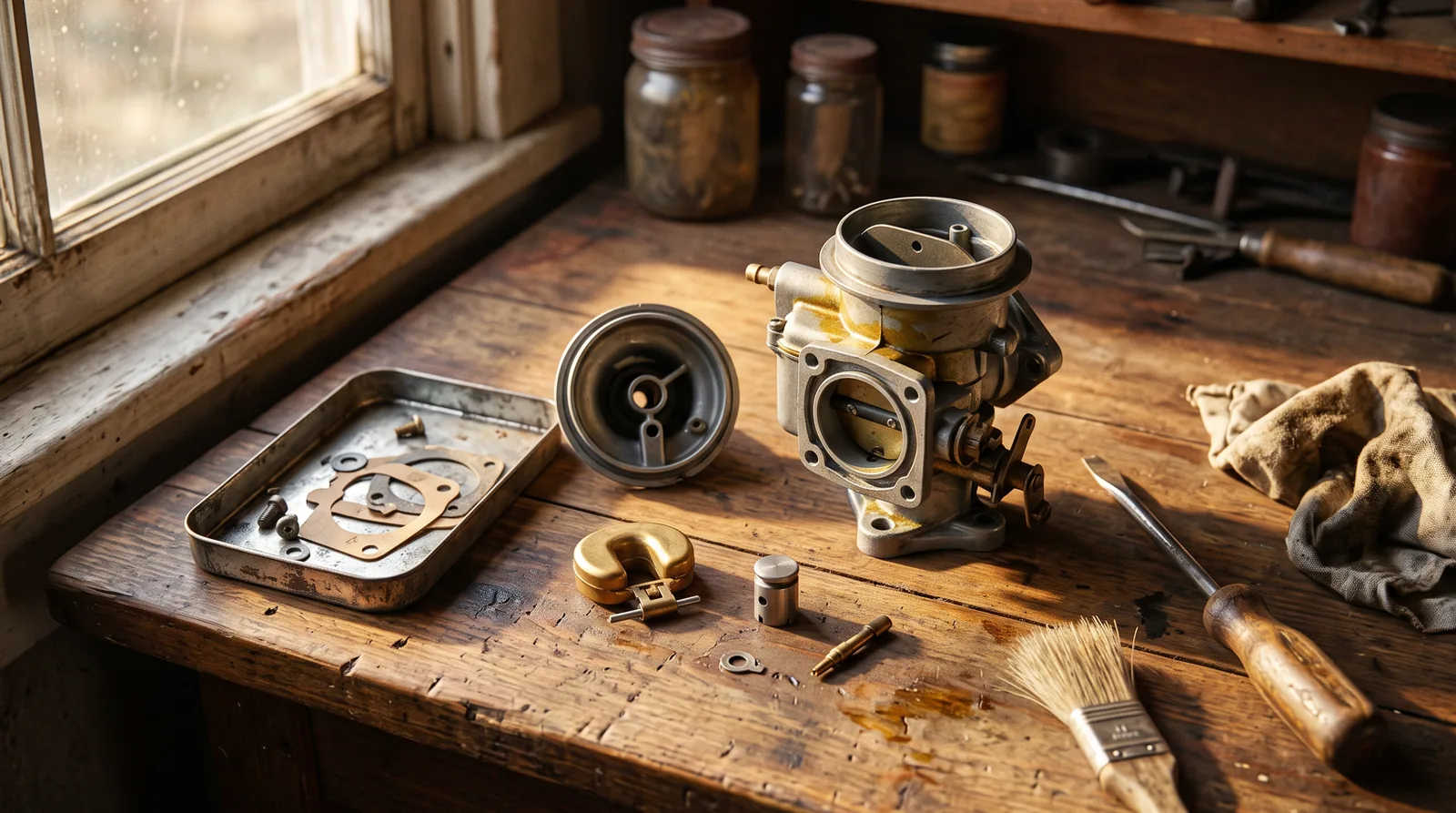
One barrel, a float bowl, an accelerator pump and a power piston. That is the whole of the Rochester B, and it is the carburettor on the front of a 1951 Chevrolet six whether that six is a 216 or a 235. It is about as simple as a carburettor gets, it is entirely rebuildable on a kitchen table, and almost everything that goes wrong with one comes down to three parts.
The catch is the one nobody warns you about: after seventy-five years of people swapping units between engines, the carburettor on your engine is very often not the carburettor that engine left the factory with. Sort that out before you order anything.
What it is and what fits what
Rochester built the Model B in one-barrel form for Chevrolet, GMC and Pontiac sixes from 1932 right through to 1962. The same basic family covers the 216, the 235 and the 261, and there are B, BC and BV variants across that run.
The important part is that a great many of them interchange. Which is convenient and is also exactly why you cannot assume. Over fifty years of repairs the correct unit was frequently not what got fitted, and GMC engines in particular often ended up wearing a Chevrolet 216 carburettor because that is what was on the shelf that day.
Identifying the one you have
This is the first job and it is less certain than you would like.
Roughly a third of these carburettors carry a metal identification tag under one of the top bolts. Another fifth or so have numbers stamped on the underside of the body assembly. That leaves close to half with no readable identification at all, in which case you are matching the rebuild kit to the year and engine of the vehicle rather than to the part in your hand.
So: look for the tag first, turn it over and look for a stamping second, and only then fall back to matching by application. And check what engine is actually in the car before you do any of that, because a 1951 with a later six in it needs the kit for the later engine.
"Half of these have no number on them anywhere. That is not a disaster, it just means you order by what the truck is rather than by what the carburettor says. What is a disaster is ordering by what the seller told you the engine was."
— Earl Dawson
What actually goes wrong
| Fault | What you see | How bad |
|---|---|---|
| Power piston sticking | Flat spots, poor enrichment under load | Serious. It is not readily available as a replacement part |
| Lost gold anodising | Green corrosion where steel fasteners meet bare metal | Cosmetic until it is not. Clean it properly |
| Butterfly valve slop | Rough idle, will not hold a setting | Fixable, but only take the butterflies out if the slop is genuinely excessive |
| Float trouble | Flooding, fuel smell, leaks | Common and entirely fixable with a correct setting |
The power piston is the one to be careful about. It and its spring are fragile and they are not something you can simply buy again, so the golden rule when the carburettor is apart is to handle that assembly as if it were the only one left in the world. Because as far as your afternoon is concerned, it is.
Setting the float, which is the whole rebuild
Everything else on a Rochester B is cleaning and reassembly. The float setting is the part where the numbers matter, and there are two of them, taken with the air horn inverted.
| Measurement | Figure |
|---|---|
| Float pontoon top to gasket, air horn upside down | 1 9/32 in |
| Gasket to float pontoon top, air horn inverted | exactly 1 3/4 in |
You get there by bending the small centre tabs, gently. Delicate is the word. Get both figures right and the carburettor will behave; get them wrong and you will chase a flooding problem for a month and blame the fuel pump.
Check this first
- Which engine is in the car. 216, early 235, later 235 or 261. The kit follows the engine, not the badge on the hood.
- The identification tag under the top bolts. About one in three has one. Look before you assume there is none.
- The underside of the body for a stamping. Another one in five hides its number there.
- Mounting flange bolt spacing against your manifold. If it is wrong, swap the base rather than the carburettor.
- The power piston, before anything else comes apart. If it is stuck, you need to know now, because it is the one part you may not be able to replace.
- Butterfly shaft play. Only pull the butterflies if there is real slop. Taking them out unnecessarily creates work.
Where this fits
A carburettor rebuild is the cheapest meaningful improvement you can make to one of these cars, and it is usually the first thing worth doing on an engine that has stood. Which engine is under your hood, and why it matters more than anything else on the car, is in the engine itself and the 235. The wider account of the drivetrain is in what was under the bonnet, and where fuel system work sits in a full job is in the guide to restoring one.
Sources and notes
- Rebuilding a Rochester B carb, DevesTechNet - the float bowl, power piston, accelerator pump and butterfly arrangement, the B, BC and BV variants differing in mounting flange bolt spacing and the advice to swap the base rather than discard the carburettor, roughly 30 per cent carrying an identification tag under the top bolts and another 20 per cent stamped on the underside, the float settings of 1 9/32 inch and exactly 1 3/4 inch with the air horn inverted, the fragility and unavailability of the power piston, lost gold anodising and green corrosion, butterfly slop, grinding screw ends before removal, spray gun cleaning kits for the small passages, and the warning about over-applying gasket sealer.
- 1950-1962 rebuild kit for Rochester carburetor, six cylinder Chevrolet pickup truck, Jim Carter Truck Parts - the Rochester one-barrel Model B and BC fitted to 1932 to 1962 Chevrolet and GMC sixes including the 216 and 235, how widely the units interchange, and the warning that the correct unit was often not used as a replacement over the last fifty years, so the carburettor must be checked before a kit is ordered.
- Chevrolet Stovebolt engine, Wikipedia - the single barrel downdraught carburettor on the 216 and 235 sixes, and the engine families this carburettor served.
- Stovebolt 6 engine history and information, Restore An Old Car - the 216 and 235 as the engines this carburettor sat on, and what separates them.
- 1951 Chevy truck parts, Chevs of the 40s - a year-organised catalogue covering fuel system and engine parts for the 1951 six.
- 1947-55 Chevrolet GMC Advance Design trucks, Jim Carter Truck Parts - carburettor kits among the ordinary catalogue items for these engines, and the general breadth of the parts supply.
More from the garage
Rebuilding a Chevy 216
Rebuilding a 216 is not like rebuilding anything made after about 1955, and the difference is not the tools. It is that on most engines the botto...
The 1951 Chevrolet Apache
There is no 1951 Chevrolet Apache. The Apache name belongs to the generation of Chevrolet trucks that came after the one built in 1951, and it do...
The 1951 Chevrolet Impala
There is no 1951 Chevrolet Impala. The name did not exist in 1951, the car did not exist in 1951, and nothing Chevrolet built that year was ever...