The 1951 Chevrolet Cooling System
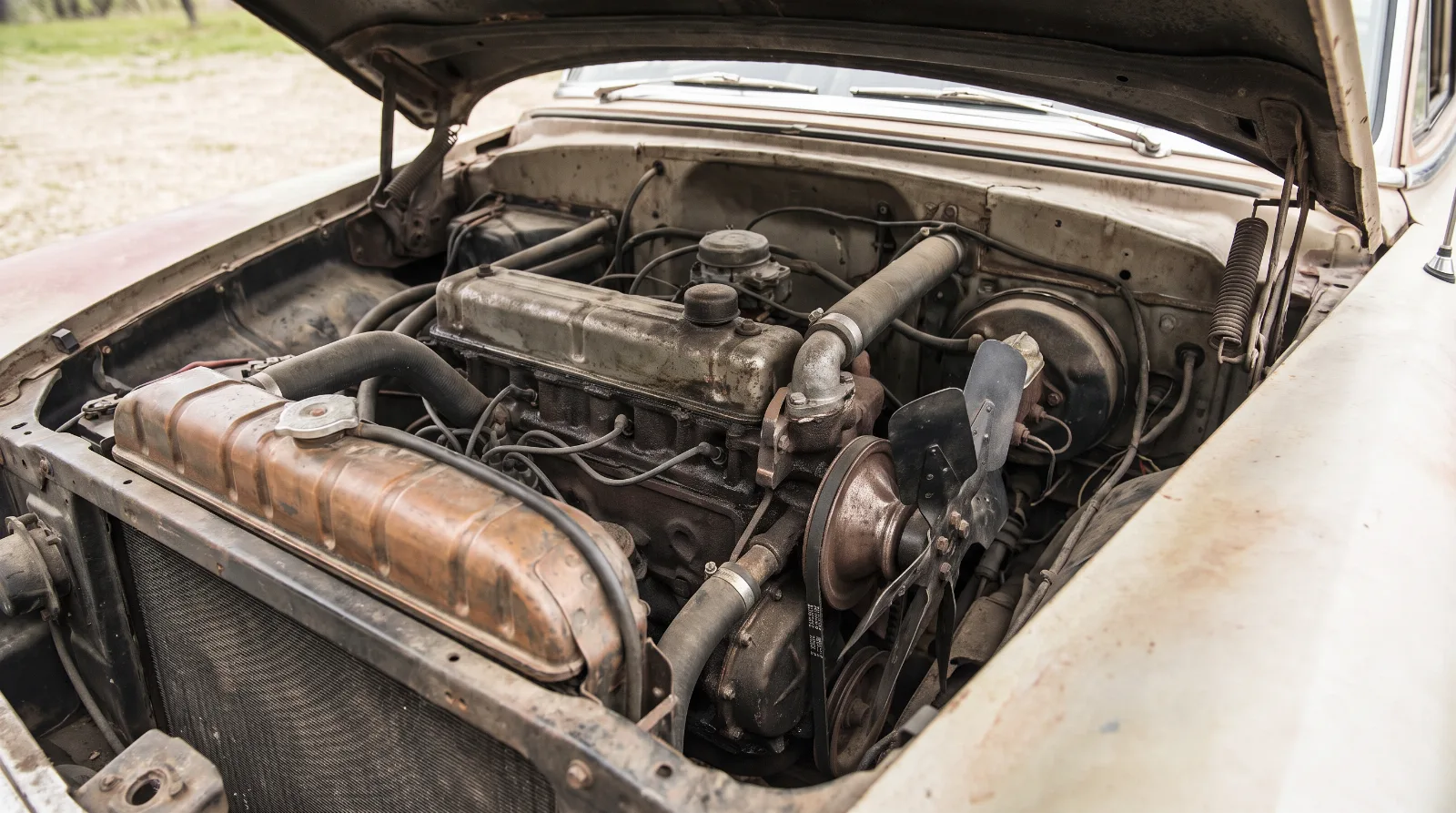
Fifteen quarts. Sixteen if the car has a heater. That is what the cooling system on a 1951 Chevrolet holds, and it is a useful number to lead with because it tells you two things at once: this is a big, slow, low-pressure system, and there is a lot of it to go wrong quietly over seventy-five years.
Most overheating complaints on these cars are not the radiator. They are the last owner but three, and what he did or did not do about the inside of the block.
What the system is
A cast iron block and a cast iron head, a belt-driven water pump, a thermostat, a radiator with a lot of capacity and not much pressure, and a fan bolted to the pump. There is no expansion tank, no electric fan, no sensor telling a computer anything. The temperature gauge on the dash is not even electrical: it is a sealed copper capillary tube with alcohol inside, expanding as the coolant heats it.
| Item | Figure |
|---|---|
| Cooling system capacity, no heater | 15 quarts |
| Cooling system capacity, with heater | 16 quarts |
| Engine | 216.5 cu in six, cast iron block and head |
| Water pump | Belt driven, fan mounted to it |
| Temperature reading | Mechanical, sealed capillary tube to the dash |
Where the heat actually stays
The water jacket in a cast iron block collects sediment for decades, and it collects it lowest and thickest at the back of the engine, furthest from where anybody ever looks. Rust scale, casting sand that never came out in 1951, and whatever settled out of seventy-five years of tap water.
The result is an engine that cools adequately at speed and creeps up in traffic, or one that runs fine for twenty minutes and then loses its temper. People fit a new radiator, then a new water pump, then a new thermostat, and the car still does it, because the restriction was never in any of those parts.
The honest fix is to get the block clean, which on a serious case means the core plugs out and a proper job rather than a bottle of something poured in the top.
"Three parts get replaced before anybody takes a core plug out and looks at what is behind it. I have seen a block with an inch of scale in the back corner running a radiator that was two months old. Guess which one was the problem."
— Earl Dawson
The things that genuinely do fail
The water pump. A belt-driven pump with a shaft seal and a bearing, and both wear. A weep hole dripping, or play when you rock the fan, is a pump telling you it is finished. It is a catalogue item and not expensive.
The radiator core. Not usually blocked from the outside, but blocked internally by the same sediment that lives in the block. A radiator shop can tell you in a minute whether it is worth cleaning or recoring.
Hoses, and everything that clamps them. Ordinary maintenance and the cheapest thing on this list.
The thermostat. Cheap, easy, and worth changing on any car whose history you do not know. What people get wrong is removing it altogether to cure overheating. That usually makes things worse, because coolant then moves through the radiator too fast to give up its heat.
Check this first
- How hot, and when. Hot in traffic and fine at speed points at airflow and circulation. Hot everywhere points at the block or the radiator core.
- Play in the fan, and the pump weep hole. Thirty seconds and it either clears the pump or condemns it.
- What the last flush actually consisted of. On a fifteen quart system, a hose through the top of the radiator is not a flush.
- Whether the thermostat is present. Somebody having removed it is a clue to a problem that was never solved.
- Behind a core plug, on a persistent case. This is the diagnosis nobody wants to do and it is usually the one that ends the argument.
- The temperature gauge itself. Sealed capillary tube. If it has been kinked or crushed the gauge is dead and the engine may be perfectly happy.
Where this fits
The cooling system is the part of the car most often blamed for problems it did not cause, and the engine it serves is the reason. Where cooling sits among everything else under the bonnet is in the 1951 engines. What the 216 is, and why it wants to be treated gently rather than pushed, is in the Chevy 216 engine, with every capacity and clearance in the 216 specifications. The needle reporting all of this to you is explained in the 1951 gauges, and where cooling work sits in the order of a full job is in the order of a full job.
Sources and notes
- Chevrolet 216 specs, It Still Runs - the cooling system capacity of 15 quarts without a heater and 16 quarts with one, alongside the 5 quart sump and 16 gallon fuel tank.
- 1947-53 Chevy truck gauges, 1952chevytruck.com - the temperature gauge as a sealed copper capillary tube whose alcohol expands under coolant heat to move the pointer, and the failure modes of that tube.
- Chevrolet Stovebolt engine, Wikipedia - the 216.48 cubic inch cast iron block and head that this system cools, and its compression and output.
- 1951 Chevy truck parts, Chevs of the 40s - the cooling and radiator category catalogued by model year, and what is reproduced for it.
- 1947-55 Chevrolet GMC Advance Design trucks, Jim Carter Truck Parts - cooling and radiator parts among the ordinary catalogue items for these vehicles, and the general breadth of the supply.
- Stovebolt 6 engine history and information, Restore An Old Car - the cast iron Stovebolt six this system was built around, and what separates the 216 from the later 235.
More from the garage
Rebuilding a Chevy 216
Rebuilding a 216 is not like rebuilding anything made after about 1955, and the difference is not the tools. It is that on most engines the botto...
The 1951 Chevrolet Apache
There is no 1951 Chevrolet Apache. The Apache name belongs to the generation of Chevrolet trucks that came after the one built in 1951, and it do...
The 1951 Chevrolet Impala
There is no 1951 Chevrolet Impala. The name did not exist in 1951, the car did not exist in 1951, and nothing Chevrolet built that year was ever...