1951 Chevrolet Suspension
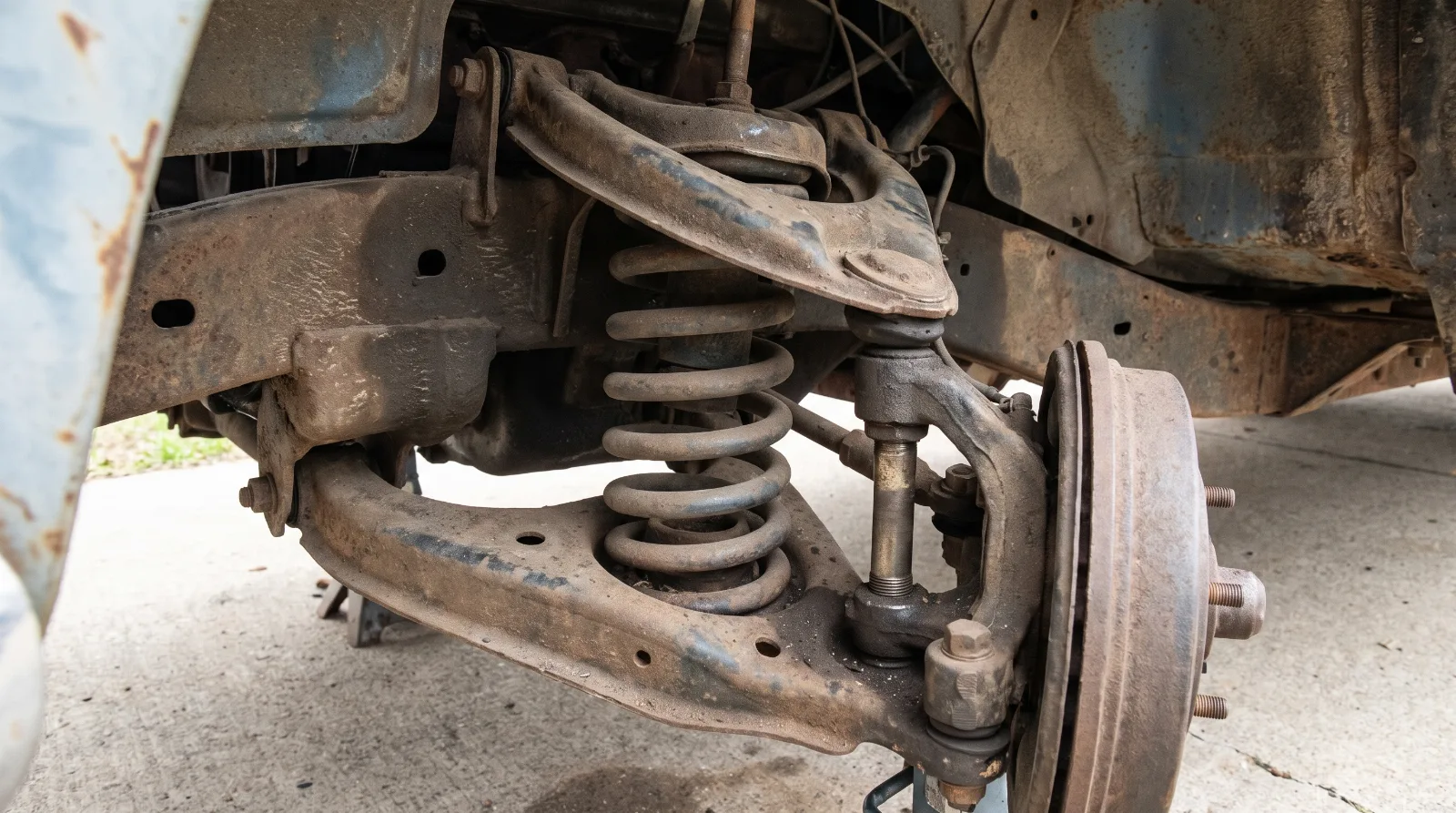
Independent front suspension on a low priced car was not a given in 1951. Chevrolet had been building it since 1939 and by the time this car was made they had the design settled: unequal length control arms, a coil spring on each side, a king pin carrying the spindle, a stabiliser bar across the front, and telescopic shock absorbers instead of the lever type units the company used before 1949.
The back of the car is the opposite kind of engineering. Semi-elliptic leaf springs, an axle inside a torque tube, and nothing else. It is about as simple as a rear suspension gets, and it lasts accordingly.
The front end, part by part
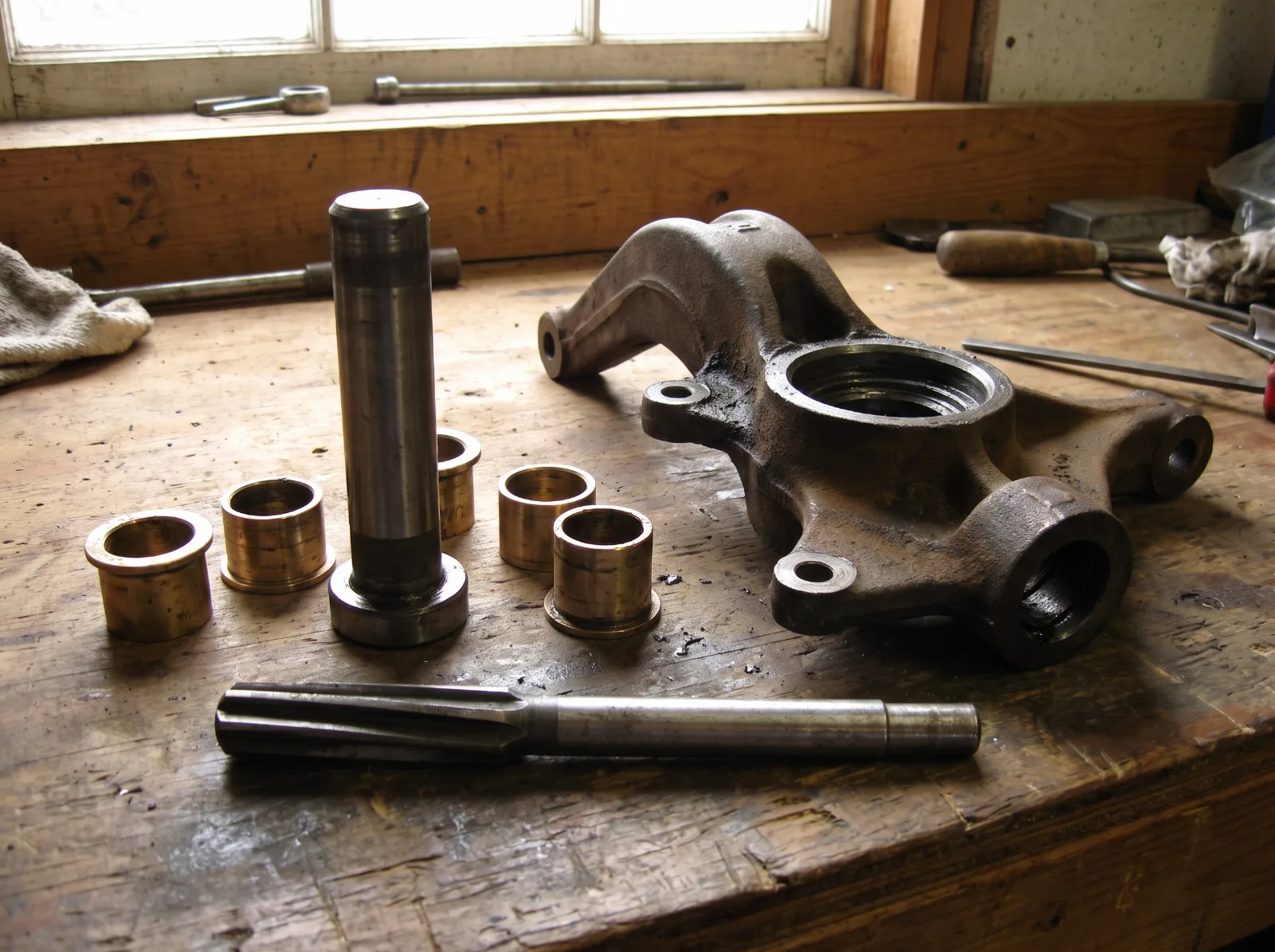
Each side has an upper and a lower control arm pivoting on shafts in bushings, with a coil spring between the lower arm and the frame. The outer ends carry a king pin, and the spindle swings on that pin through bushings. Not a ball joint. Ball joints arrived at Chevrolet in 1955, which means every front end job on a 1951 car is a king pin job whether the owner expected one or not.
The pin itself has been the same part since 1939 and stayed the same through 1954: .866 inch across and 5.31 inches long, catalogued for cars fitted with what the trade still calls knee action suspension. It is a cheap component. The labour is what costs, because the bushings in the spindle have to be reamed to the pin after they go in.
| Item | 1951 Chevrolet |
|---|---|
| Front suspension | Independent, unequal control arms, coil springs |
| Spindle pivot | King pin, .866 in x 5.31 in |
| Front anti-roll | Stabiliser bar |
| Shock absorbers | Telescopic, from 1949 onward |
| Rear suspension | Semi-elliptic leaf springs |
| Axle location | Torque tube |
| Weight it carries | About 3,400 lb |
Why the ride goes off, and what it is not
A tired 1951 Chevrolet does three things: it wallows, it wanders, and it clunks over expansion joints. Owners tend to read all three as worn out springs and start pricing new coils. Springs are usually the last thing on the list.
Bushings. The control arms pivot on shafts running in bushings, and those bushings are seventy five years old. When they are shot the geometry moves under load, which is felt as wander and as the car changing its mind mid corner.
King pins. The classic test is to jack the front and rock the wheel with hands at the top and the bottom. Movement there is the pin, its bushings, or the wheel bearings, and all three feel identical from the driver's seat. This is also the wear that gets blamed on the steering box, because it produces exactly the same vagueness at the wheel that a loose idler arm does.
Shocks. Telescopic units that have not been changed since somebody wore a hat to drive. They are inexpensive and they are the single biggest change to how the car feels on a bad road.
Grease. The whole front end is designed around a grease gun and a schedule that nobody has kept. A dry king pin is stiff, noisy, and indistinguishable from a dead one until you grease it and drive the car.
"I tell people to spend twenty minutes with a grease gun and then drive it a week before they order a single part. Half the front ends I have been asked to quote on came back off the list."
— Earl Dawson
The back of the car, and why it never gives trouble
Semi-elliptic leaf springs, shackled at one end, with the axle sitting on them. What makes this layout easy is the torque tube: the tube takes the driving and braking torque of the axle into the frame through its own mounting, so the springs are not being asked to control axle wrap the way they would on an open driveline car. They locate the axle sideways and they carry the weight, and that is all they do.
The practical consequence is that the rear suspension on these cars is usually the healthiest part of the chassis. What does wear is the rubber: spring eye bushings, shackle bushings, and the bump stops. They are cheap, they are the source of most rear end clunks, and the only reason people leave them is that getting at them means going under the car.
The one thing worth knowing before you start modifying anything back there is that the springs and the torque tube are a package. Convert the car to an open driveline and the rear springs suddenly have to do a job they were never designed for, which is why that conversion always comes with a spring decision attached to it.
Check this first
- Grease every fitting, then drive it a week. The cheapest diagnostic on the car, and it removes half the suspects.
- Rock each front wheel top and bottom. King pins, king pin bushings, or wheel bearings, and you want to know which before quoting.
- Rock each front wheel side to side. That is the steering linkage, not the suspension, and the two get confused constantly.
- Look at the control arm bushings with the weight off. Cracked, split or missing rubber explains wander that no alignment will cure.
- Bounce each corner. More than one rebound means the shocks are finished.
- Check what transmission the car has before ordering front springs. Powerglide cars take the other part number.
Where this fits
Suspension is one of the four systems under this car and they are set out together in the 1951 chassis. The wear that gets blamed on the gearbox is sorted out in the steering, and since the front drums have to come off to reach the king pins, the braking system belong in the same weekend. What the tube at the back is doing is in the enclosed driveline, and what it drives is in the rear axle. The order of a full job is in the restoration sequence.
Sources and notes
- 1951 Chevrolet Styleline De Luxe Series 2100 JK specifications, Classic Car Database - independent coil spring front suspension and semi-elliptic leaf springs at the rear, on a 115 inch wheelbase car, the De Luxe convertible weighing 3,380 pounds.
- Chevrolet De Luxe, Wikipedia - the front stabiliser bar, and the move from lever type shock absorbers to telescopic units beginning with the 1949 cars.
- Front suspension king pins, Chevs of the 40s - the king pin catalogued for knee action equipped cars from 1939 to 1954, .866 inch outside diameter by 5.31 inches long.
- Front suspension springs, Chevs of the 40s - the two front coil spring applications, one covering Powerglide cars, 1949 to 1952 convertibles and all 1953 to 1954 cars, the other covering independent front suspension cars from 1939 to 1952 that are neither.
- Front suspension parts, Chevs of the 40s - the front end broken down into control arm shafts and pins, bushings, king pins, rebuild kits, rubber bumpers, shocks, springs, sway bar and U-bolts.
- Steering box, 1950 Chevy coupe, Vintage Chevrolet Club forum - front end pins and bushings wearing the way king pins do when lubrication stops, and the mileage a properly greased bushing will give.
More from the garage
Rebuilding a Chevy 216
Rebuilding a 216 is not like rebuilding anything made after about 1955, and the difference is not the tools. It is that on most engines the botto...

The 1951 Chevrolet Apache
There is no 1951 Chevrolet Apache. The Apache name belongs to the generation of Chevrolet trucks that came after the one built in 1951, and it do...
The 1951 Chevrolet Impala
There is no 1951 Chevrolet Impala. The name did not exist in 1951, the car did not exist in 1951, and nothing Chevrolet built that year was ever...