The 1951 Chevrolet Gasser
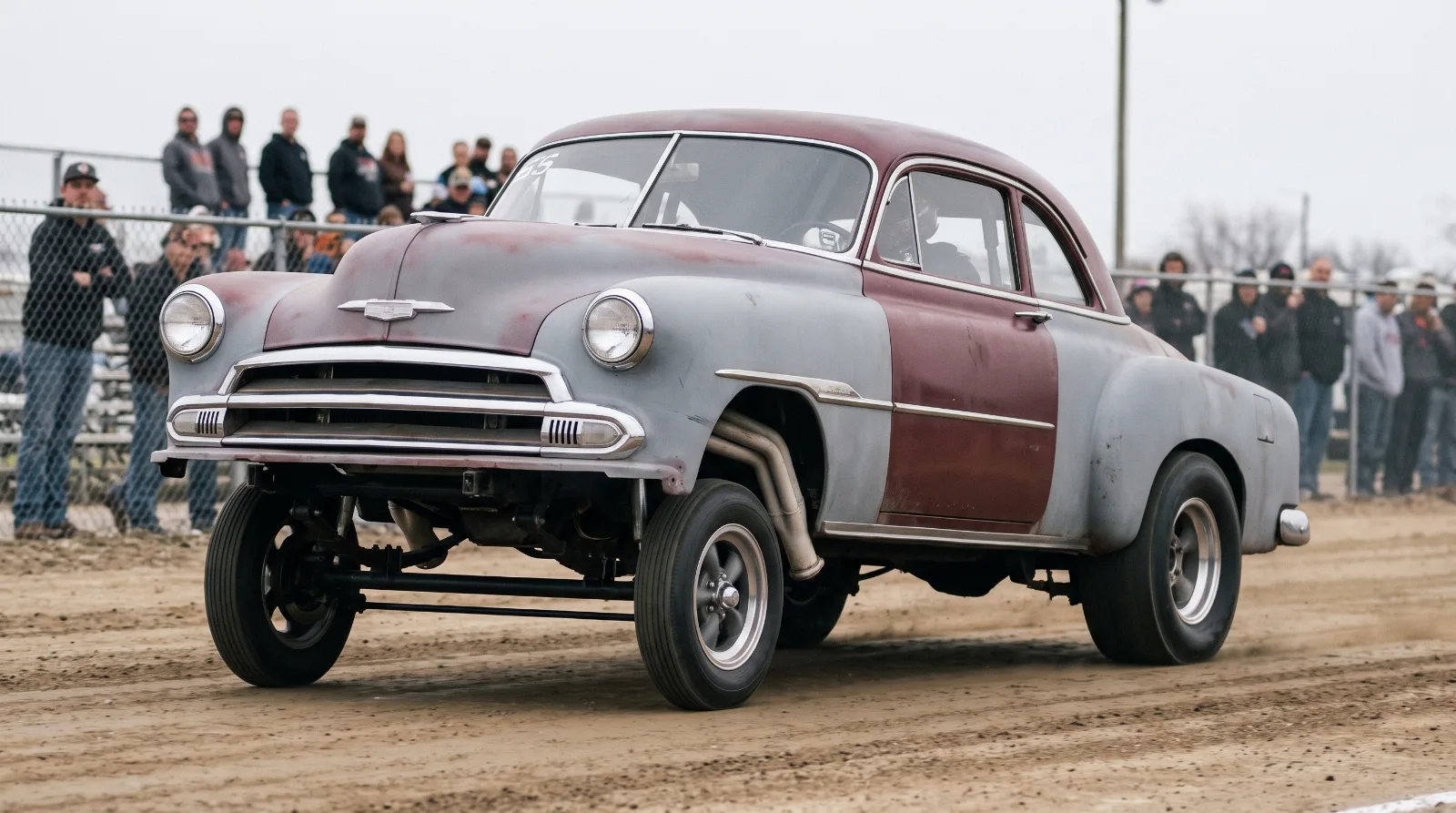
A gasser sits nose up, on skinny front tyres and fat rear slicks, with more engine than the body was ever meant to hold. It looks wrong from every angle and every part of it is there for one reason: getting weight onto the back wheels in the first sixty feet.
A 1951 Chevrolet is not the classic gasser shell, but it was used, and understanding why means understanding that the whole thing was a rulebook before it was a look.
What a gasser actually was
The name comes from the National Hot Rod Association's Gas Coupe and Sedan classes, run through the 1950s and 1960s. Cars were sorted by dividing weight by engine displacement, with an adjustment for supercharging, and that ratio put you in A/Gas, B/Gas and so on down the alphabet, with the lightest bodies and biggest engines at the top.
So the class rewarded one thing above all: a light body with a lot of engine in it. That is why the celebrated gassers are Willys coupes, Ford Anglias and Henry J's, cars that are short, tall and easy to overpower. Short wheelbases transfer weight better, and tall bodies put the mass higher up.
The era runs roughly from 1958 to 1968, with the peak in the middle sixties. After that the classes changed and the style became something people built because they liked it rather than because a rulebook made them.
| Element | Purpose |
|---|---|
| Straight front axle | Raises the front, moving the centre of gravity up and back |
| Nose high stance | Longer lever arm to rotate weight onto the slicks |
| Stripped interior | Weight, which sets the class |
| Largest possible engine | The other half of the class formula |
| Slicks and skinny fronts | Traction behind, minimum rolling drag in front |
| Headers through the wings | Nowhere else for them to go |
The 1951 Chevrolet as a gasser
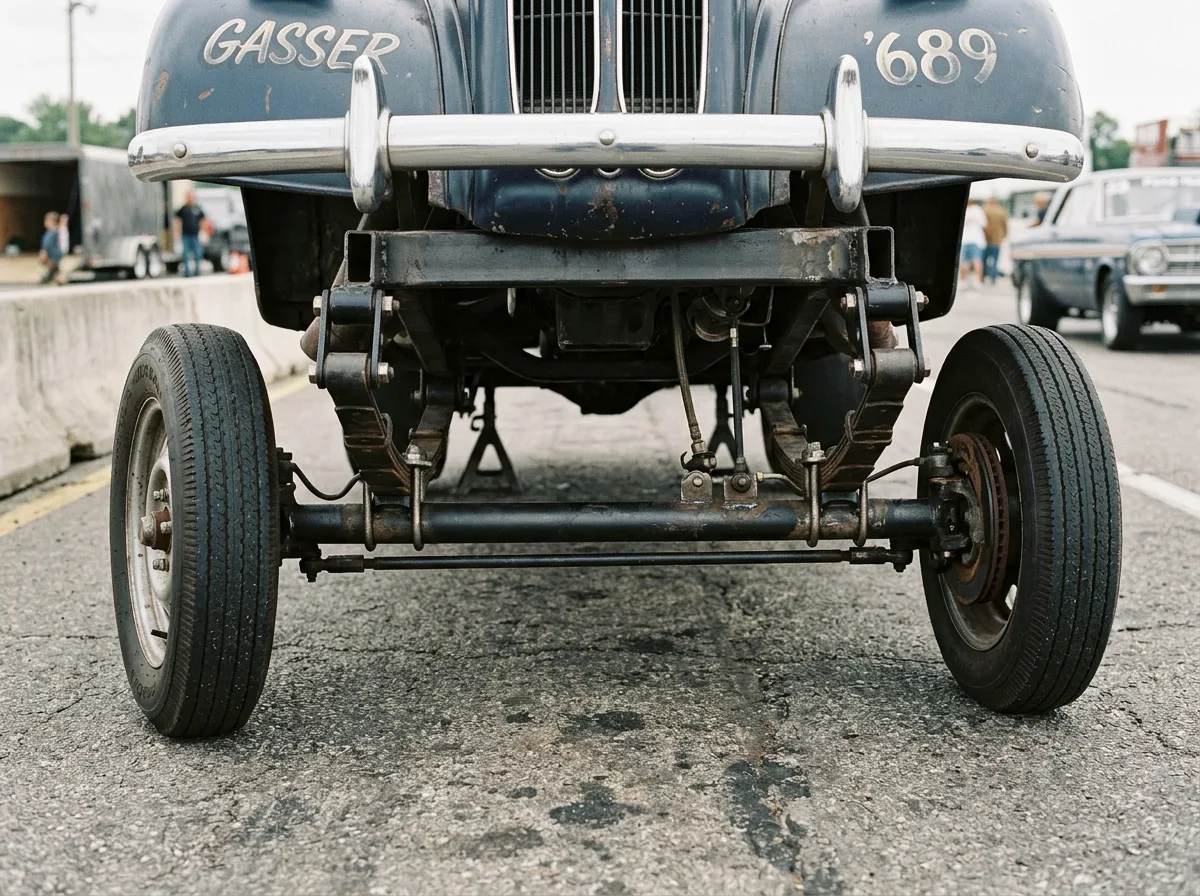
On the class formula, this car is not an obvious candidate. It is long, it is heavy, and its wheelbase is 115 inches against the eighty odd inches of an Anglia. Everything the rulebook rewarded, this car has the wrong amount of.
What it had instead was availability. A used 1951 Chevrolet in 1962 was one of the cheapest cars in America, mechanical parts were everywhere, and the body is simple to work on. For somebody building a car for the lower gas classes rather than chasing A/Gas, that mattered more than a theoretical advantage in weight transfer.
It also has a shape that suits the stance. The heavy, rounded body with its low waistline looks purposeful with the nose in the air in a way that a lighter, more delicate car does not, which is why the modern gasser style revival has taken to these cars far more than the original classes ever did.
"Nobody was winning A/Gas in a Fleetline and nobody was trying to. They built what was sitting in the yard, and half the fun of the gas classes was that the rules let you."
— Earl Dawson
Building one now
Almost every gasser built today is a style exercise rather than a class car, and there is nothing wrong with that as long as everybody says so. What it means practically is that you can pick which parts of the recipe you want, and the ones worth taking seriously are the ones that affect whether the car works.
The straight axle is the big decision. It replaces the original independent front suspension entirely, which means new steering, new brakes at the front, and geometry that has to be worked out rather than inherited. It is the point of no return on the car and it is not reversible in any practical sense.
The engine changes everything downstream. A V8 in a 1951 Chevrolet drags the steering box, the driveline and the electrical system into the job, exactly as it does in any other version of this swap. The original torque tube has to go, which is the real fabrication.
The brakes are the part nobody talks about. Four drums on a single hydraulic circuit was adequate for ninety two horsepower. It is not adequate for four hundred, and a straight axle conversion means you are choosing the front brakes anyway.
And the honest note: this is the most irreversible of the four custom traditions. A lowered car can be raised, a rat rod can be painted, but a car cut for a straight axle is a gasser for the rest of its life. Start with one that has already been modified.
Check this first
- Whether the car has already been cut. This build is permanent and there are plenty of altered cars about.
- The frame, everywhere. A straight axle puts loads into the rails that the factory never planned for.
- What is happening to the front brakes. You are choosing them as part of the axle, so choose properly.
- Whether the driveline plan is thought through. The torque tube has to go and something has to replace it.
- Whether you want a class car or the look. They are different projects with different budgets.
- Where it will actually be driven. A nose high car on skinny fronts is a specific experience on a public road.
Where this fits
The gasser is one of four traditions mapped in the 1951 Chevrolet custom, and it sits at the opposite end from the lowrider. The engine question is in the V8 swap, the front suspension it replaces is in the springs and king pins, and the driveline it has to deal with is in the torque tube. The brakes that need rethinking are in the brakes and going to discs, and the standard car is in the standard car.
Sources and notes
- What is a gasser, Speedway Motors - the name coming from the NHRA Gas Coupe and Sedan classes of the 1950s and 1960s, the weight divided by displacement formula with a supercharger adjustment producing A/Gas down through the alphabet, the straight axle raising the centre of gravity up and rearward to lengthen the lever arm and load the slicks, the stripped interiors and maximum engine, the era of roughly 1958 to 1968 peaking in the mid sixties, and the preference for short, tall Willys coupes, Anglias and Henry J's.
- 1951 Chevrolet Styleline De Luxe Series 2100 JK, Classic Car Database - the 115 inch wheelbase, the 3,380 pound weight of the convertible coupe, the independent coil front suspension a straight axle would replace, and the eleven inch drums on all four corners.
- CP-1109 small block Chevy V8 engine mounting kit for 1949-1954 Chevy, Chassis Engineering - the frame braces that have to be cut for engine mounting, the removal of the original engine, transmission and rear end, and the small block range the kit covers.
- 1951 Chevrolet De Luxe Series, conceptcarz - the production scale that made these cars cheap and available to anybody building for the lower gas classes a decade later.
- 1949-1952 Chevrolet Styleline and Fleetline, specs and history, Motogallery - the standard performance of these cars, with nought to sixty in the low twenty second range and a top speed in the low to mid eighties.
- Rat rod, Wikipedia - the surrounding custom vocabulary and the distinction between period recreation and modern style building, which is the same distinction a modern gasser build has to make.
More from the garage
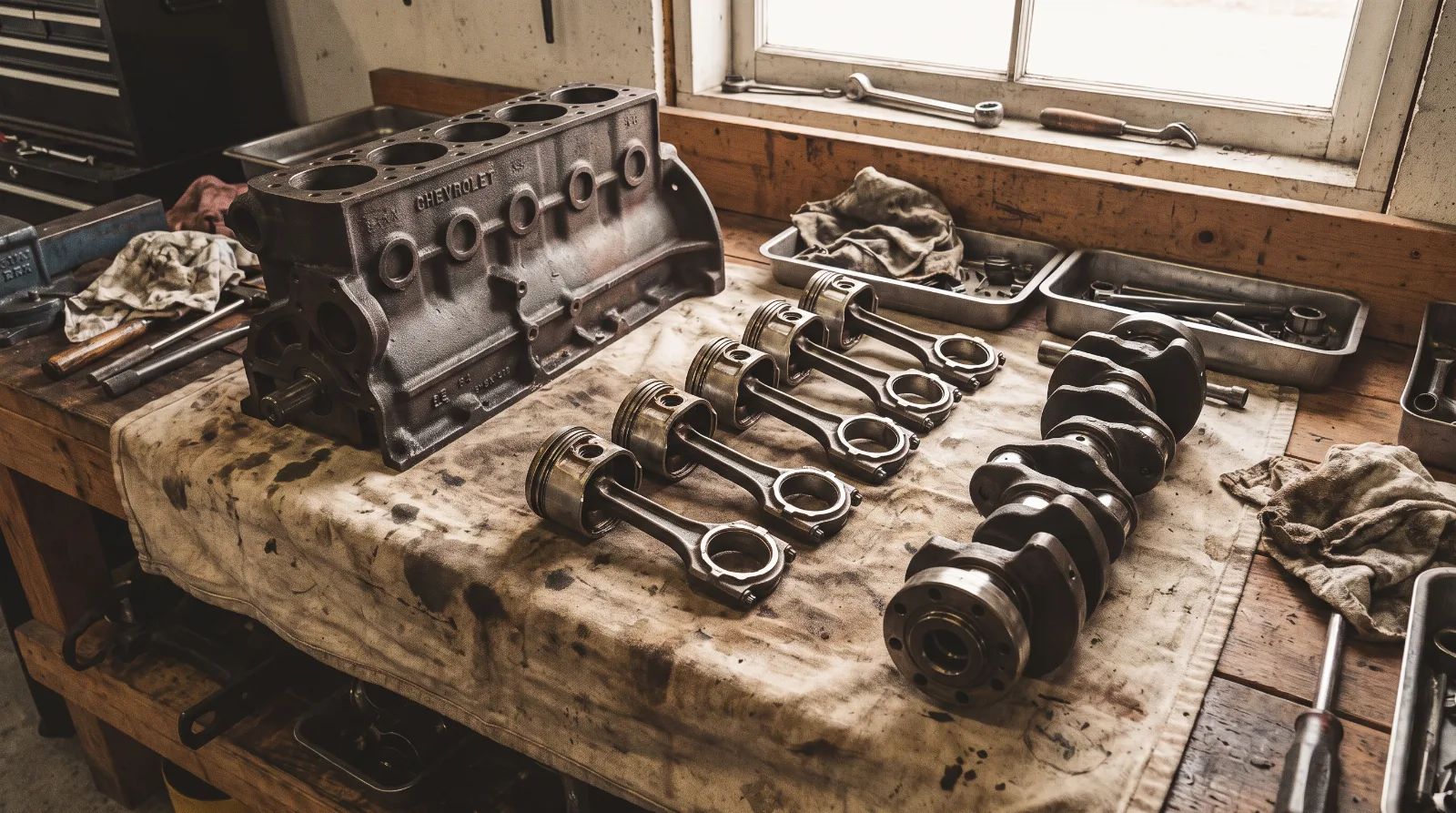
Rebuilding a Chevy 216
Rebuilding a 216 is not like rebuilding anything made after about 1955, and the difference is not the tools. It is that on most engines the botto...
The 1951 Chevrolet Apache
There is no 1951 Chevrolet Apache. The Apache name belongs to the generation of Chevrolet trucks that came after the one built in 1951, and it do...
The 1951 Chevrolet Impala
There is no 1951 Chevrolet Impala. The name did not exist in 1951, the car did not exist in 1951, and nothing Chevrolet built that year was ever...