Powerglide Identification
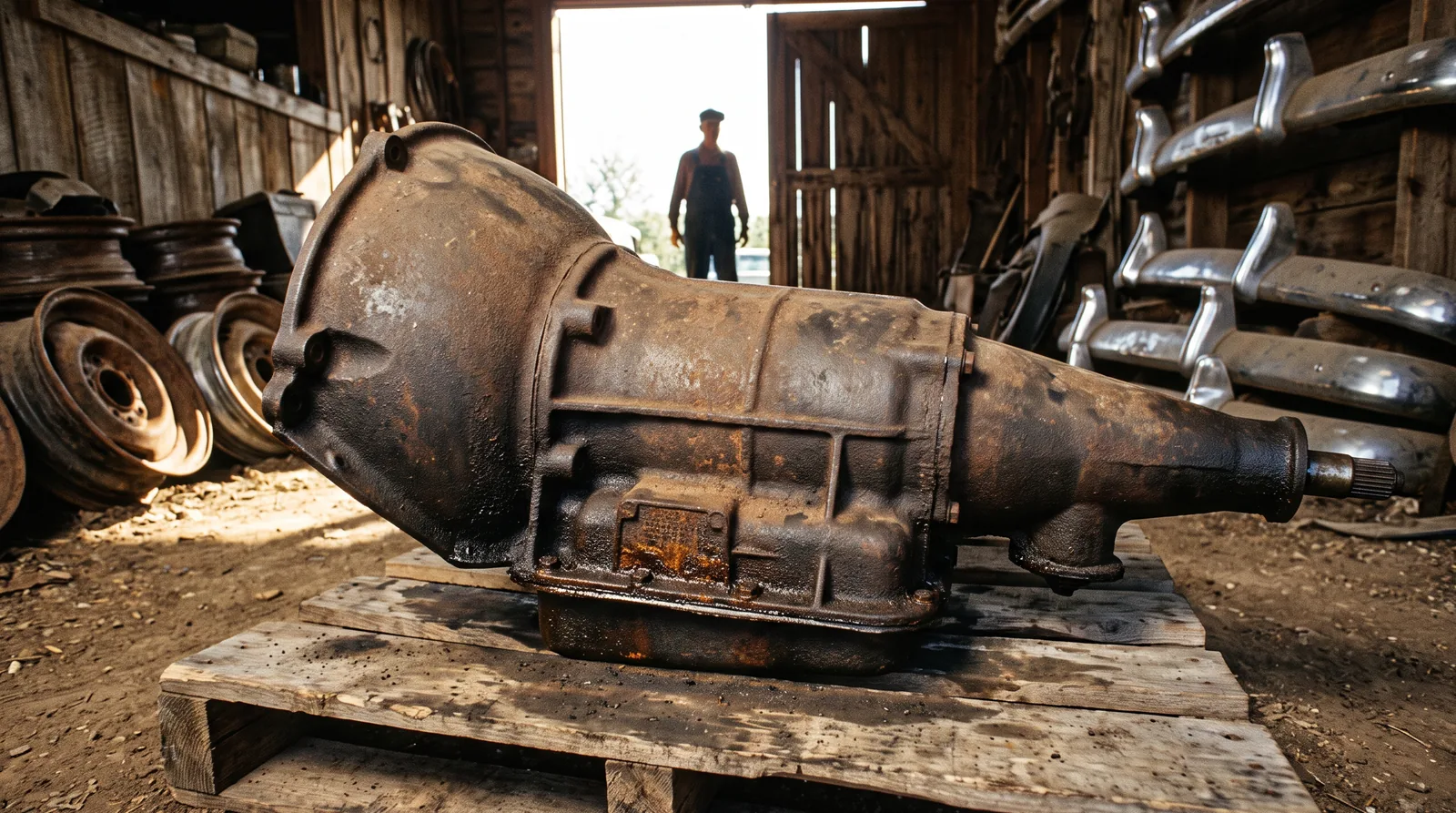
Powerglide ran for twenty-four years, from 1950 to 1973, and Chevrolet changed it a great deal along the way. So when somebody offers you a Powerglide, or when you find one already bolted into a 1951, the first question is not whether it works. The first question is which one it is, because the answer decides whether it belongs in the car at all.
There are three splits that matter, and you can settle two of them standing next to the vehicle.
Split one: cast iron or aluminium
This is the easy one and it takes about two seconds. Powerglide was cast iron from its introduction in 1950 until 1963. The aluminium case arrived in 1962 on the Chevy II, and by 1963 the cast iron unit was finished.
A 1951 car had a cast iron Powerglide. If the case in front of you is aluminium, it is a 1962 or later unit and it is in that car because somebody put it there. That is not automatically wrong, and the aluminium version is the one drag racers have been using for sixty years because it is strong and simple. But it is not what the car left the factory with, and it should be priced that way.
Split two: does it shift by itself
This one you settle by driving it, and it is the split that matters most on a car this old.
The 1950 to 1952 Powerglide has no automatic upshift. In Drive the car pulls away on the torque converter and stays in top; if you want Low you select it yourself and you move it back up yourself, usually somewhere around thirty to forty miles an hour. Automatic upshifting arrived for 1953, with the shift point set by throttle position.
So a 1951 that changes gear on its own has a 1953 or later gearbox in it. That swap is common, it is sensible, and the car is nicer to drive for it. It is still a swap.
| What you find | What it is |
|---|---|
| Cast iron, no automatic upshift | 1950 to 1952. Correct for a 1951 |
| Cast iron, upshifts on its own | 1953 to 1963. A later unit, commonly fitted |
| Aluminium case | 1962 or later. A much later unit |
Split three: the numbers on the case
Once you need to be precise rather than approximate, the casting numbers, date codes and assembly markings on the case are what you read. Be aware that the coding system itself changed partway through the transmission's life: before 1967 the code carried a plant prefix, a production date and a shift designation, marked D or N. From 1967 the scheme changed to a code giving transmission type, year, month and day.
For a 1951 you are firmly in the earlier system, and what you are trying to establish is simply whether the numbers are consistent with a 1950 to 1952 build. If they are not, refer back to split two, because the way it drives will have told you the same thing already.
"Drive it before you crawl under it. Whether the thing shifts on its own answers more than any casting number will, and it costs you nothing but a lap of the block."
— Earl Dawson
What should be in front of it
The gearbox is only half the check. Chevrolet did not sell Powerglide as a standalone option in 1951: cars ordered with it got the 235.5 cubic inch six with hydraulic lifters, rated at 105 horsepower, in place of the standard 216.5 at 92. Engine and gearbox arrived together.
And it was a De Luxe option only, at around $159. Put those two facts together and you have the whole originality test for a 1951 automatic:
Check this first
- Cast iron or aluminium. Aluminium is 1962 or later, full stop.
- Does it upshift on its own. A genuine 1951 unit does not. If it does, it is 1953 or later.
- What engine is in front of it. Should be a 235 with hydraulic lifters, not a 216.
- Which series the car is. Special series plus an automatic did not happen at the factory.
- Casting numbers and date codes, in the pre-1967 scheme. Plant prefix, production date and the D or N shift designation.
- Fluid condition. Whatever era it is from, burnt fluid in a cast iron unit means the same thing it means anywhere.
Where this fits
What the transmission is, how the converter does the work a first gear would normally do, and why the 1951 car behaves the way it does, is in the two speed automatic. The three-pedal alternative that almost every 1951 actually has is the three-speed manual, and the engine that came bolted to the automatic is in the bigger six. For the whole drivetrain in one place, see the engines of 1951.
Sources and notes
- Powerglide, Wikipedia - production from 1950 to 1973, cast iron from 1950 to 1963 with the aluminium version arriving in 1962 on the Chevy II, no automatic shifting on the 1950 to 1952 units with the driver moving Low to High around 30 to 40 mph, automatic upshift from 1953 set by throttle position, casting numbers, date codes and assembly markings, and the identification scheme changing in 1967 from plant prefix, production date and D or N shift designation to a type, year, month and day code.
- Secrets of the Chevy Powerglide 1950-73, Mac's Motor City Garage - the $159 option price, De Luxe models only, and the 235 cubic inch engine with hydraulic lifters at 105 horsepower supplied with it against the standard 216.5 at 90.
- Chevrolet Deluxe, Wikipedia - the automatic offered exclusively on De Luxe and Bel Air models, and the 216.5 standard against the optional 235.5.
- 1951 Chevrolet De Luxe Series specifications, Conceptcarz - the 92 and 105 horsepower ratings Chevrolet quoted for 1951.
- 1951 Chevrolet passenger car models chart, The Old Car Manual Project - the series 1500 Special and series 2100 De Luxe split that decides which cars could carry the option at all.
- Chevrolet Stovebolt engine, Wikipedia - the 235 coupled to Powerglide as the only application Chevrolet officially called Blue Flame, and from 1953 rather than 1951.
More from the garage
Chevy 216 and 235 Firing Order and Timing Marks
1-5-3-6-2-4 for the 216 and 235, which way the rotor turns, and why the 1951 timing mark is a steel ball in the flywheel.
The Chevy 235 Carburetor
One barrel, a float bowl, an accelerator pump and a power piston. That is the whole of the Rochester B, and it is the carburettor on the front of...
Rebuilding a Chevy 216
Rebuilding a 216 is not like rebuilding anything made after about 1955, and the difference is not the tools. It is that on most engines the botto...