Choosing a Wiring Harness for a 1951 Chevrolet
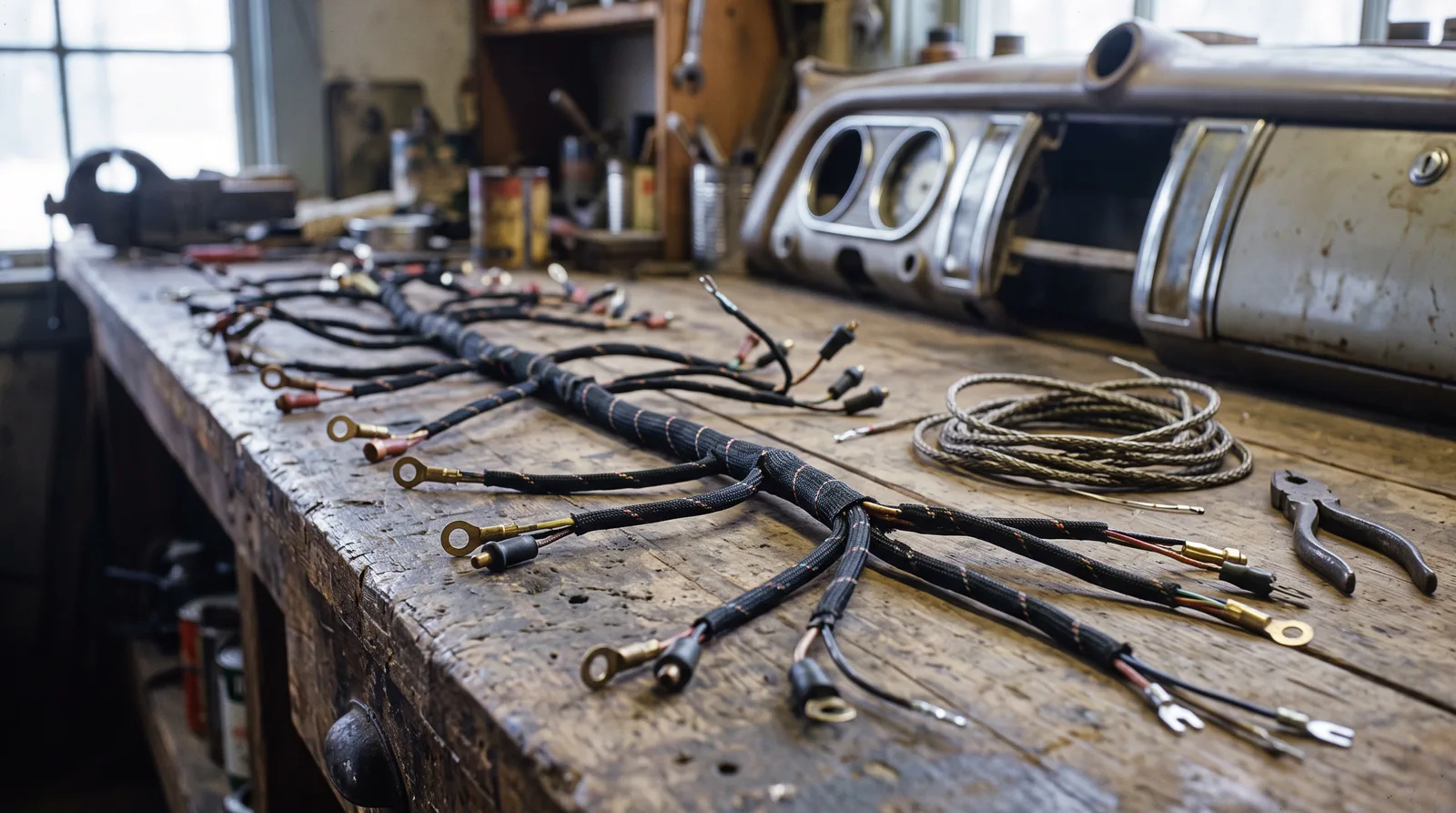
Buying a 1951 chevy wiring harness comes down to one question you should answer before you open a catalog: is the car staying on 6 volts with its generator, or is it going somewhere else? Everything else (cloth or plastic, fuse panel or no fuse panel, car set or truck set) follows from that. I have pulled more cooked cloth harnesses out of these cars than I care to count, and the trouble usually started the day somebody bought the wrong kind of replacement for the car they actually had. Before you order anything, sit down with the 1951 wiring diagram and know what your car or truck is supposed to connect.
What the original 1951 system looks like
Start with what you are replacing. The 1951 passenger car runs a 6 volt Delco battery, the 15AA4-W, rated 100 amp-hours, sitting at the right side under the hood, with the negative terminal grounded. The 1951 trucks, including the 3100, 3600 and 3800, are also 6 volt and also negative ground, with a Delco 15AA6-W of 100 amp-hours, but on the light trucks it lives below the floor on the right side of the driver's compartment. That one difference changes where the heavy cables run, and it is why a car harness and a truck harness are not the same bundle with a different label. If someone tells you these cars were positive ground, read about the positive ground myth; the factory spec book says negative for both.
The original car system has very few fuses. The owner's manual lists a 14 amp fuse, number 147685, at the end of the A-lead at the accessory junction block for the radio, and another 14 amp fuse of the same number on the back of the switch for the heater and defroster. The headlamps, tail lamps, parking lamps and instrument lights have no fuse at all. They run through a thermal circuit breaker.
Car harness versus truck harness
The truck operator's manual lists what the truck's electrical system ties together: generator, combined voltage and current regulator, starting motor, battery, distributor, ignition lock, ignition coil, ammeter, gasoline gauge, horn, lamps, switches and wiring. The car covers the same ground, but the circuits are not laid out the same way, and two of the differences are ones you can see from the driver's seat.
The car's starter is solenoid operated with a push-button on the dash. The 3100, 3600 and 3800 trucks start by pedal; only the Series 3700 and 3900 trucks get the push-button and solenoid. So a car harness carries a starter button and solenoid circuit that a 3100 does not have. The ignition locks differ too: three positions on the car (on, locked off, unlocked off), two on the truck (on and off, with the key coming out only in off).
| Circuit or part | 1951 passenger car | 1951 3100, 3600, 3800 truck |
|---|---|---|
| Battery | 6 V Delco 15AA4-W, 100 Ah, right side under hood | 6 V Delco 15AA6-W, 100 Ah, under floor, right side of driver compartment |
| Ground | Negative | Negative |
| Starter control | Solenoid, push-button on dash | Pedal |
| Ignition lock | Three positions | Two positions |
| Charging | Delco-Remy 6 V generator and regulator | Delco-Remy generator 1102749, rated 6 to 8 V; regulator 1118301 on the dash, left side of engine compartment |
| Circuit protection | 14 amp fuses for radio and heater; thermal breaker for lights | See Group 13 of the 1948 to 1951 truck shop manual |
The point of the table is simple. Order the harness for the body you have. A truck set is laid out for a pedal starter and a battery under the cab floor; a car set carries the dash button and solenoid circuit a pickup never had.
1951 chevy wiring harness: original cloth or modern PVC
An original-style 1951 chevy wiring harness is cloth covered. One reproduction maker says Chevrolet cars used cloth-covered harnesses until early 1953 and vinyl-covered ones from late 1953 and all of 1954, which puts a 1951 squarely in the cloth years, and describes its original-style sets as the wrapped, braided wire type complete with the original fittings. That is the harness to buy if the car is staying stock, staying 6 volt and keeping its generator. It routes where the old one did and looks right when somebody lifts the hood at a show.
The modern kits are a different animal, and they are built for a different car. American Autowire's Classic Update harness for 1947 to 1955 first-series Chevrolet trucks is a fair example of the type. It puts an 18-fuse, 21-circuit fuse box under the dash with the turn-signal flasher, hazard flasher and horn relay, uses GM color-coded wire, includes dome light, floor dimmer switch, a headlight switch with circuit breaker and heater leads, and runs 8-gauge alternator leads. Its rear body harness plugs into the main harness in the original position. And in the maker's own description, it "does not support generators or externally regulated alternators."
Read that last line before you buy. A kit that will not run a generator does not belong on a truck that still has one. The retailer's page does not state a voltage, but the maker's instruction sheet does: the kit is for a 12 volt system only, and any 6 volt accessories have to be converted before it goes in. So that kit means converting to 12 volt, and the harness becomes one line on a longer list. Another street-rod truck harness sold for the same 1947 to 1955 trucks covers the dash, instrument cluster, front lighting, engine and starter, rear body, courtesy lights and heater controls, adds a modern fuse box and relay kit, "allows for original or custom routing," and has connectors for GM SI internally regulated and one-wire alternators. Same story: alternator only.
"Nobody ever regretted buying the harness for the car they actually have. Plenty have regretted buying the one for the car they were going to build someday."
— Earl Dawson
Wire gauge on a 6 volt system
Here is the part people get backward. A 6 volt part draws twice the current of a comparable 12 volt part, so the wire has to be heavier, not lighter. A restorer writing in AutoRestorer works it through on a 50-watt headlamp, about 8.33 amps at 6 volts against about 4.17 amps at 12, and calls for 1-gauge battery cables at a minimum on any 6 volt system. He warns that the 4-gauge cables common on 12 volt cars can overheat on a 6 volt starter and, at worst, melt their insulation or catch fire. Going the other way, an owner of a 1950 Chevrolet on the VCCA 1949 to 1954 technical forum reports that the heavier 6 volt harness works fine after a 12 volt conversion, since 12 volts draws less current, as long as you add current limiters for the gauges and fuel sending unit and fit a 12 volt coil. That is the safe direction. I would not run a harness built to 12 volt sizes on a 6 volt car.
I am not going to give you a circuit-by-circuit list of factory gauges from memory. The factory shop manual reprints carry the electrical chapter (it closes the 1949 to 1954 car manual, and it is Group 13 in the 1948 to 1951 truck manual), and that is where you check the gauge of each run against what a reproduction maker is selling you.
Installing it in order
There is no factory procedure for this, but American Autowire's instruction sheet for its 1947 to 1955 truck kit gives an order, and it makes sense on any harness. Disconnect the battery first, so a loose bare wire end cannot short. Then the kit goes in by section: dash harness, instrument cluster, engine, parking lamps, front lights, rear body, courtesy lamps, and the alternator and main connection last. Before the battery goes back on, the sheet wants four grounds in place: battery to engine block, battery to frame, engine block to frame, and body to frame. Then check every circuit before you call it done. My own habit, before anything comes off the car, is to lay the new harness out next to the old one and tag each end.
Get the harness that matches the car, the voltage and the charging system you will actually run, and the install is mostly patience. Get the wrong one and it turns into a month of splices.
Sources and notes
- 1951 Chevrolet specifications, engine electrical, Old Car Manual Project - the passenger car battery, negative ground, solenoid starter with dash button and three-position ignition lock.
- 1951 Chevrolet truck specifications, Old Car Manual Project - the truck battery and its location, negative ground, generator and regulator numbers, pedal starter and two-position lock.
- 1951 Chevrolet Owner's Manual, Old Car Manual Project - the two 14 amp fuses and the thermal circuit breaker on the lighting circuit.
- 1947 to 1955 Classic Update wiring harness, The Filling Station - the contents of the American Autowire truck kit and its note that it does not support generators.
- Classic Update 1947-55 Chevy truck instructions, American Autowire - the 12 volt only rule, the installation order by section and the four grounds to check before reconnecting the battery.
- Getting the most from a 6-volt system, AutoRestorer - why 6 volt parts draw twice the current and why 6 volt battery cables must be heavier.
- Wiring harness and converting to 12 volt, VCCA forum - an owner's report that the heavier 6 volt harness works on 12 volts with current limiters and a 12 volt coil.
More from the garage
6 Volt to 12 Volt Conversion
The six volt to twelve volt conversion is the most argued-about job on an early Chevrolet, and most of the argument is between people who have ne...
The 1951 Chevrolet Gauges
Four gauges in the cluster, and three of them are not electrical at all. That is the thing to understand about a 1951 dash before you start diagn...
The 1951 Chevrolet Generator and Regulator
A 1951 Chevrolet charges its battery with a generator and a regulator, not an alternator. Those are different animals, they fail in different way...