Chevy 216 and 235 Intake Manifolds: Stock and Dual-Carb Setups
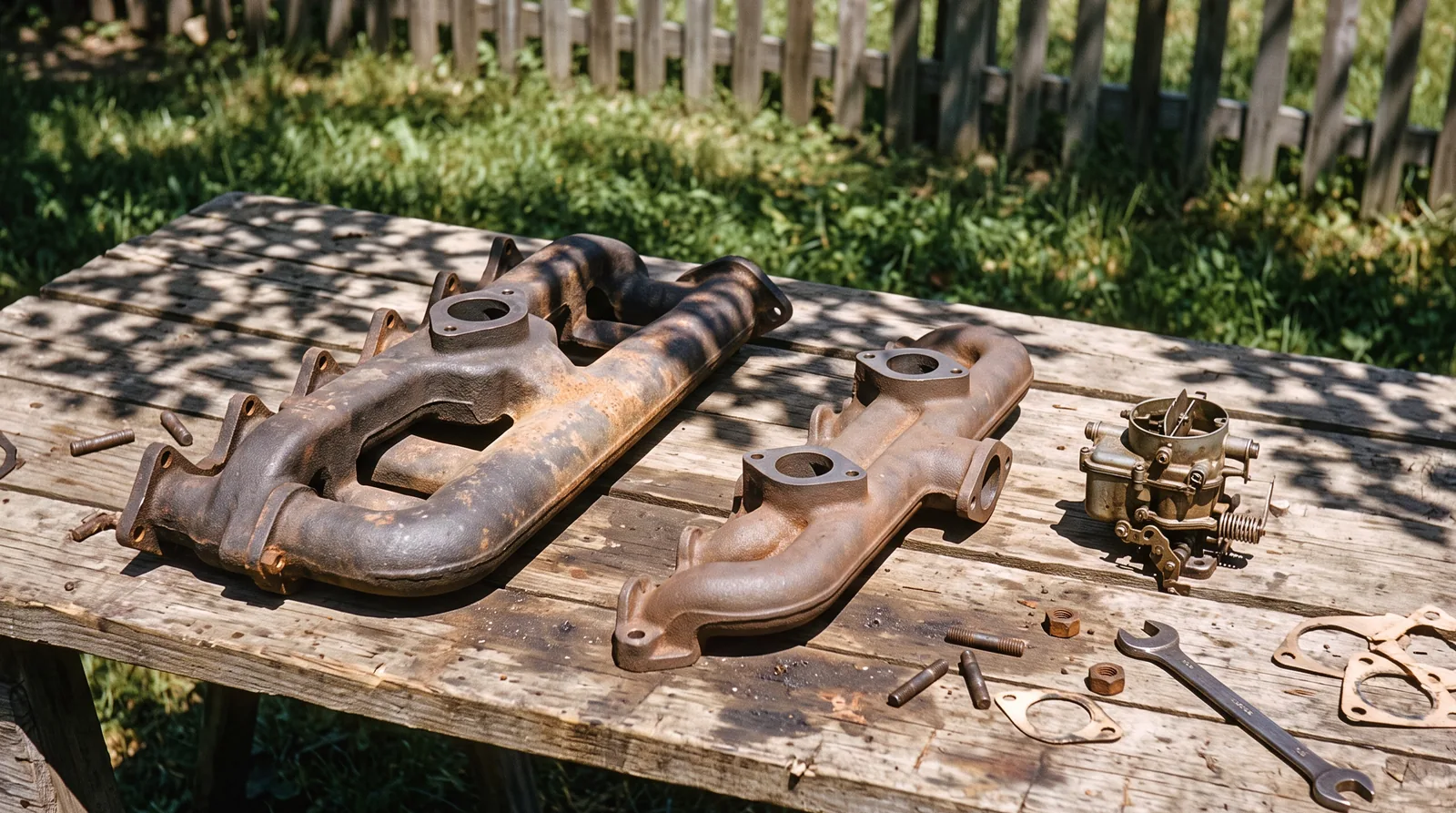
Half the people who ask me about a Chevy 235 intake manifold for a 1951 car actually own a 216, and that has to be settled before anyone spends money. A 1951 passenger car came with one of two sixes: the 216 with the manual transmission, or the early 235 with Powerglide. Their manifolds look alike from across the shop. They are not the same parts, and the aftermarket dual-carb intakes follow the same split. If you want the bigger picture of the 235 and how it relates to the 216, start there. This piece stays on the manifold: how the stock one is built, what changed on the 1950 to 1951 Powerglide engine, and which dual one-barrel intakes bolt on.
How the stock manifold is put together
On these sixes the intake and exhaust manifolds are separate castings, bolted together and mounted to the head as one assembly. The shop manual treats them as part of the cylinder head assembly. The carburetor and air cleaner sit on top of the intake. On the 1949 216 the manual describes the intake passage as having a "D" shaped cross section, there to spread the mixture evenly to the cylinders.
The two castings are joined for a reason. A thermostatic heat control valve inside the exhaust manifold sends hot exhaust against the center of the intake while the engine is cold, then closes as it warms up. That is how a stock six keeps the incoming mixture at the right temperature on a cold morning. The thermostatic spring is wound about half a turn to slip over its anchor pin, and the manual stresses that its tension matters.
When that valve sticks, you feel it. Stuck in the heat-on position, the manual lists poor performance, overheating and detonation. Stuck in the heat-off position, you get poor running, particularly while the engine warms up. I have freed more of these shafts than I care to count, and the manual's own method still works: kerosene with a little baking soda in it on the shaft, and a new spring if the old one is distorted. A longtime hand on the club forum adds that the shaft should have at least 1/8 in of front to back play, and that it should be tapped back and forth with a brass or other soft hammer.
The stock carburetor on every 1950 and 1951 model is the GM Model "B" downdraft one-barrel, built in separate 216 and 235 versions that differ in throat diameter and jet orifices. The details of the stock one-barrel carburetor get their own page.
The Chevy 235 intake manifold on a 1951 Powerglide car
When Chevrolet put the 235 behind Powerglide for 1950, it gave that engine its own manifolds. The supplement to the shop manual says the inlet manifold is new, with a larger round cross section in place of the 216's "D" passage. The exhaust manifold is described as "similar but not interchangeable," with larger throats. The gaskets are new as well, to fit the new spacing and larger inlet openings, and a special threaded stud of about 1 in, threaded into each end of the head, lines up the manifold assembly.
The ports grew along with the manifold. The 1950 and later 235 has larger intake and exhaust ports, carburetor studs set farther apart and a larger throttle bore than the 1941 to 1949 engines, which share the small ports. In practical terms, the aftermarket listings put the small-base pattern at 2-5/8 in between carburetor bolt centers and the big-base pattern at 2-15/16 in.
So on a 1951 car the rule is simple. A manual-transmission car with the 216 takes 216 manifolds, small-base carburetors and the small sleeves. A Powerglide car with the early 235 takes the big-port parts. I once had a Styleline come in with a 235 intake forced onto a 216 head, and the owner could not understand why it never idled right. The sleeves were the giveaway.
Dual one-barrel intakes and which one fits
The dual intakes listed for these sixes carry two single-barrel carburetors. That is not a two-barrel carburetor, and the distinction matters when you buy carbs. The current Offenhauser listings split the same way the factory parts do.
| Intake | Listed fitment | Carb base | Intake heat |
|---|---|---|---|
| Stock 216 (1951 manual car) | 216 only | One GM "B" one-barrel, small base | Heat valve in stock exhaust manifold |
| Stock 235 (1950 to 1951 Powerglide car) | Early 235 only | One GM "B" one-barrel, larger throttle bore | Heat valve in stock exhaust manifold |
| Offenhauser 1034, dual | 1936 to 1952 216/235/261 with manual transmission | Two one-barrels, 2-5/8 in bolt centers | Bolts to heat box of stock exhaust manifold |
| Offenhauser 1035, dual | 1950 to 1959 with Powerglide, 1953 to 1959 manual | Two one-barrels, 2-15/16 in big base | Fabricated heat needed with split manifolds or headers |
| Fenton reproduction, dual | 1953 to 1962 235/261 (listing title says 1950 to 1962) | Two one-barrels, with fuel line kit and linkage | Separate Fenton intake heat kit listed for 1950 to 1962 |
For a 1951 manual car with the 216, the Offenhauser 1034 is the listed part. It is cast aluminum with a non-progressive linkage, so both carburetors open together, and it bolts to the heat box of the stock exhaust manifold. That last detail is the one people miss: keep the stock exhaust manifold and you keep your cold-start heat.
For a 1951 Powerglide car the Offenhauser 1035 is listed for "1950-1959 engines w/ PowerGlide," which tells you the early 235 shares the later port and flange layout. The reproduction Fenton dual intake is a closer call. Its listing body says it fits 1953 to 1962 engines while the title says 1950 to 1962, so on a 1951 Powerglide engine it is plausible but not stated. It is not listed for the 216 at all.
"Two carburetors on a six will make you smile, but only if the engine under them is healthy. Put a pair on a tired 216 and you just have two things to synchronize instead of one."
— Earl Dawson
Triple one-barrel intakes
Search the listings and the club threads and you find the stock one-barrel intake and multi-carb intakes built for single-barrel carburetors. I have not found a four-barrel intake or a two-barrel-carb intake documented for the 216 or the early 235, and I would not pay for one sight unseen.
A triple is listed, but not for every 1951. The Offenhauser 1409 carries three one-barrels on 2-15/16 in big-base bolt centers, with non-progressive linkage, and is listed for 235 and 261 engines: 1950 to 1959 with Powerglide and 1953 to 1959 with the manual transmission. That covers a 1951 Powerglide car on paper and leaves the 216 out. The idea had a factory precedent, but not on a 1951 engine. The 1953 Corvette ran a special high-pressure 235 with mechanical lifters, a higher-lift cam and three Carter YH carburetors, rated at 150 hp. That is the later 235, and none of it bolts to a 1951 car's engine without help.
One limit sits in the head itself. Stock Chevy six heads have siamesed ports, three intake and four exhaust, so each intake port feeds two cylinders. Adding carburetors on top does not change that. The Wayne 12-port head, with six intake and six exhaust ports, is the aftermarket answer usually cited.
Heat, leaks and fitting it on a 1951 car
The moment you change the exhaust side, the intake loses its heat source. With split manifolds or headers you have to supply heat to the intake yourself, with a fabricated heat box using exhaust or coolant. Without heat the manual's heat-off symptom applies: poor performance, particularly while the engine warms up.
Leaks around the two castings are the other complaint. In one club forum thread on a 216, an exhaust leak at the manifold left a soot line along the exhaust manifold, and a longtime member pointed out that a twisted intake ring will keep the manifold from seating against the head. Another member's fix was to free the bolts that hold the manifolds together, refit the assembly to the head snug but not tight, and tighten the manifolds together last.
My advice for a 1951 car is plain. Match the intake to the engine you actually have, not the one on the title. Keep the stock exhaust manifold with a dual intake if you want an easy first season, and only go to headers once you have a plan for heat. Get those right and a pair of one-barrels on a sound six is a pleasant thing to drive. The difference between the 216 and the 235 is set out in the 1951 engines.
Sources and notes
- Engine assembly 6-4, 1949 Chevrolet Passenger Car Repair Manual, Old Car Manual Project - the "D" intake passage, how the heat control valve works, its spring and what happens when it sticks.
- 1950-1951 Passenger Car Supplement, page 13, Old Car Manual Project - the new 235 inlet and exhaust manifolds, gaskets and the aligning studs.
- Offenhauser 1034 Dual Carb Intake Manifold, Gas Tank Depot - fitment, 2-5/8 in bolt centers, linkage and the heat box notes for the small-base dual intake.
- Offenhauser 1035 Dual Carb Intake Manifold, Gas Tank Depot - the Powerglide fitment and 2-15/16 in big-base pattern.
- Offenhauser 1409 Triple Carb Manifold, Gas Tank Depot - fitment and linkage of the triple one-barrel intake.
- Fenton Manifolds, The Filling Station - the reproduction Fenton dual intake fitment and the separate intake heat kit.
- '40 chevy engine "blow-by", VCCA Chat forum - owner advice on heat riser shaft play, intake rings and reassembling the manifolds.
More from the garage
Powerglide Identification
Powerglide ran for twenty-four years, from 1950 to 1973, and Chevrolet changed it a great deal along the way. So when somebody offers you a Power...
Chevy 216 and 235 Firing Order and Timing Marks
1-5-3-6-2-4 for the 216 and 235, which way the rotor turns, and why the 1951 timing mark is a steel ball in the flywheel.
The Chevy 235 Carburetor
One barrel, a float bowl, an accelerator pump and a power piston. That is the whole of the Rochester B, and it is the carburettor on the front of...