Chevy 235 Distributor, Points and HEI

The ignition on a 1951 Chevrolet six is simple enough to fix at the side of the road, which is most of its charm. The chevy 235 distributor is a Delco-Remy unit with breaker points, a condenser, a centrifugal advance and a separate vacuum control, and the 216 uses the same layout with different advance numbers. Most of the trouble I see with these comes from owners who skipped the boring maintenance, or bought an HEI unit thinking it would bolt in. It will not, and I will get to why.
First, the scope. A 1951 car has either the 216 with the manual transmission or the early version of the 235 with Powerglide. The numbers below come from the 1949 to 1953 car manual unless I say otherwise, and where the two engines differ, I say which is which.
Where the chevy 235 distributor sits and what it drives
The distributor lives on the right side of the engine. It is gear driven from the camshaft and turns at camshaft speed, and its housing pilots into the right side of the block. Trucks of 1948 to 1951 use the same arrangement.
The part people forget: the distributor also drives the oil pump. The pump connects to a tang on the lower end of the distributor shaft and runs at distributor speed. When you put the distributor back, the manual has you line up the oil pump drive slot with that tang. I have watched a man try to pull one down with the hold-down clamp instead. It went about as well as you would expect.
So when a parts counter or a swap meet table hands you "a 216/235 distributor," ask which. The 1951 passenger car specification sheets give the numbers: Delco-Remy 1112362 for the 216 and 1112363 for the Powerglide 235. Read the number on your own unit and compare, rather than trusting a description in a catalog.
Points, condenser and the factory numbers
Breaker points are a wear item, and these engines expect them to be checked. The manuals give a new point gap of .022 inch and a reset gap of .018 inch for a used set, because the cam follower wears in after the first miles. Several factory pages state it this way, and every figure in them falls inside the owner's manual range of .018 to .024 inch. Set new points at .022 and you are right by every book.
| Item | Factory figure | Applies to |
|---|---|---|
| Point gap, new points | .022 inch | 1949 to 1952 cars |
| Point gap, used points reset | .018 inch | 1949 to 1952 cars |
| Breaker arm spring tension | 17 to 21 oz | 1949 to 1952 cars; trucks the same |
| Condenser capacity | 0.2 microfarad | 1949 to 1952 cars |
| Ignition timing | 5 degrees before top dead center | 1949 to 1952 cars, 216 and 235 |
| Spark plug gap | .035 inch, AC 46-5 plugs | 1949 to 1952 cars |
| Firing order | 1 5 3 6 2 4 | 1951 cars (specification sheet) |
Timing is set with a neon timing light on the steel ball in the flywheel, lined up with the pointer in the flywheel housing opening. For the 1953 engines the figure changed to 2 degrees after top dead center, so do not borrow a 1953 number for a 1951 car. The full procedure belongs to firing order and timing.
Check this first
- Points. The factory names burned or corroded points as a hard-starting cause, and so are points that are out of adjustment.
- Condenser. A low-capacity condenser is on the same factory list; the specification is 0.2 microfarad.
- Spark plugs. Plugs gapped wrong make the list too; the gap is .035 inch.
- Wires and primary connections. Loose or corroded high-tension wires and loose primary connections round out the factory list.
Chevy 235 vacuum advance and the octane selector
This is where the 1951 unit surprises people used to later Chevrolets. There is no vacuum canister on the side of the housing. The vacuum spark control is a separate unit attached to the distributor bracket, fed from a port in the carburetor, and it turns the whole distributor body. The 1949 manual describes it on the 216 as advancing the spark with vacuum and retarding it on acceleration. On the 1950 to 1952 216 and 235, advance begins at 7 to 8.5 in. Hg and reaches its full 18 to 22 degrees at 16.5 to 18.5 in. Hg.
There is also an octane selector with a scale on it. The factory procedure: set the timing with the selector at "0," then on a road test adjust the selector until the engine gives a slight ping at wide-open throttle. I still do it that way, on a quiet road, with the window down so I can hear it.
"Set it with the light, then set it with your ears. The light gets you in the neighborhood. The road test tells you which house."
— Earl Dawson
Electronic ignition on a 6 volt car
A stock 1951 Chevrolet is a 6 volt car with a generator and negative ground. The factory specification sheets list the car battery as 6 volt, 100 amp-hours, terminal grounded negative, and the trucks as 6 volt, negative ground as well. The charging side is a Delco-Remy generator and regulator. Any electronic ignition or coil you add to a stock car has to be a 6 volt part.
Points-replacement modules made for 6 volts do exist. PerTronix lists its Ignitor 1161 for Delco 1112xxx-series six-cylinder distributors in 12 volt negative ground form, and the 1161N6 instructions describe a 6 volt negative ground version that needs a coil with a primary resistance of at least 1.5 ohms on a six. The 1951 distributors carry 1112362 and 1112363, so they sit in that series, but the maker pages I opened do not name the 1951 Chevrolet; confirm the fit with the maker before you order. If you go this route, measure your coil before you remove or bypass any resistor, as the instructions require.
HEI on a 1951: part of a conversion, never a bolt-in
An HEI distributor is a different animal. Aftermarket HEI units sold for the early Chevrolet sixes say plainly that they are "designed for a 12 volt electrical system with an alternator," that they are not compatible with a generator, and that they cannot be used with a ballast resistor. A stock 1951 car has none of that: 6 volts, a generator, no alternator.
So on these cars HEI only makes sense as one step in a larger job. First the car goes to 12 volts with an alternator. Owners who have converted a 1949 Chevrolet pickup on the VCCA forum describe a 12 volt coil that needs no external resistor and a 12 to 6 volt resistor feeding the gauges. Only after that does an HEI distributor have the power it was designed for. Read the fitment closely, too. One supplier's 12 volt HEI distributor is listed for the 1941 to 1953 216 and for the 1954 to 1962 235 and 261, which leaves out the 1950 to 1953 Powerglide 235, and for the 216 it says the unit may require changing to the original distributor gear. Remember that the distributor drives the oil pump, so that is not a detail to guess at.
My view: a well-kept point distributor on a 6 volt car starts and runs fine, and a 6 volt module is the most I would add to a car that stays original. If you are already planning the 12 volt question for other reasons, HEI can ride along with it. Just do not buy the distributor first. Which engine the distributor sits in is covered in the 1951 engines.
Sources and notes
- 1949-53 Passenger Car Shop Manual, page 12-31, Old Car Manual Project - the distributor layout, its drive from the camshaft and why the 1950 to 1952 216 and 235 units do not interchange.
- 1949-53 Passenger Car Shop Manual, page 12-33, Old Car Manual Project - the vacuum and centrifugal advance figures and the 5 degree timing for 1949 to 1952.
- 1949-53 Passenger Car Shop Manual, page 12-34, Old Car Manual Project - the grease cup and cam wick care and the new and used point settings.
- 1951 Chevrolet Specifications, Passenger, Engine page 34, Old Car Manual Project - the 216 distributor number, condenser, plug gap, firing order and the 6 volt negative ground battery.
- 1951 Chevrolet Specifications, Automatic Transmission Option supplement, Old Car Manual Project - the Delco-Remy 1112363 distributor and its advance figures for the Powerglide 235.
- PerTronix Ignitor 1161N6 installation instructions, ManualsDir - the 6 volt negative ground module and its 1.5 ohm coil requirement.
- FS-728E electronic ignition distributor, The Filling Station - an example 12 volt HEI unit, its engine fitment and the possible gear change on a 216.
More from the garage
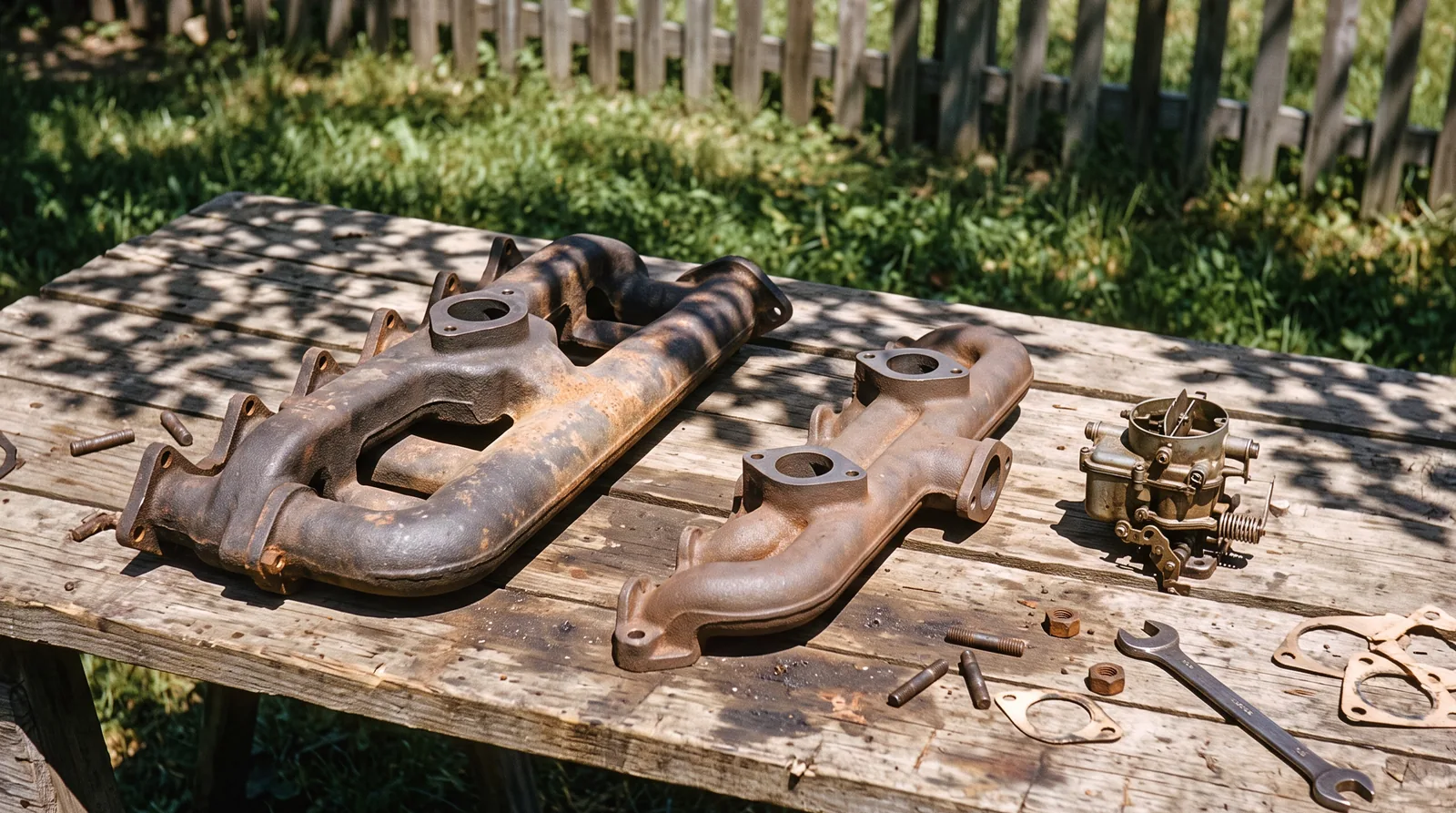
Chevy 216 and 235 Intake Manifolds: Stock and Dual-Carb Setups
Stock 216 and early 235 intake manifolds on a 1951 Chevrolet, the dual one-barrel intakes that fit each, and how to keep intake heat.
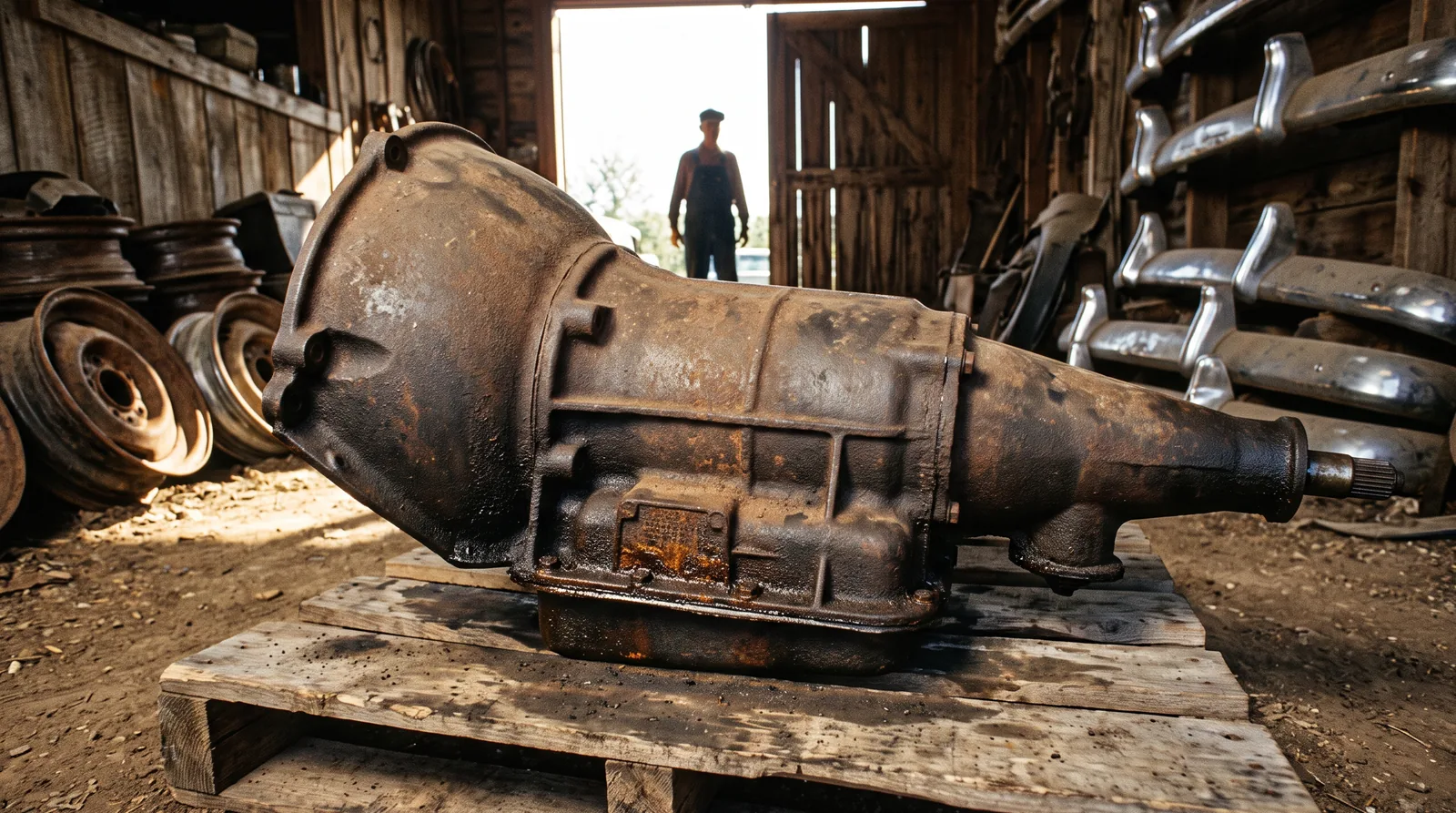
Powerglide Identification
Powerglide ran for twenty-four years, from 1950 to 1973, and Chevrolet changed it a great deal along the way. So when somebody offers you a Power...
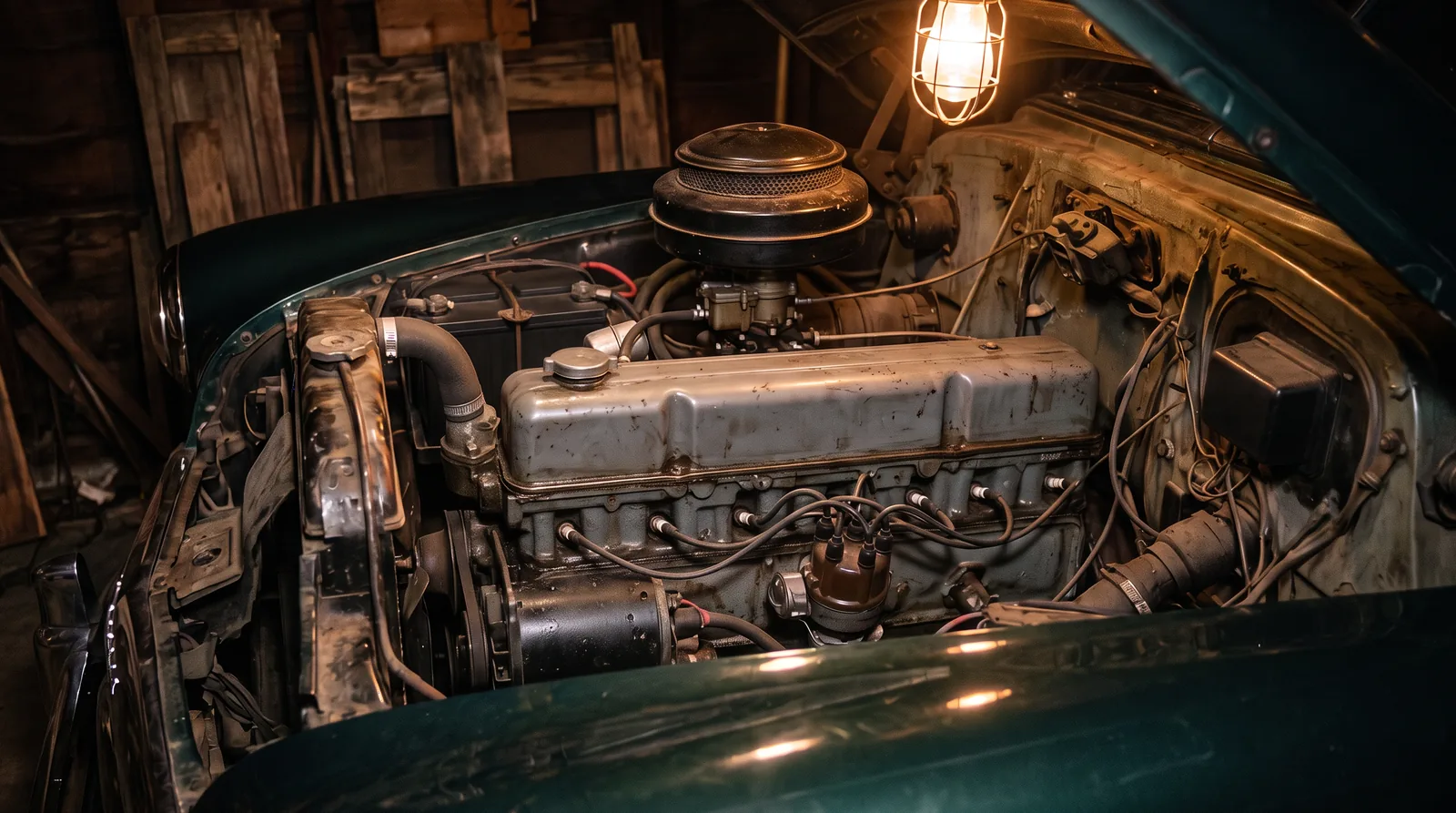
Chevy 216 and 235 Firing Order and Timing Marks
1-5-3-6-2-4 for the 216 and 235, which way the rotor turns, and why the 1951 timing mark is a steel ball in the flywheel.