The Chevy 235 and 216 Fuel Pump
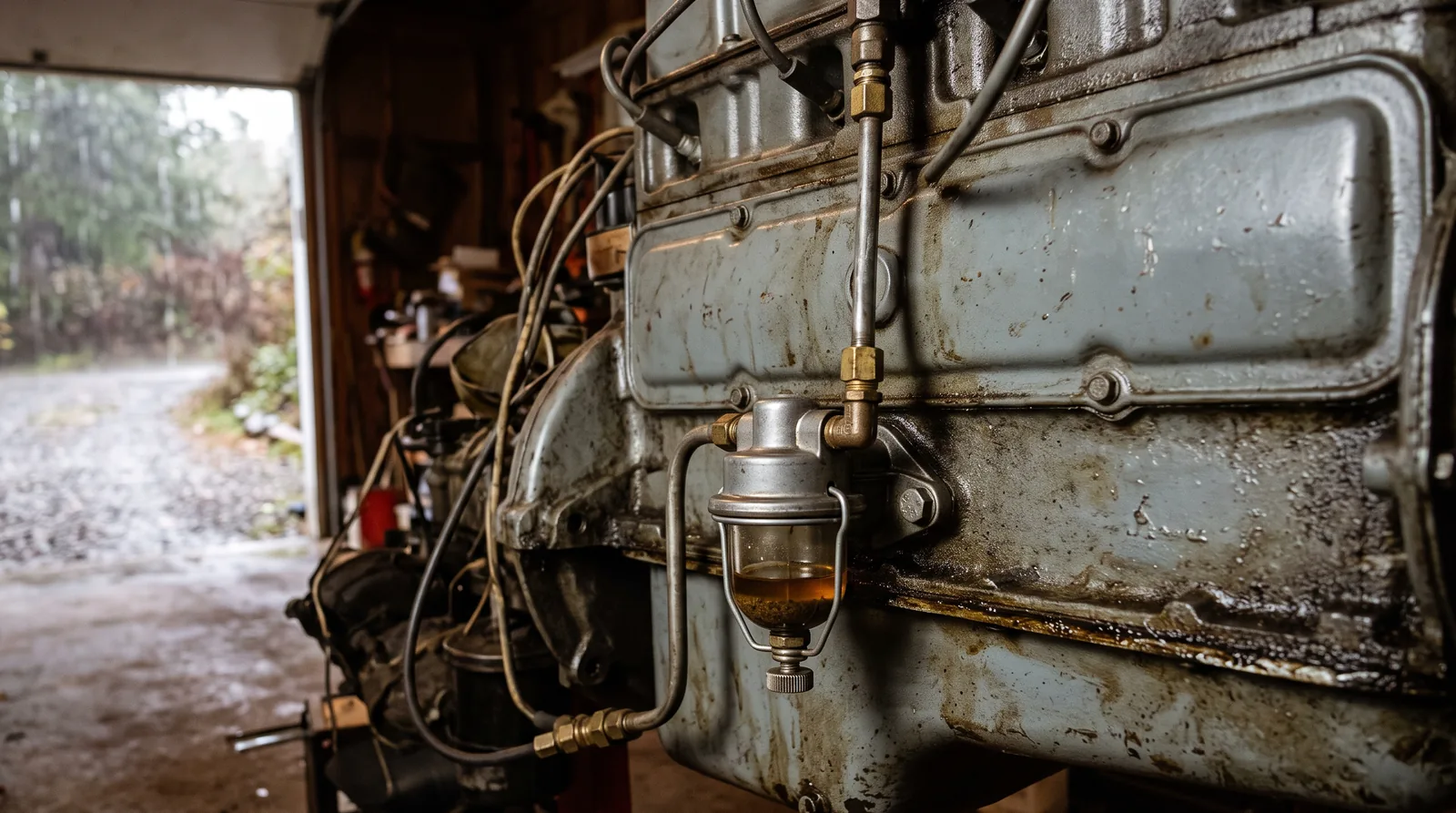
Every 1951 Chevrolet six I have worked on gets its gas the same way: a small mechanical pump on the side of the block pulls fuel from the tank and pushes it up to the carburetor, with nothing electric involved. The chevy 235 fuel pump and the one on the 216 share one design on the 1949 to 1953 cars, so most of what follows applies whichever engine sits under your hood. When one quits, it rarely quits all at once. It gets lazy, it draws air, and the owner blames the carburetor first.
A 1951 car left the factory with one of two sixes: the 216 with the manual transmission, or the early version of the 235 with Powerglide. The shop manual covers the pump for both in one section, and the 1948 to 1951 truck manual repeats it. That makes this one of the few parts on these cars where the engine question hardly matters.
What the chevy 235 fuel pump is and where it sits
It is a diaphragm-type mechanical pump, bolted to the right side of the crankcase near the front of the engine. A rocker arm reaches inside the block and rides on a special cam, an eccentric on the camshaft, and that rocker arm works the diaphragm through a link. Trucks of 1948 to 1951 use the same arrangement. The 1951 passenger car specification sheets name the pump: an AC model AF, listed as a mechanical diaphragm pump of the "high reserve" type, with a 120-mesh screen in the dome and 3 to 4 PSI at the carburetor.
The factory parts list is short. Body, rocker arm and link, diaphragm, diaphragm spring, oil seal and seal spring, cover, inlet and outlet valves, a fine screen strainer, and the glass sediment bowl with its retainer. One detail worth knowing before you take one apart: the manual says the inlet and outlet valve assemblies are interchangeable.
That glass bowl is more than a window. The manual treats it as a settling chamber where sediment and water drop out before fuel reaches the fine screen, and it has to seal fuel and air tight or the pump cannot draw at all. A tired cork gasket under the bowl, or a bowl nut that has backed off, is enough to starve a healthy engine. I once spent an afternoon chasing a stumble on a Styleline that turned out to be a bowl nut a quarter turn loose. Humbling.
| Item | Factory figure | Applies to |
|---|---|---|
| Pump pressure at idle | 3 to 4 lb | 1949 to 1953 cars (given in the combination pump section) |
| Minimum capacity | One pint in one minute at idle | 1949 to 1953 cars (given in the combination pump section) |
| Mounting bolts | 15 to 20 ft-lb, new gasket between pump and engine | 1949 to 1953 cars, 1948 to 1951 trucks |
| Bowl and screen cleaning | At least twice a year, spring and fall | 1949 to 1953 cars |
| Vacuum section output | 8 to 10 in. Hg at about 25 mph | 1949 to 1953 cars with the combination pump |
The vacuum booster: an option, not a given
Some 1951 pumps carry a second section. GM called it the combination fuel and vacuum pump, and the manual says it "may be used as optional equipment on all passenger car models." One rocker arm drives both halves through separate links. The fuel side does the same job as the plain pump; the vacuum side is there for the windshield wipers.
Those wipers run on vacuum, and manifold vacuum drops when you open the throttle to pass or climb. The booster section helps the wiper when manifold vacuum is low, under acceleration and at high speed. When manifold vacuum is higher, the wiper runs on it and the pump section just flutters along. The 1951 specification sheets list the combination unit as an AC model BW, rated at 3 1/2 to 4 1/2 PSI at the carburetor, and note that its vacuum section works only when manifold vacuum is not enough for the wiper. On the 1951 price list the option was the "Fuel & Vacuum Pump Booster": RPO 340J on cars without Powerglide and RPO 340K on cars with it, list price $8.38 on the revised list of September 19, 1951. Half-ton trucks had it as RPO 340A or 340C, listed at $8.50 and $8.38.
So a 1951 car with a plain pump is not automatically wrong. If yours has the combination pump, the factory test is simple: the wiper should start on pump vacuum at about 15 mph and reach full speed at about 40 mph, and the vacuum section alone should give 8 to 10 in. Hg at about 25 mph. Owners of 1950 cars on the VCCA forum report vacuum sections that leaked oil from the start or blew oil out of the vent sooner or later, and the advice given there is a regular fuel pump with the wipers taken off the intake manifold, accepting weaker wipers on hills. I have made that swap on cars that get driven, and kept the combination pump on cars that get judged.
Symptoms, and the factory's own trouble list
The manual's diagnosis starts from one complaint: little or no fuel reaching the carburetor. Before you condemn the pump, the factory wants you to rule out the plumbing around it, and in my experience the plumbing is guilty more often than the pump.
Check this first
- Bowl gasket. A worn gasket lets air in, and a pump that pulls air cannot pull fuel.
- Bowl screen. Look for a clogged or corroded screen inside the glass bowl.
- Line connections. Loose or cracked fittings on either side of the pump are on the factory list.
- The fuel line itself. A clogged line from the tank starves a good pump.
- Diaphragm flange screws. Loose screws around the diaphragm flange let the pump leak and lose output.
- Flexible inlet line. A broken or porous flexible line at the pump inlet draws air.
If all six pass, test the pump where it sits. The manual is clear that you test it on the car and do not remove the pump to check it. You want 3 to 4 lb of pressure at idle and at least one pint of fuel in one minute at idle. If pressure and volume pass, the pump is not your problem, and the trouble lives downstream in the carburetor it feeds.
Chevy 216 and 235 fuel pump rebuild kit or replacement
Rebuild kits for these pumps are sold separately for 1937 to 1951 pumps and for 1952 to 1957 pumps, with and without the vacuum section. Vendor listings and owner discussion agree that something changed for 1952, so a 1951 car wants the earlier kit. One maker's kit, the Filling Station FS-910, is listed for single-diaphragm glass-bowl AC pumps on 1937 to 1942 and 1946 to 1957 Chevrolet cars and trucks, fits AC 9798 and AC 9832, and contains an "alcohol resistant diaphragm with shaft." Its dual-diaphragm kit, FS-910D, is listed for 1937 to 1951. Match the kit to the pump in your hand, plain or combination, not just to the year on the title.
My rule is plain. If the body is sound and the bowl seat is not damaged, rebuild it. You keep the glass bowl, the correct look, and a pump that already fits your block. New complete pumps are sold too, including 1937 to 1951 glass-bowl pumps with the fuel lines straight in and out, parallel to the block, as one supplier lists them. Whatever you bolt on, hold it to the same factory numbers: 3 to 4 lb at idle and a pint a minute.
When you have the old one apart, feel the diaphragm. A long-time VCCA forum adviser puts it this way: diaphragm edges that feel like sticky friction tape are a bad sign, and a good one feels like rubber.
"A fuel pump that sat in a barn for twenty years is a paperweight with a glass bowl. Rebuild it before you trust it on a highway."
— Earl Dawson
Ethanol and the diaphragm
The factory diaphragm was several layers of specially treated cloth clamped between two metal discs on a push rod, and the manual says that material is "not affected by gasoline or benzol." That was written for the fuel of its day. It says nothing either way about ethanol.
The best evidence I know of is a Kettering University study by Davis and Hoff, SAE paper 2010-01-2135. They ran six vintage fuel systems, built from rebuilt original or new aftermarket parts, on E10 and on ethanol-free gas. All six performed normally. After 3,000 hours of static exposure the parts showed only minor changes, and nothing suggested imminent failure. Those systems ranged from a 1948 Ford to a 1970 Chrysler, so this is vintage cars in general, not a 1951 Chevrolet in particular.
So I do not tell people that pump gas eats these pumps. What I tell them is that old cloth and rubber parts age whatever fuel they see, and a pump that has been sitting dry or half full is the one to rebuild first. If you are rebuilding anyway, a kit with an alcohol resistant diaphragm costs you nothing extra in effort. If your car has the 216, all of this applies as written: same pump, same bolts, same test. Which of the two sixes your car has is settled in the 1951 engines.
Sources and notes
- 1949-53 Passenger Car Shop Manual, page 6-90, Old Car Manual Project - the factory trouble list, the pressure and volume test on the car, the vacuum section test and the twice-a-year cleaning.
- 1949-53 Passenger Car Shop Manual, page 6-89, Old Car Manual Project - the combination fuel and vacuum pump as optional equipment and what its vacuum section does for the wipers.
- 1951 Chevrolet Specifications, Passenger, Engine page 32, Old Car Manual Project - the AC model AF and model BW pumps and their pressures at the carburetor.
- 1951 Chevrolet Production Options sheets, Old Car Brochures - the RPO 340 codes and the list prices for the fuel and vacuum pump booster.
- FS-910 fuel pump repair kit, The Filling Station - an example kit with an alcohol resistant diaphragm and its listed fitment.
- SAE paper 2010-01-2135, Davis and Hoff, SAE Mobilus - the Kettering University E10 tests on six vintage fuel systems.
- Combination pump thread, VCCA Chat - owner reports of oil leaking from vacuum sections and the plain pump alternative.
More from the garage
Chevy 235 Distributor, Points and HEI
The Delco-Remy distributor on the 1951 216 and 235: points, condenser, vacuum control, octane selector, 6 volt modules and why HEI needs 12 volts...
Chevy 216 and 235 Intake Manifolds: Stock and Dual-Carb Setups
Stock 216 and early 235 intake manifolds on a 1951 Chevrolet, the dual one-barrel intakes that fit each, and how to keep intake heat.
Powerglide Identification
Powerglide ran for twenty-four years, from 1950 to 1973, and Chevrolet changed it a great deal along the way. So when somebody offers you a Power...