The 1951 Chevy Truck Gas Tank
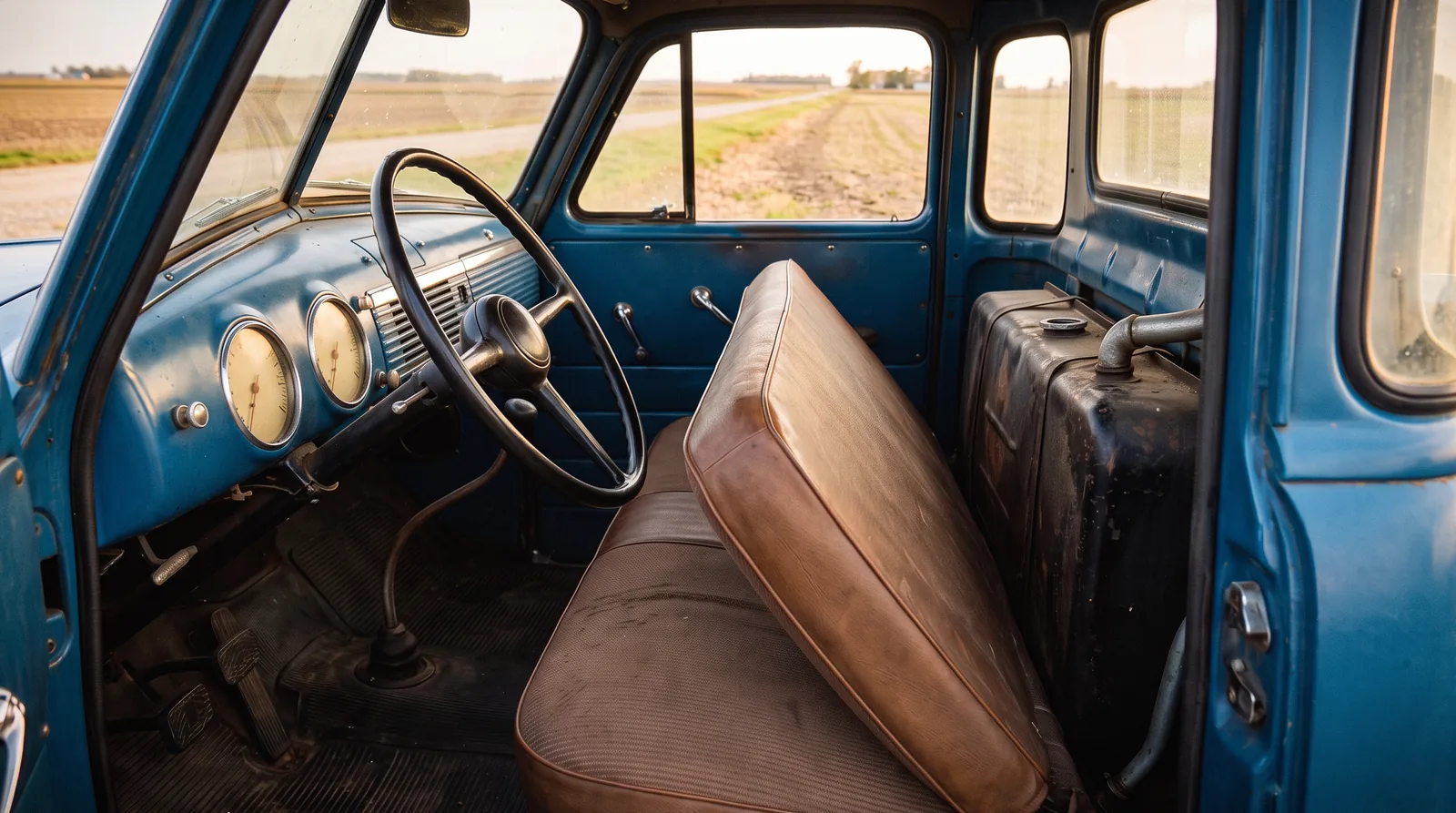
Open the door of a 1951 Chevy pickup, tip the seat back forward, and there it is: the fuel tank, sitting right behind your shoulder blades. The 1951 chevy truck gas tank surprises people who come from cars, and it worries people who have read about it on the internet. I have pulled more of these tanks out of cabs than I can count, and most of what I hear about them is half right. This piece covers where the tank sits, where you fill it, how much it holds, how the gauge reads it, and what really happens when you move it somewhere else.
Where the 1951 chevy truck gas tank sits
On every 1951 Chevrolet truck with a cab, the 3100, 3600 and 3800 included, the factory put the tank behind the seat, inside the cab. The 1951 spec book lists it that way, and it lists two fittings that go with it: a fuel line shutoff and a drain cock. If your truck still has both, you have a useful pair of tools. The shutoff lets you isolate the tank before you open a line, and the drain cock lets you empty it without siphoning through the filler.
Not every 1951 truck carried the tank in the cab. The same spec book puts the tank inside the frame on the right side for 3100 and 3600 chassis and single-unit bodies, the ones that left the factory without the pickup cab. So if you are looking at a panel or a Suburban type body, do not assume the tank is behind a seat. Look under the truck first.
The in-cab tank was also not the plan from day one. From mid-1947 through 1948 the half-ton pickups carried the tank under the bed, inside the frame rail. It moved back into the cab in 1949 (most accounts say early 1949), and it stayed there through the 1951 trucks and beyond. A 1951 that has its tank under the bed today got it there from an owner, not from the factory.
Filler, capacity and construction
The filler is on the right side of the vehicle, which on a cab pickup means the passenger side, just aft of the door handle. If someone tells you the filler on a 1951 pickup belongs in the bed or behind the license plate, they are describing a modified truck.
Capacity is where I see the most confusion, because the numbers in circulation do not agree. The factory figure is the one to trust. The 1951 operator's manual and the 1951 spec book both give the cab-mounted tank as 17-1/2 gallons. A popular reproduction tank is sold as 18 gallons, and that figure has drifted into forum posts as if it were original. It describes that reproduction, nothing more. The 1951 passenger car tank is 16 gallons, which is a third number people mix up with the truck.
| Item | 1951 truck figure | Notes |
|---|---|---|
| Tank location, cab models | Behind the seat, in the cab | Fuel line shutoff and drain cock fitted |
| Tank location, chassis and single-unit bodies | Inside the frame, right side | 3100 and 3600 without the pickup cab |
| Capacity, cab-mounted tank | 17-1/2 gallons | Operator's manual and spec book agree |
| Capacity, other 1/2 and 3/4 ton (and 1 ton forward control) | 16 gallons | Other trucks 18 gallons, school bus 30 gallons |
| Filler | Right side of the vehicle | Aft of the passenger door handle on cab pickups |
| Construction | Two stamped pans, seam welded | Same on every 1951 truck tank |
| Gauge | AC, electric | 6 volt, negative ground system |
| 1951 passenger car, for contrast | 16 gallons | Not interchangeable figures |
The tank itself is simple: two stamped pans, seam welded together. When I get one out of a truck that has sat for decades, the seam is the first place my eyes go, and the inside gets a hard look with a light before I decide whether it stays in service. That inspection habit is mine, not a factory instruction.
The sending unit and the 6 volt gauge
The fuel gauge on a 1951 truck is an AC electric unit, and the truck runs a 6 volt, negative ground system. The sending unit sits in the tank and tells the dash gauge how much is left. On a cab truck that puts the sender behind the seat with the tank.
Reproduction senders are easy to find. One listing I have seen describes a stainless steel, 0 to 30 ohm unit made to fit the behind-the-seat tank on 1947 to 1953 trucks, under part number 1515466, sold in 6 volt or 12 volt versions. The listing calls 0 to 30 ohms the correct resistance for Chevrolet gauges. Watch the years: the same listing puts the 1954 and 1955 trucks on a different unit, 1517952, so a sender for a later truck is not the one you want.
If the truck has been converted to 12 volts, the gauge side needs attention. One owner on a Chevrolet club forum, writing about a 1950 car, advises buying current limiters for the gauges and the fuel sending unit, along with a 12 volt coil. I would rather keep a 1951 truck on 6 volts and keep the gauge honest.
"Half the bad gauges I chase on these trucks turn out to be a sender for the wrong year, or a 12 volt conversion nobody finished. Check the tag on the part before you blame the wiring."
— Earl Dawson
Why the tank went back into the cab
The move away from the under-bed tank had a practical reason, at least according to Jim Carter of Jim Carter Truck Parts, who has written about these trucks for years. In his account, the 1947 and 1948 under-bed tanks took a beating from road debris. Tanks were punctured in deep ruts and farm fields, rocks and stumps opened leaks, and GM answered by putting the tank back in the cab for 1949. I have not seen a factory document that states that reason in so many words, so treat it as his explanation.
He also makes a safety argument for the in-cab tank, and it is worth hearing out before you cut anything. His view: GM protected the tank with double wall reinforced cab metal, the doors and the seat riser frames. He adds a point I agree with from my own nose. With the tank in the cab, you smell gasoline right away if the sending unit gasket or the filler hose starts to fail. An under-bed tank can leak for weeks and you notice only when it drips.
Relocating the tank: the options and their weak points
Plenty of owners still want the tank out of the cab, usually to get more room behind the seat or to clean up the cab interior. There are three common places to put it, and each one trades the in-cab risk for a different one. Carter's assessment of each is blunt, and I present it as his.
- Behind the rear axle. In his words it offers "very little protection from a rear end hit." There is a second cost: a vendor note points out that a tank back there leaves you no place for a spare tire.
- Outside the frame rail, under the bed. In a side impact, the only thing between the tank and the other car is the bedside sheet metal.
- Inside the frame rail, under the bed. This is the 1947 and 1948 location, and it brings back the debris damage that, by his account, sent GM back to the cab.
None of those is free. If you relocate, you are choosing which risk you prefer, and I would want a solid reason beyond a cleaner cab. I have kept the tank in the cab on every truck I have finished for myself.
Living with the in-cab tank
If you keep the tank where GM put it, a few checks matter more than the rest. These are the ones I run on any 1951 pickup that comes into the shop, and they belong on the list whenever you are restoring one.
Check this first
- Any fuel smell in the cab. Treat it as a leak until proven otherwise. Start at the sending unit gasket and the filler hose, the two spots the in-cab argument names.
- The shutoff and drain cock. Make sure both are present and work. They are on the factory list for the cab tank and they make service far easier.
- The sender's years. A 1947 to 1953 truck sender is a different part from the 1954 to 1955 unit. Confirm the fit before you install.
- A reproduction tank's inlet. One vendor warns that some reproductions have the top fuel inlet bent so the hose does not fit. Test fit the hose before the tank goes in.
- The capacity you expect. An original holds 17-1/2 gallons. If a reproduction is in there, it may be the 18 gallon type, so do not read a fuel stop as a gauge fault.
A gas tank behind your back sounds like a strange idea in 2026. On a truck built this way, with a working shutoff, a sound sender and a tight filler hose, it is also the location the factory chose and the one you will notice first if something goes wrong. I would fix the tank before I would move it.
Sources and notes
- 1951 Chevrolet Specifications, truck fuel system, Old Car Manual Project - Tank locations by body type, the shutoff and drain cock, capacity, seam welded construction, right side filler and the AC electric gauge.
- 1951 Chevrolet Truck Operator's Manual, page 98, Old Car Manual Project - The 17-1/2 gallon capacity of the cab-mounted tank and the other truck capacities.
- In-Cab Gas Tank: Friend or Foe, Jim Carter Truck Parts - Carter's safety argument for the in-cab tank and his view of each relocation option.
- 1947-48 1/2 ton under-bed gas tank, a poor location, Jim Carter Truck Parts - The road debris damage to the 1947 and 1948 under-bed tanks and the 1949 move back into the cab.
- Gas tank, behind seat, 1949-early 1955, Jim Carter Truck Parts - The 18 gallon reproduction tank, the bent inlet warning and the lost spare tire spot behind the axle.
- Sending units, Chevs of the 40s - The 0 to 30 ohm reproduction senders for 1947 to 1953 and 1954 to 1955 trucks and their part numbers.
- Wiring harness and converting to 12 volt, VCCA Chat - One owner's advice to fit current limiters for the gauges and sending unit and a 12 volt coil.
More from the garage

The 1951 Chevrolet Canopy Express
Before the supermarket, somebody had to bring the groceries to the street. That is what the Canopy Express was for: a panel truck with the sides...
1951 Chevrolet Truck V8 Swap
A small block Chevrolet V8 in an Advance Design pickup is the most common engine swap in the American hobby, and it is common for good reasons. T...
The 1951 Chevrolet Apache
There is no 1951 Chevrolet Apache. The Apache name belongs to the generation of Chevrolet trucks that came after the one built in 1951, and it do...