Chevy 235 Oil Filter, Oil Pan and Capacity
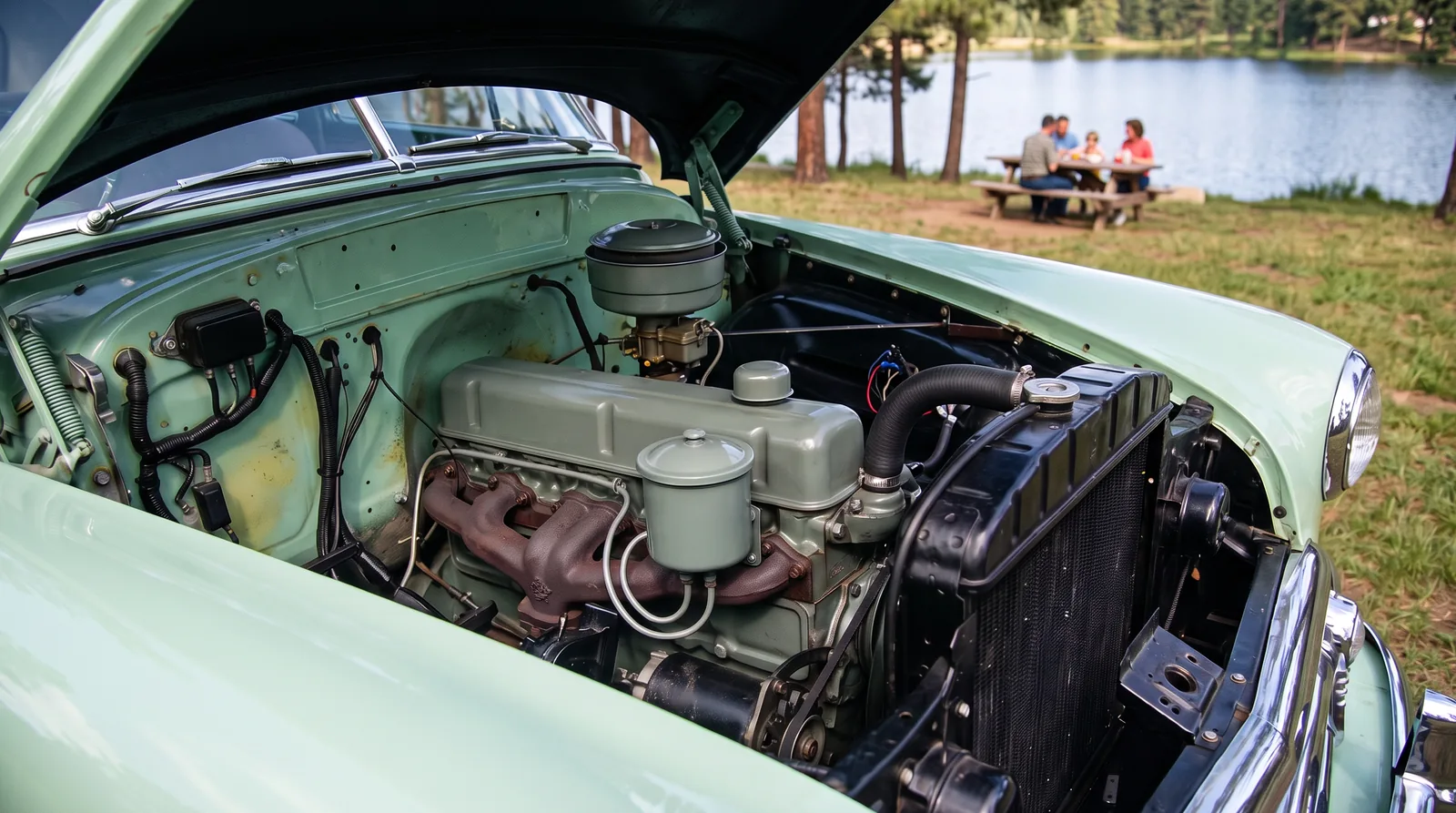
Most people who ask me about a chevy 235 oil filter assume the engine left the factory with one. On a 1951 car that is not a safe assumption. The filter was an option you paid extra for, the crankcase holds five quarts, and the oiling system under it works differently from the engines most of us learned on. If you are still sorting out which of the two 1951 sixes sits in your car, the oil system is a good place to start, because most of the answers are on paper.
Was the chevy 235 oil filter standard in 1951?
No. Chevrolet listed the oil filter as a regular production option on the 1951 passenger cars. The option sheet carries two codes: RPO 237A, "Oil Filter, Not used w/ #317", and RPO 237D, "Oil Filter, Used only w/ #317". Option 317 is Powerglide, so 237D is the filter for the Powerglide car, which is the car with the 235, and 237A is the filter for the manual car with the 216. Both appear against the Styleline and Fleetline Deluxe models.
The price tells you how Chevrolet thought about it. On the revised list of September 19, 1951, RPO 237A and 237D listed at $9.80, with $.50 for delivery and handling. That is an accessory, priced like one. The 1951 owner's manual backs this up in a quieter way: its maintenance schedule gives oil change and chassis lube intervals but says nothing about changing a filter. Change the oil after the first 500 miles, then every 2,000 to 3,000 miles, and that is all the book asks.
The trucks had their own codes. For the 1951 3100 series half-ton, the option list shows RPO 237B and 237F as "Oil Filter (2 Qt. Cap.)" and RPO 237G and 237J as "Oil Filter (1 Qt. Cap.)". A truck buyer chose a size; a car buyer had to ask for one at all.
Not every filter you find on a 1951 block came from GM, either. Dealers also fitted aftermarket units. On the Vintage Chevrolet Club forum, a longtime adviser identified one block-mounted filter as an aftermarket make that had nothing to do with GM, said a lot of Chevrolet dealers installed them when the cars were new, and called them popular in 1950 and 1951. I have opened plenty of these hoods and found more bare blocks than canisters, and a fair share of the canisters were clearly bolted on long after the car left the showroom.
How the accessory filter is plumbed and what goes in it
The accessory filter on these engines is a bypass type. In a forum thread on a 1951 filter, the same adviser describes the lines: the main feed hose goes to a tee at the oil pressure line location on the block, the return hose goes into the side of the block at the lower center, and the filter clamps onto the manifold to the rear of the carburetor. Another member in that thread notes that a bypass design only processes about 10% of the oil. In plain terms, it takes a side stream of oil, cleans it, and sends it back to the crankcase. The bearings are not fed through it, which is part of why so many cars ran without one.
If your car has a canister, the cartridge is the part you buy. One parts seller lists an AC-style P-115 cartridge (its FS-99A) at 4 1/8 in. across and 5 1/4 in. tall for Chevrolet cars and trucks from 1916 to 1964, and a Fram-style C-4 (its FS-99) at 4 1/8 in. across and 4 7/8 in. tall for Chevrolet cars. The catch is that fit depends on which canister is actually on your car, and after seventy-odd years that could be the GM option, a dealer unit, or something a previous owner liked.
Measure the inside of the can before you order. The catalog picture and the can on the engine rarely agree.
Spin-on conversions: what exists and what does not
A lot of owners want to swap the canister for a spin-on filter. The trouble is that I could not find a maker's spin-on conversion kit built for the 216 or 235. The parts seller's oil system pages show cartridges and oil line kits for the 216 and 235, but no spin-on conversion, and the common spin-on conversion kit I looked up is listed for Chevrolet V8 engines only. None of that describes a 1951 six.
You can bolt a remote spin-on head to a bracket and run hoses to the feed and return points the canister used. That is improvisation, not a kit. My view is simple: on a bypass system, a sound canister with a fresh cartridge does its job and looks right under the hood. Until somebody shows me a conversion made for this block, I keep the can.
Chevy 235 oil capacity and the right oil
The 1951 owner's manual gives one figure for engine oil capacity: 5 quarts. The table does not split it by engine, so it covers both the 216 and the Powerglide 235. If a filter is fitted, add what the filter holds on top of that. The car manual does not give a filter quantity, but the truck option list tells you a filter could hold 1 or 2 quarts depending on which one was ordered.
You will see other numbers quoted. I go with the owner's manual: 5 quarts, plus the filter if there is one, and then read the dipstick. The dipstick is a bayonet type on the right side of the crankcase, and oil goes in through the filler cap hole on top of the valve cover.
| Item | 1951 figure | Scope |
|---|---|---|
| Engine oil capacity | 5 qts (plus filter if fitted) | 1951 cars, 216 and 235 |
| Oil above 32 F | SAE 20 or 20W | 1951 cars |
| Oil down to +10 F | 20W | 1951 cars |
| Oil down to -10 F | 10W | 1951 cars |
| Oil below -10 F | 10W plus 10% kerosene | 1951 cars |
| Oil change | First 500 miles, then every 2,000 to 3,000 miles | 1951 cars |
| Oil pressure | 14 lb at 2,000 rpm | 1949 to 1953 cars, except 1953 Powerglide |
| Oil pan bolts | Flange 6 to 7 1/2 ft-lb; corners 12 1/2 to 15 ft-lb | 1949 to 1953 cars; same 1948 to 1951 trucks |
The manual recommends Premium or Heavy Duty oils, with Regular oil acceptable for light service. That is the only oil advice I can point to on paper. Questions about detergent versus non-detergent oil, or zinc additives, get argued on every forum, and I have not seen a source for these engines that settles them. I will not pretend otherwise here.
The oil pan, the dippers and the gauge
This is where the 1951 engine parts company with modern ones. The factory calls it a pressure-stream and splash system. The oil pan has troughs and nozzles built into it. Dippers on the connecting rod caps dip into the troughs at low speed and catch the nozzle streams at higher speed. Main and camshaft bearings get positive pressure, and the rockers are fed by a pipe. So the splash-oiled 216 is really only splash-oiled at the rods, and the early 235 kept the same dipper system.
The same oil pan fits the 216 and the 235 of this period. What differs is dipper height, and the factory set it with a gauge: J-969-2A for the 216 (1949 to 1952) and J-1514 for the 235 (1950 to 1952, and the 1953 Standard). The lower rod bearings are centrifugally cast babbitt, and the mains are precision thin-wall babbitt inserts. The oil pump has two gears, a pressure relief valve and a fine mesh screen on the inlet.
The 1953 Powerglide 235 is a different animal: full pressure lubrication and a 45 lb pressure figure. If you are reading a parts listing or a rebuild guide written for that engine, its oil numbers do not apply to a 1951 car.
"A low gauge on one of these is not bad news by itself. Fourteen pounds at 2,000 rpm is what the book asks for. I have watched owners pull good engines apart chasing a number the engine was never built to make."
— Earl Dawson
What I would do with a 1951 engine today
If the car came without a filter, it is still correct without one: five quarts of the grade the manual lists, changed on the book's interval. If a canister is fitted, measure it, buy the cartridge that fits, and check the lines. And keep the 1953 Powerglide figures out of the conversation unless that is the engine you have. The full engine story, including where the later versions changed the oiling, is in my piece on the 235.
Sources and notes
- 1951 Chevrolet Production Options, page 5, Old Car Brochures - the RPO 237A and 237D oil filter codes and their link to Powerglide option 317.
- 1951 Chevrolet owner's manual, page 22, Old Car Manual Project - the factory oil grades by temperature and the oil change interval.
- 1951 Chevrolet owner's manual, page 29, Old Car Manual Project - the 5 quart engine oil capacity.
- 1949 to 1953 Chevrolet shop manual, page 6-21, Old Car Manual Project - the pressure-stream and splash system, the shared oil pan and the dipper height gauges.
- 51 Oil Filter, Vintage Chevrolet Club forum - where the accessory filter's feed and return lines run and how a bypass filter works.
- Can you ID this oil filter?, Vintage Chevrolet Club forum - the dealer-installed aftermarket filters of 1950 and 1951.
- Engine oil system parts, The Filling Station - the P-115 and C-4 style cartridge sizes and fitment listings.
More from the garage
Chevy 235 Exhaust Manifolds and Fenton Headers
The stock exhaust manifold and heat riser on 1951 Chevrolet sixes, Fenton pattern headers and split manifolds, fitment and the usual leak points.
The Chevy 235 and 216 Fuel Pump
Where the 1951 six's mechanical fuel pump sits, what the optional vacuum booster does, the factory tests, rebuild kits and what ethanol really do...
Chevy 235 Distributor, Points and HEI
The Delco-Remy distributor on the 1951 216 and 235: points, condenser, vacuum control, octane selector, 6 volt modules and why HEI needs 12 volts...